Quick Answer: GFCIs protect people from electric shock by cutting power when current leaks to ground. They’re required in kitchens, bathrooms, garages, outdoor areas, and laundry rooms.
AFCIs protect against electrical fires by detecting dangerous arcing in damaged wiring. They’re required in bedrooms, living rooms, and other living spaces.
Montana’s adopted electrical code requires both, in different rooms. Some circuits, such as kitchen countertop circuits, may need both types of protection through a dual-function device.
Flip open a modern Montana electrical panel, and you’ll likely see a mix of standard breakers alongside outlets or breakers labeled “GFCI” and “AFCI.”
Homeowners often use these two terms interchangeably. However, they protect against very different electrical hazards.
Ground-fault circuit interrupters (GFCIs) and arc-fault circuit interrupters (AFCIs) each serve a specific purpose. Montana’s adopted electrical code requires them in certain rooms and circuits. They are not required everywhere, and they are not interchangeable.
Getting this wrong during a remodel, new build, or DIY outlet swap can lead to a failed inspection or costly rework. More importantly, it can leave your home without protection from certain electrical hazards.
Below, we explain what each device does, where the Montana-adopted National Electrical Code (NEC) requires them, and how to determine whether your Missoula or Bitterroot Valley home may be missing required protection.
What Is a GFCI and How Does It Protect You?
A ground-fault circuit interrupter (GFCI) is designed to protect people from electric shock. It constantly monitors the amount of current flowing out to a device on the “hot” wire and compares it to the amount of current returning on the “neutral” wire. In a normal circuit, those two numbers match. If even a small amount of current, as little as 4 to 6 milliamps, is leaking somewhere it shouldn’t, like through a person’s body to the ground, the GFCI detects the imbalance and cuts power in a fraction of a second, well before a dangerous shock can occur.
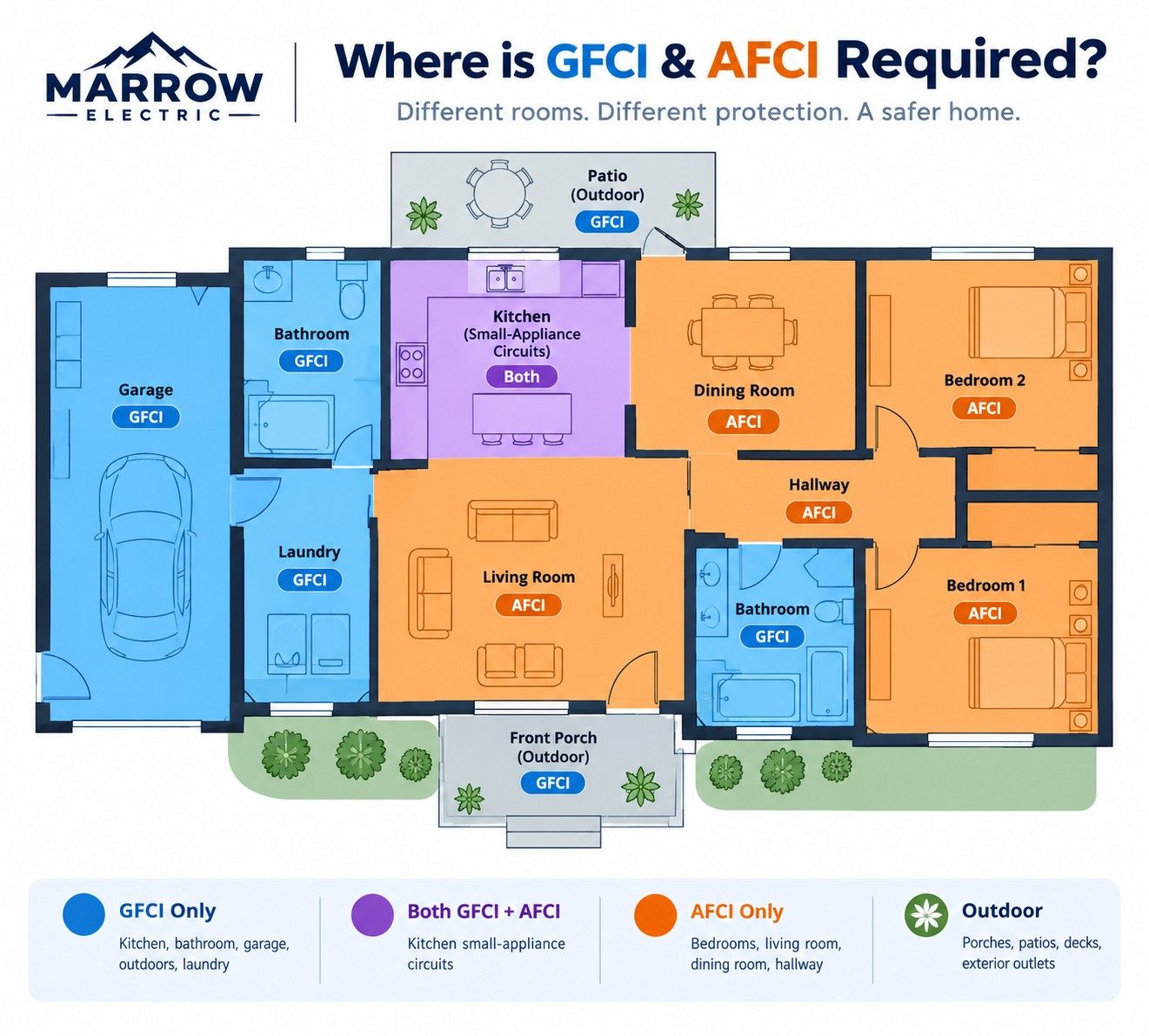
This is why GFCIs are concentrated in areas where water and electricity are most likely to meet: kitchens, bathrooms, garages, unfinished basements, laundry areas, and anywhere outdoors. Water dramatically lowers the resistance of the human body, turning a minor shock into a potentially lethal one, which is exactly the scenario a GFCI is built to prevent.
You’ll typically see GFCI protection in one of two forms: a GFCI receptacle (the outlet itself has “test” and “reset” buttons) or a GFCI breaker in the electrical panel, which protects every outlet on that circuit. Either approach satisfies code, though panel-level GFCI breakers are often preferred in remodels where opening up walls to add individual GFCI outlets isn’t practical.
If you’re not sure which of your outlets are GFCI-protected, our electrical service and troubleshooting team can test every circuit in the house and map out exactly what’s protected and what isn’t.
What Is an AFCI and How Does It Prevent Fires?
An arc-fault circuit interrupter (AFCI) protects against a completely different hazard: electrical fires caused by arcing. An arc fault happens when electrical current jumps across a gap it shouldn’t, through a nicked wire, a loose connection, a staple driven through a cable, or aging insulation. These arcs generate intense, localized heat, often enough to ignite nearby wood framing, insulation, or drywall dust, long before a standard circuit breaker would ever trip. Standard breakers are designed to respond to overloads and short circuits, not the subtle, intermittent arcing that can smolder inside a wall for months.
AFCI devices use onboard electronics to recognize the specific current signature of a dangerous arc and distinguish it from the normal, harmless arcing that happens when you flip a light switch or unplug a lamp. When it detects a genuine arc fault, it interrupts the circuit immediately.
Because arc faults are most commonly associated with damaged wiring inside walls rather than water exposure, AFCI protection is required primarily in living spaces: bedrooms, living rooms, family rooms, dining rooms, dens, hallways, and closets, the rooms where a home’s original wiring tends to age, get nicked during a remodel, or suffer rodent damage in older Bitterroot Valley farmhouses.
Like GFCIs, AFCI protection can be provided by a dedicated breaker in the panel or by an AFCI-rated outlet, though panel-level breakers are far more common since they protect the entire branch circuit at once.
GFCI vs. AFCI: The Core Differences
The easiest way to remember the difference: GFCI protects people, AFCI protects property.
• What it detects: GFCI detects current leaking to ground (a shock hazard); AFCI detects dangerous arcing (a fire hazard).
• What it protects against: GFCI guards against electrocution and shock; AFCI guards against electrical fires caused by damaged wiring.
• Where it’s typically required: GFCI in wet or damp locations (kitchens, bathrooms, garages, outdoors); AFCI in living and sleeping areas.
• Trip threshold: GFCI trips on a few milliamps of leakage current; AFCI trips on the unique waveform signature of an arc, regardless of current level.
• Overlap: Some circuits, like kitchen small-appliance circuits under current code cycles, require both protections at once, which is where dual-function combination devices come in.
Because these two devices solve different problems, one cannot substitute for the other. A GFCI outlet in a bedroom won’t catch a fraying wire behind the drywall, and an AFCI breaker on a bathroom circuit won’t protect someone from a shock if a hairdryer falls in the sink. Montana’s adopted code accounts for this by specifying both, in different rooms, for different reasons.
| Feature | GFCI | AFCI |
|---|---|---|
| Primary Purpose | Protects people from electric shock | Helps protect against electrical fires caused by hazardous arcing |
| Detects | Current leaking to ground | Electrical arcing patterns |
| Main Hazard | Electric shock | Electrical fire |
| Common Locations | Kitchens, bathrooms, garages, laundry areas and outdoor locations | Bedrooms, living rooms and other applicable dwelling areas |
| Typical Device | GFCI receptacle or GFCI breaker | AFCI circuit breaker or approved AFCI device |
| Can Both Be Required? | Yes | Yes |
Where GFCIs Are Required in Montana Homes
Montana has adopted the National Electrical Code (NEC), and local jurisdictions like Missoula and Ravalli County enforce it through their building departments. Under the current adopted code cycle, GFCI protection is required for receptacles in:
• Kitchens (all countertop receptacles)• Bathrooms (all receptacles)• Garages and accessory buildings with a floor at or below grade• Outdoors, including anywhere on a deck or porch• Unfinished basements and crawl spaces• Laundry areas• Within 6 feet of any sink (kitchen, wet bar, utility)• Receptacles serving dishwashers, garbage disposals, and similar appliances in some jurisdictions
If you’re planning a kitchen or bathroom remodel, this is one of the first things our crew checks during the walkthrough, older Missoula and Bitterroot Valley homes built before GFCI requirements existed often have zero shock protection in these rooms, even after a cosmetic renovation. Our residential remodel electrician team folds GFCI upgrades into remodel scopes as a matter of course, since it’s far cheaper to add protection while walls are already open than to retrofit later.
One nuance worth knowing: GFCI protection requirements have expanded with each NEC code cycle. A home wired to code in 2005 may be missing protection that’s now mandatory, even though nothing about the wiring itself has “failed.” That’s a code update, not a defect, but it still matters for safety and for passing inspection on any permitted work you do in that space.
Where AFCIs Are Required in Montana Homes
AFCI protection requirements arrived later than GFCI and have expanded significantly since they were first introduced in the early 2000s. Under the current adopted code, AFCI protection is required for branch circuits supplying outlets and devices in:
• Bedrooms• Living rooms and family rooms• Dining rooms• Dens, libraries, and sunrooms• Hallways and closets• Recreation and laundry areas in many jurisdictions
In practice, this means nearly every 120-volt, 15- and 20-amp circuit in the living portions of a home needs AFCI protection, a much broader footprint than GFCI, which is concentrated in wet locations. This is one of the most common gaps we find in older homes throughout Missoula and the Bitterroot Valley: houses built even 15-20 years ago frequently have zero AFCI protection, because the requirement simply didn’t exist yet when they were wired.
This matters most in two situations: first, if you’re doing a remodel and touching any circuit that feeds these rooms, code will typically require you to bring that circuit up to current AFCI standards. Second, if your home has warning signs of arcing, flickering lights, warm outlet covers, a persistent burning smell, or breakers that trip without an obvious cause, it’s worth having a licensed electrician test those circuits rather than assuming an old breaker is just “sensitive.”
Protects Against Electric Shock
GFCI protection is designed to reduce the risk of electric shock by detecting current leakage to ground and quickly interrupting power.
Common locations include:
- Kitchens
- Bathrooms
- Garages
- Laundry areas
- Outdoor locations
- Other locations specified by applicable code
Helps Protect Against Electrical Fires
AFCI protection is designed to detect electrical arcing patterns that can indicate a potentially dangerous fault and interrupt the circuit.
Common locations include:
- Bedrooms
- Living rooms
- Family rooms
- Dining areas
- Hallways
- Other applicable dwelling areas
Dual-Function (Combination) AFCI/GFCI Devices
Some circuits fall into both categories at once. Kitchen countertop receptacles, for example, need GFCI protection because they’re near sinks and appliances, but under more recent code cycles many also require AFCI protection because they sit in a space where cords, small appliances, and worn insulation are common. Rather than stacking two separate devices, manufacturers make combination AFCI/GFCI breakers and outlets that provide both types of protection from a single device.
These dual-function devices are becoming the default choice in new construction and major remodels because they simplify panel layout and reduce the chance of a code-required protection being missed. They cost more per device than a single-function GFCI or AFCI, but for circuits that legally require both types of protection anyway, there’s no real alternative.
If you’re not sure whether a given circuit in your home needs single-function or dual-function protection, that’s exactly the kind of judgment call that benefits from an on-site look rather than a guess, wire gauge, circuit routing, and which rooms share a circuit all factor in.
Signs Your Missoula or Bitterroot Valley Home May Be Missing Protection
A few practical ways to check where you stand:
Look at your electrical panel. If none of your breakers are labeled GFCI or AFCI, check your kitchen and bathrooms for GFCI outlets with “test” and “reset” buttons. If you don’t find either type of protection, your home may predate current electrical requirements.
Test your GFCI outlets. Press the “test” button and confirm that power shuts off. Then press “reset” to restore power. If the test button does not trip the outlet, it may be wired incorrectly or have an internal failure.
Watch for nuisance tripping. AFCI breakers that trip repeatedly can sometimes indicate a wiring issue. This may happen when using vacuums, hair dryers, or certain LED dimmers. Have repeated trips diagnosed rather than simply resetting the breaker each time.
Note your home’s age. Homes wired before the early-to-mid 2000s typically have little to no AFCI protection. Homes wired before the 1970s and 1980s may also have limited GFCI protection.
If any of this sounds familiar, our electrical service and troubleshooting crew can run a full panel and circuit assessment, identify exactly which rooms and circuits are missing required protection, and give you a straightforward, prioritized plan, rather than a blanket recommendation to rewire the whole house.
What Does It Cost to Add GFCI/AFCI Protection in Missoula and the Bitterroot Valley?
Costs depend heavily on whether you’re adding protection at the outlet or at the panel, and how accessible your wiring is.
• Individual GFCI outlet replacement: typically the most affordable option, especially when several outlets are done in the same visit.• GFCI or AFCI breaker installation: costs more per device than a simple outlet swap, since it involves panel work, but protects the entire circuit at once rather than a single outlet.• Whole-panel upgrades: if your panel is older, undersized, or doesn’t support modern AFCI/GFCI breakers, a broader panel upgrade may be the more cost-effective long-term move rather than piecemeal fixes.• Remodel-integrated upgrades: the lowest incremental cost per device, since walls are already open and labor is already allocated to the project.
Every home is different, and pricing depends on your panel type, how many circuits need attention, and whether any existing wiring needs correction along the way. We provide upfront, written estimates before any work begins, no surprises once the job is underway. You can request one through our estimate request form.
GFCI and AFCI Requirements for New Home Construction
If you’re building new in Missoula, Hamilton, or anywhere in the Bitterroot Valley, GFCI and AFCI requirements aren’t optional add-ons, they’re baseline code compliance, and your local building inspector will check for them before signing off on a certificate of occupancy. Because new construction wiring is planned from the ground up, it’s far more cost-effective to design the panel around combination AFCI/GFCI breakers from the start than to retrofit protection into a finished home later.
When we work on residential new construction projects, we plan panel capacity, circuit layout, and device selection together, so you’re not paying twice, once for the initial wiring and again for a later upgrade to meet a code cycle you didn’t know had changed. This is also the right time to plan for future loads like EV chargers or a home standby generator, since adding those circuits later is more disruptive than including them in the original panel design.
Do Commercial Buildings Need GFCI and AFCI Protection Too?
Commercial and light industrial spaces have their own set of requirements, generally less extensive than residential AFCI rules but with GFCI protection required in similar wet-location scenarios: break rooms, restrooms, rooftop and outdoor receptacles, and areas near sinks or water sources. Tenant improvement projects are a common point where these requirements get missed, especially when a space changes use (a former office becoming a break room, for instance) without the electrical being brought up to match the new occupancy.
Our commercial tenant improvement team checks code requirements against the specific use of each space during a build-out, rather than assuming the prior tenant’s electrical was compliant for the new use, a gap that can otherwise surface during a health department or fire marshal inspection.
Why This Isn’t a DIY Project
Swapping a standard outlet for a GFCI outlet looks simple, and for a single outlet with straightforward wiring, it sometimes is. But a few things complicate it quickly: identifying line versus load wiring correctly (getting this backward means the “protected” outlets downstream aren’t actually protected), confirming the circuit doesn’t have shared neutrals that will cause nuisance tripping, and knowing whether a given circuit legally requires AFCI, GFCI, or both under current code, not just what was required when the house was originally wired.
Getting any of this wrong doesn’t just risk a failed inspection. It can create a false sense of protection, where a “GFCI outlet” is installed but isn’t actually interrupting power the way it should in a real fault. Because these devices exist specifically to prevent shock and fire, we’d rather a homeowner call us for something that turns out to be simple than skip a call and get something safety-critical wrong.
Frequently Asked Questions
Do I need both GFCI and AFCI protection in my kitchen?
In many cases, yes. Kitchen countertop receptacles typically require GFCI protection because they’re near water, and under current code cycles many also require AFCI protection. This is usually satisfied with a single dual-function combination breaker or outlet rather than two separate devices.
Can I install a GFCI outlet where an AFCI breaker is required, or vice versa?
No. They protect against different hazards, so one can’t substitute for the other. A circuit that requires AFCI protection at the panel still needs it even if the outlets on that circuit happen to be GFCI type, and vice versa.
Why does my AFCI breaker keep tripping?
It could be a genuine arc fault somewhere on the circuit, a compatibility issue with certain LED bulbs or dimmers, or a shared neutral wiring configuration that confuses the breaker’s detection. Repeated tripping is worth having diagnosed rather than repeatedly reset, since it may be flagging a real problem.
Is my older Missoula or Bitterroot Valley home required to be upgraded to current GFCI/AFCI code?
Generally, existing wiring isn’t required to be retroactively upgraded just because code has changed, unless you’re doing permitted work on that specific circuit or room. Once you remodel, add circuits, or do other permitted electrical work in a space, code typically requires bringing that circuit up to current standards.
How much does it cost to add GFCI or AFCI protection to my home?
It depends on whether you’re adding individual outlets, panel breakers, or a broader panel upgrade, and how accessible your wiring is. We provide a written estimate before any work begins so there are no surprises.
Where should I start if I don’t know what protection my house currently has?
A full panel and circuit assessment is the fastest way to find out. Our team can identify exactly which rooms and circuits are missing required protection and prioritize a plan based on your budget and timeline.
Protect Your Home the Right Way
GFCI and AFCI protection solve two different problems, shock hazards and fire hazards, and Montana’s adopted electrical code requires both, in different rooms, for good reason. Whether you’re planning a remodel, building new, or just want to know what protection your current home has, the safest first step is a proper assessment rather than a guess. Marrow Electric has served Missoula and the Bitterroot Valley With All Your Might for 20 years, and we’re glad to walk through your panel with you.
Ready to get started? Request your free estimate or give us a call at (406) 360-8071.
Leave a Reply