Montana winters don’t wait for a convenient time to knock out the power grid. Between heavy snow loads, high winds in the Bitterroot Valley, and the occasional summer wildfire-related outage, a standby generator has gone from a luxury to a practical necessity for many Missoula homeowners. But before you buy, the question every homeowner asks is the same one: what size generator do I actually need? Get it wrong and you either overpay for capacity you’ll never use, or you buy a unit that can’t keep your furnace, well pump, and refrigerator running at the same time.
In this guide, the licensed electricians at Marrow Electric walk you through how standby generator sizing works, what affects the right kW rating for your home, and how to get an accurate, no-guesswork answer for your specific property in Missoula or the Bitterroot Valley.
Why Montana Winters Make Standby Generators Essential
Missoula and the surrounding Bitterroot Valley see frequent winter storm outages, and rural properties on well water lose more than just lights when the power drops. Without electricity, a well pump stops, a sump pump stops, and a furnace’s blower motor stops, even on a home heated by propane or natural gas. If you’ve ever dealt with flickering lights or a home that keeps tripping breakers, you already know how disruptive electrical issues can be. A power outage is that same disruption, just for your whole house at once.
A properly sized standby generator automatically kicks on within seconds of an outage, keeping your heat, water, refrigeration, and essential circuits running until utility power returns — no extension cords, no manual startup in the dark, no frozen pipes.
Generator Sizing Basics: Watts, kW, and What They Mean for Your Home
Standby generators are rated in kilowatts (kW), where 1 kW equals 1,000 watts. Every appliance and circuit in your home draws a certain number of running watts, and larger motor-driven appliances (like well pumps, air conditioners, and furnace blowers) require an extra surge of “starting watts” for a second or two when they kick on. Sizing a generator correctly means adding up:
- Running watts for everything you want powered at the same time
- The single highest starting-watt surge in that group (not all of them stacked together)
- A safety margin, typically 20%, so the unit isn’t running at maximum capacity constantly
Get this math wrong in either direction and you either buy more generator than your home will ever use, or end up with a unit that stalls out the moment your well pump and furnace try to start at once.
Step-by-Step: Calculating the Right Generator Size
Option 1: Essential Circuits Only (Smaller, Budget-Friendly Systems)
This approach powers only the circuits you truly need during an outage, furnace, well pump, refrigerator, sump pump, a handful of lighting circuits, and maybe the garage door opener. Most Missoula homes on this plan land in the 10–16 kW range. It’s the most affordable option and is popular with smaller homes, condos, and townhouses in town.
Option 2: Whole-Home Coverage (Full Comfort and Convenience)
This approach powers your entire electrical panel, including central air conditioning, electric range, dryer, and every outlet in the house, nothing to think about, nothing to shed. Most Missoula-area homes in the 2,000–3,500 sq. ft. range need 20–26 kW for true whole-home coverage. Larger custom homes, especially those with electric vehicle chargers, geothermal systems, or multiple well pumps, often need 30 kW or more.
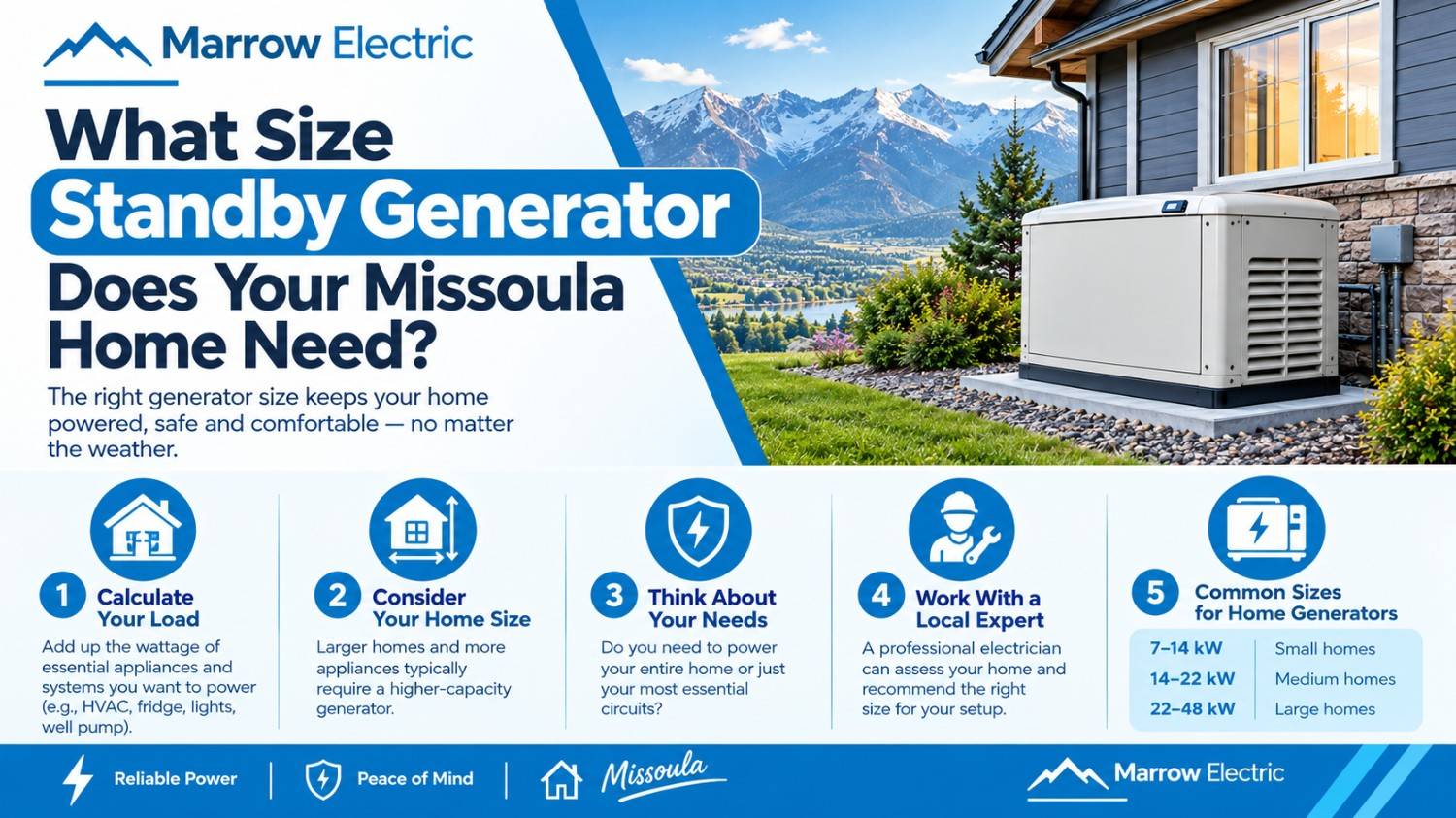
Common Standby Generator Sizes for Missoula & Bitterroot Valley Homes
- 10–14 kW — Small homes and cabins, essential circuits only (furnace, fridge, well pump, select lighting)
- 16–20 kW — Mid-size homes (1,500–2,500 sq. ft.), most essential + some comfort circuits
- 22–26 kW — Larger homes (2,500–4,000 sq. ft.), full whole-home coverage including central A/C
- 30+ kW — Large custom homes, properties with multiple wells, shops, or EV charging
These ranges are a helpful starting point, but they’re not a substitute for a load calculation on your actual panel. If your home has had recent panel upgrades or additions, your real-world numbers may be different than a same-size home built a decade earlier.
Factors That Affect Your Generator Sizing
- Square footage and number of HVAC zones
- Whether you have a private well (well pumps have a heavy starting-watt surge)
- Electric vs. gas appliances (electric ranges and dryers pull significantly more power)
- Home additions, shops, or detached garages on the same service
- Fuel source and availability, propane, natural gas, or diesel
- Local and Montana electrical code requirements for transfer switch placement and clearances
If you’re already planning other upgrades, it’s worth reviewing current Montana electrical code requirements or the code considerations for homeowner remodels at the same time, since generator installation, panel capacity, and remodel wiring often overlap.
Why Professional Sizing and Installation Matters
An undersized generator will overload and shut down at the exact moment you need it most — usually when your furnace and well pump both call for power during a cold snap. An oversized unit costs more upfront and burns more fuel than necessary. Because generator installation involves a dedicated electrical service connection, an automatic transfer switch, and gas or propane line coordination, it’s not a project for guesswork or a mismatched box-store unit.
As a licensed master electrician serving Missoula, Hamilton, Stevensville, Florence, Lolo, and the entire Bitterroot Valley, Marrow Electric performs an on-site load calculation before recommending a generator size, the same careful process we use for whole-house rewiring projects and new construction. If you’ve had an emergency electrician call in Missoula during a past outage, a properly sized standby generator is the long-term fix that prevents the next one.
| Generator Size | Home Type | Typical Coverage |
|---|---|---|
| 10–14 kW | Small homes & cabins | Essential circuits such as furnace, refrigerator, well pump, and select lighting |
| 16–20 kW | Mid-size homes | Most essential circuits plus some comfort circuits |
| 22–26 kW | Larger homes | Full whole-home coverage, including central A/C |
| 30+ kW | Large custom homes | Multiple wells, shops, EV charging, and other high-demand loads |
Get a Custom Generator Sizing Estimate for Your Home
Every Missoula and Bitterroot Valley home is different, and the only way to know your exact kW number is a real load calculation from a licensed electrician. Marrow Electric provides free, no-pressure generator sizing estimates for homeowners throughout the valley, from Hamilton to Missoula and everywhere in between.
Ready to stop worrying about the next outage? Request your free standby generator estimate and we’ll size, quote, and install a system built around how your home actually uses power.
Frequently Asked Questions
What size generator do I need to run my whole house?
Most Missoula-area homes between 2,000 and 3,500 square feet need a 20–26 kW standby generator for full whole-home coverage, including central air conditioning and major appliances. Smaller homes or essential-circuits-only setups can often run on 10–16 kW.
How much does a standby generator installation cost in Missoula?
Total cost depends on the generator’s kW size, fuel type, panel condition, and how far the unit sits from your gas or propane line and electrical panel. A licensed electrician can give you an accurate, itemized quote after an on-site load calculation.
Can a generator that’s too small damage my home’s electrical system?
An undersized generator won’t damage your wiring, but it can shut itself down or fail to start high-draw appliances like well pumps and HVAC compressors, leaving you without power exactly when you need it. It can also shorten the generator’s own lifespan from repeated overload trips.
Do I need a permit to install a standby generator in Montana?
Yes. Standby generator installations require an electrical permit and inspection, along with proper clearances and an automatic transfer switch installed to current Montana electrical code standards. A licensed contractor handles permitting as part of the installation.
How long does a standby generator installation take?
A straightforward residential installation typically takes one to two days, including electrical connections, the transfer switch, and fuel line coordination. Homes with panel upgrades needed first may take longer.
Marrow Electric Inc. | Missoula & Bitterroot Valley Master Electrician | (406) 360-8071 | www.marrowelectric.com
Leave a Reply