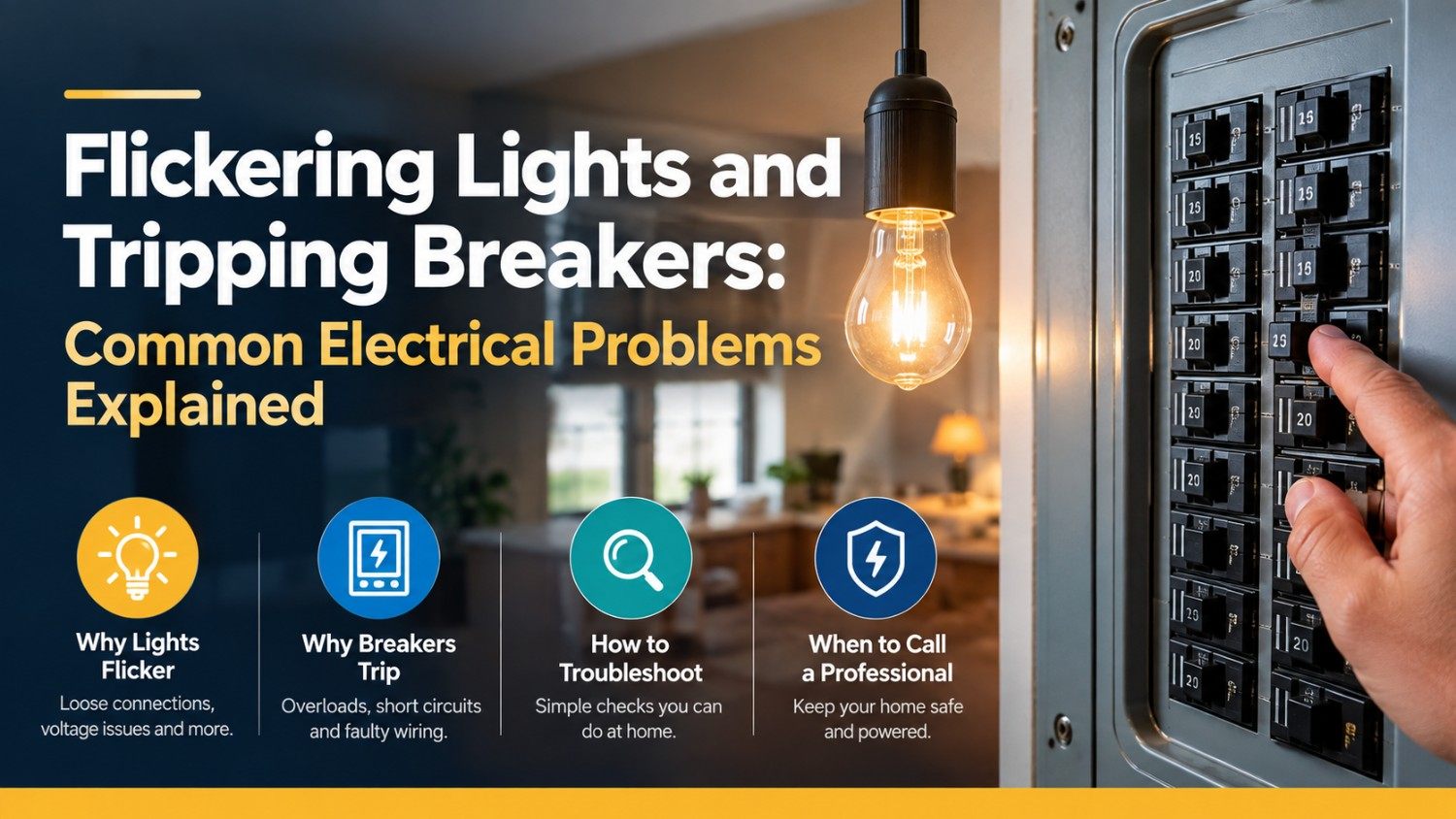
Flickering lights and breakers that trip without warning are two of the most common electrical complaints homeowners across Missoula and the Bitterroot Valley bring to Marrow Electric. Both can look like minor annoyances, a bulb that dims for a second, a breaker that pops when the microwave and toaster run together, but they’re often the visible symptom of something happening inside the walls that deserves attention.
Some causes are harmless and easy to explain. A cheap bulb screwed in slightly loose will flicker for reasons that have nothing to do with your wiring. Other causes point to loose connections, aging wiring, or an overloaded circuit that can become a genuine fire hazard if it’s ignored long enough. The tricky part for most homeowners is telling which situation they’re in.
This guide walks through why lights flicker, why breakers trip, how the two problems are connected, what you can safely check yourself, and when it’s time to call a licensed electrician. Whether you’re in an older bungalow near downtown Missoula or a newer build out toward Florence or Hamilton, the basics below will help you make a more informed call about your home’s electrical system.
Quick Electrical Problem Guide
| What You Notice | Possible Cause | What to Do |
|---|---|---|
| One bulb flickers | Loose bulb, socket, or LED issue | Try a known-good bulb |
| Several rooms flicker | Loose connection or service issue | Call an electrician |
| Breaker trips repeatedly | Overload, short, ground fault, or breaker problem | Stop repeatedly resetting it |
| Burning smell or scorch marks | Overheating or damaged wiring | Shut off power and call promptly |
When One Light Flickers vs. When the Whole House Flickers
A Single Bulb Flickering
If only one fixture flickers, the problem is almost always local to that fixture, a loose bulb, a worn socket, or a failing dimmer switch. This is the least concerning version of the problem and often the easiest to fix without any tools beyond a step stool.
Flickering Across Multiple Rooms
When flickering shows up in several rooms at once, especially rooms on different circuits, it points to something further upstream, a loose connection at the main panel, a problem with the neutral wire, or an issue with the utility’s service connection to your home. This version is worth a professional look sooner rather than later.
Flickering When Appliances Turn On
Momentary dimming when a large appliance kicks on, an air conditioner, a well pump, a space heater, is common and usually not dangerous by itself. These appliances draw a large burst of current the instant their motor starts, which briefly pulls voltage down on a shared circuit. It becomes a concern when the dimming is severe, lasts more than a second or two, or happens on circuits that shouldn’t be sharing a load with that appliance.
The Most Common Causes of Flickering Lights
Loose or Worn-Out Bulbs
The simplest explanation is often the right one. A bulb that isn’t screwed in fully, a worn-out socket contact, or an LED bulb reaching the end of its life can all cause flickering that has nothing to do with your home’s wiring. Tightening or replacing the bulb solves this instantly.
Loose Wiring Connections
Wire connections in switches, outlets, junction boxes, and the panel itself can loosen over time as the house settles and materials expand and contract with temperature. A loose connection creates resistance, and resistance creates heat and intermittent contact, which shows up as flickering. This is one of the more serious causes, since a loose connection under load can overheat enough to start a fire.
Overloaded Circuits
Older homes, especially those built before the 1990s, were often wired for a fraction of the electrical load modern households actually use. Running several high-draw appliances on one circuit, space heaters, hair dryers, window AC units, can push that circuit close to its limit, and lights on the same circuit will dim or flicker under the strain.
Voltage Fluctuations from the Utility
Occasionally the cause isn’t inside your home at all. Fluctuations on the utility side, a problem with a transformer, or a loose connection at the meter can cause flickering that affects the whole house and sometimes neighboring homes as well. This is worth mentioning to your electrician, since the fix may involve a call to NorthWestern Energy rather than panel work.
An Aging or Failing Electrical Panel
Panels have a service life, and older panels, particularly certain brands known for reliability issues, along with any panel showing rust, scorch marks, or a burning smell, can develop internal connection problems that cause flickering throughout the house. A panel inspection is the right next step any time flickering is widespread and doesn’t trace back to a specific appliance or fixture.
Why Do Circuit Breakers Trip?
Circuit Overload
This is the most common and least concerning cause. When the total current draw on a circuit exceeds what the breaker is rated for, the breaker trips to prevent the wiring from overheating. It’s usually solved by redistributing appliances across circuits or, if the pattern keeps repeating on a circuit that genuinely needs more capacity, adding a dedicated circuit for that space.
Short Circuits
A short circuit happens when a hot wire contacts a neutral wire, usually because of damaged insulation, a pinched wire behind a wall, or a wiring mistake. Short circuits cause a sudden, large surge of current, and the breaker will trip immediately and often forcefully. A breaker that trips the instant you flip it back on, with no appliances running, usually points to a short.
Ground Faults
A ground fault occurs when a hot wire contacts a grounded surface, a metal box, a damp wall cavity, an appliance frame. GFCI outlets and breakers are designed specifically to catch this and trip fast, which is why they’re required in kitchens, bathrooms, garages, and outdoor outlets. A GFCI that won’t reset, or keeps tripping with nothing plugged in, usually means moisture has reached a connection somewhere on that circuit.
A Worn-Out Breaker
Breakers themselves wear out. The internal mechanism that senses current and trips the switch can become oversensitive or unreliable with age, causing trips that aren’t actually caused by an overload, short, or ground fault. If a breaker trips under a light, normal load and a different breaker handles the same appliance fine elsewhere in the house, the breaker itself is a reasonable suspect.
Flickering and Tripping: How the Two Problems Connect
Flickering lights and tripping breakers frequently share a root cause, which is why they often show up together. A loose connection that causes flickering under light load can generate enough heat and resistance under heavier load to trip the breaker outright. An overloaded circuit might dim the lights gently most of the time and only trip the breaker when an especially demanding appliance joins in. When homeowners describe both symptoms happening around the same time or on the same part of the house, that overlap is actually useful diagnostic information for an electrician, it narrows down where to start looking.
Safe DIY Checks Before You Call an Electrician
A few checks are safe for most homeowners to do themselves and can save a service call if the fix turns out to be simple:
- Tighten any bulbs that look flickering-prone, and try a known-good bulb in the fixture to rule out the bulb itself.
- Note which specific lights or outlets are affected, and check whether they’re all on one side of the house or one level, this tells your electrician a lot before they even arrive.
- Unplug large appliances one at a time to see if a specific one is triggering the flicker or trip.
- Check the breaker panel for a breaker sitting in a middle position (neither fully on nor off), that’s a tripped breaker, and it should be pushed firmly to OFF before being reset to ON.
- Press the test and reset buttons on any GFCI outlets on the affected circuit; a GFCI that won’t reset should be treated as a real fault, not a nuisance.
- Note the time of day and what was running when the problem happened, since patterns tied to specific appliances or times point directly to the cause.
None of these checks require opening a panel cover, touching wiring, or working with anything beyond a light bulb and a plug. That line, panel covers and wiring, is where DIY should stop.
Warning Signs That Mean Stop and Call a Professional
Some symptoms shouldn’t wait for a convenient time. Call an electrician promptly, and consider it urgent, if you notice any of the following:
- A burning smell near an outlet, switch, or the panel
- An outlet or switch plate that’s warm or discolored to the touch
- Visible scorch marks, melted plastic, or a crackling or buzzing sound
- A breaker that trips immediately every time it’s reset, with nothing plugged in
- Sparks when plugging in or unplugging a cord
- Flickering that’s accompanied by any of the above, rather than occurring on its own
If you see any of these, shut off the breaker for that circuit (or the main breaker if you’re unsure which one) and call an electrician rather than continuing to reset and use the circuit.
What It’s Like Having an Electrician Diagnose the Problem
A proper diagnosis starts with the pattern you’ve noticed, which rooms, which appliances, what time of day, since that narrows the search considerably before any tools come out. From there, an electrician typically checks voltage at the affected outlets and fixtures, inspects panel connections for looseness or heat damage, and tests the breaker itself under load to see whether it’s tripping at the rated threshold or prematurely.
For flickering that spans the whole house, checking the main service connection and the neutral bus in the panel is usually the next step, since a loose neutral is a classic cause of house-wide flickering that gets worse as more appliances turn on. For a single circuit, tracing the run from the panel to the affected outlets, checking every junction box and switch along the way, is more typical.
Most single-circuit diagnoses can be completed in one visit. Whole-panel issues sometimes require a follow-up appointment if a part needs to be ordered, particularly for older or discontinued panel brands. Bringing notes on when the problem happens, what’s plugged in nearby, and whether it’s gotten more frequent over time helps an electrician skip straight to the likely cause instead of testing every circuit in the house.
It’s also worth asking your electrician to check for related issues while they’re already in the panel or tracing a circuit. Loose connections and overloaded circuits rarely exist in total isolation, a home with one flickering circuit often has one or two other circuits carrying more than they should, even if they haven’t caused a visible problem yet. A full diagnostic visit is a reasonable time to get ahead of those before they turn into a second service call.
Special Considerations for Missoula and Bitterroot Valley Homes
Older Homes and Outdated Panels
Missoula’s older neighborhoods have a mix of homes with original 1950s–1970s wiring and panels that were never designed for today’s electrical loads. Some of these panels use breaker types that are no longer manufactured, which makes even a simple breaker swap more involved than it would be in a newer home. A panel inspection is worth scheduling proactively in homes of this age, even before flickering or tripping shows up.
Winter Heating Loads
Montana winters push electric space heaters, heat tape, and block heaters into heavy use on circuits that weren’t necessarily designed with that load in mind. It’s common for flickering and tripping complaints to spike in the colder months as homeowners add supplemental heat to rooms that run cold.
Well Pumps and Rural Properties
Out toward Florence, Lolo, and the broader Bitterroot Valley, well pumps are a frequent cause of the appliance-triggered dimming described earlier. A pump on a dedicated, correctly sized circuit shouldn’t cause noticeable flickering; one sharing a circuit with lighting, or one that’s undersized for the well depth, often will.
Common Myths About Flickering Lights and Tripping Breakers
Myth: A Tripped Breaker Means the Breaker Is Broken
A breaker tripping is almost always the breaker working correctly, not failing. It’s designed to interrupt current the moment it senses an overload, a short, or a ground fault, so a single trip with an obvious cause, too many appliances running at once, isn’t a sign the breaker itself needs replacing. Repeated trips with no clear cause are the real red flag, not the act of tripping itself.
Myth: LED Bulbs Don’t Flicker
LEDs are less prone to certain kinds of flicker than older incandescent or fluorescent bulbs, but they’re not immune. Cheap or incompatible dimmer switches are a common cause of LED-specific flicker, since many older dimmers weren’t designed for the lower wattage LEDs draw. Swapping to an LED-rated dimmer often solves flicker that seems to start right after a bulb switch.
Myth: If the Lights Aren’t Flickering, the Wiring Is Fine
Wiring problems don’t always announce themselves with flicker. A loose connection can sit quietly for months, generating heat only under specific load conditions, before it finally causes a visible symptom or, in worse cases, a failure behind a wall where it can’t be seen at all. This is part of why periodic panel inspections are worth doing on a schedule rather than only in response to a symptom.
How Much Does It Cost to Fix Flickering Lights or Tripping Breakers?
Costs vary widely depending on the cause. A loose bulb or a worn switch is typically a sub-$200 fix. Diagnosing and repairing a single loose connection, or replacing one breaker, commonly falls in the $150–$400 range depending on how much time is needed to trace the fault. Circuit overloads that require adding a dedicated circuit run higher, often $300–$800 depending on the distance from the panel. Panel-level problems, including a full panel replacement or upgrade, generally run $1,800–$4,000 depending on panel size, amperage, and the age of the home. Getting an on-site diagnosis is the only reliable way to know which category a specific problem falls into.
Preventing Future Electrical Problems
A handful of habits go a long way toward avoiding repeat visits:
- Avoid running multiple high-draw appliances on the same circuit or outlet strip
- Have your panel inspected every few years, especially in homes over 25 years old
- Replace flickering or dimming bulbs promptly rather than living with them
- Don’t ignore a breaker that trips more than once in a short period, get it looked at before it becomes routine
- Consider a panel upgrade proactively if your home still has its original panel from before 1990
Why Are My Lights Flickering?
Check the bulb, socket, dimmer, or individual fixture.
Possible circuit, panel, neutral, service, or utility issue.
If yes, note the appliance and timing for your electrician.
Frequently Asked Questions
1. Why do my lights flicker when I turn on a big appliance?
This usually means that appliance is pulling a large surge of current the moment it starts, which briefly drops voltage on the shared circuit. It’s common with air conditioners, well pumps, and space heaters. Occasional dimming is normal; lights that flicker hard or stay dim afterward point to an overloaded circuit or a loose connection that should be checked by an electrician.
2. Is it dangerous if my breaker trips a lot?
A breaker that trips repeatedly is doing its job by cutting power before a wire overheats, but frequent tripping means something upstream is wrong, an overloaded circuit, a short, or a failing breaker. Repeated tripping shouldn’t be reset over and over without finding the cause, since each trip is a sign of a real fault.
3. Can I just replace the breaker myself?
Swapping a breaker involves working inside a live electrical panel, which carries a serious shock and arc-flash risk even with the main off. Montana requires licensed electricians for panel work in most jurisdictions, and a misapplied breaker (wrong amperage or type) can leave a circuit unprotected. This is a call-a-professional job.
4. Why does only one room in my house flicker?
Flickering isolated to one room usually traces back to that circuit specifically, a loose wire nut, a worn switch, or a failing outlet feeding downstream fixtures. Whole-house flickering points to the main panel, the service connection, or the utility line instead.
5. much does it cost to fix flickering lights or a tripping breaker?
Simple fixes like a loose bulb or a worn switch typically run under $200. Diagnosing a loose wiring connection or replacing a single breaker is often in the $150–$400 range. Panel-level issues, including a full panel upgrade, generally run $1,800–$4,000 depending on panel size and home age.
6. Is a flickering light an emergency?
Flickering paired with a burning smell, warm outlet or switch plate, visible scorch marks, or buzzing sounds is an emergency, shut off the circuit and call an electrician right away. Occasional, mild flickering with no other symptoms can usually wait for a scheduled appointment.
Talk to a Licensed Missoula Electrician
Flickering lights and tripping breakers are your electrical system’s way of telling you something needs attention. Most causes are straightforward to diagnose and fix once an electrician can see the pattern in person, and catching them early is almost always cheaper and safer than waiting. If you’re noticing either issue in your Missoula or Bitterroot Valley home, Marrow Electric can diagnose the cause and walk you through the right fix, whether that’s a $150 repair or a panel upgrade.
Flickering Lights or a Breaker That Keeps Tripping?
Don’t keep resetting the breaker or ignoring recurring flickering. A professional diagnosis can identify whether you’re dealing with an overloaded circuit, loose connection, faulty breaker, or another electrical issue.
Request an Electrical EstimateServing Missoula and the Bitterroot Valley
Schedule an inspection with Marrow Electric today to get flickering lights and tripping breakers sorted out before they become a bigger problem.
Leave a Reply