
A home needs a subpanel when the main electrical panel has run out of breaker spaces, or when you need to feed power to a location far from the main panel, such as a detached garage, shop, barn or home addition. The catch is that a subpanel only works when your home’s electrical service still has spare capacity. A subpanel adds breaker slots and local distribution. It does not add amps from the utility.
That one distinction saves Missoula homeowners a lot of money and frustration. If you are planning a basement finish, a shop, an EV charger or a hot tub, the first question is not “where do I put more breakers?” The first question is “does my home have enough electrical capacity for what I want to add?” This guide walks you through both questions, so you know whether you need a subpanel, a panel upgrade, or something simpler.
Quick Answer: When Does a Home Need a Subpanel?
Here is the short version, written for anyone who wants the answer fast:
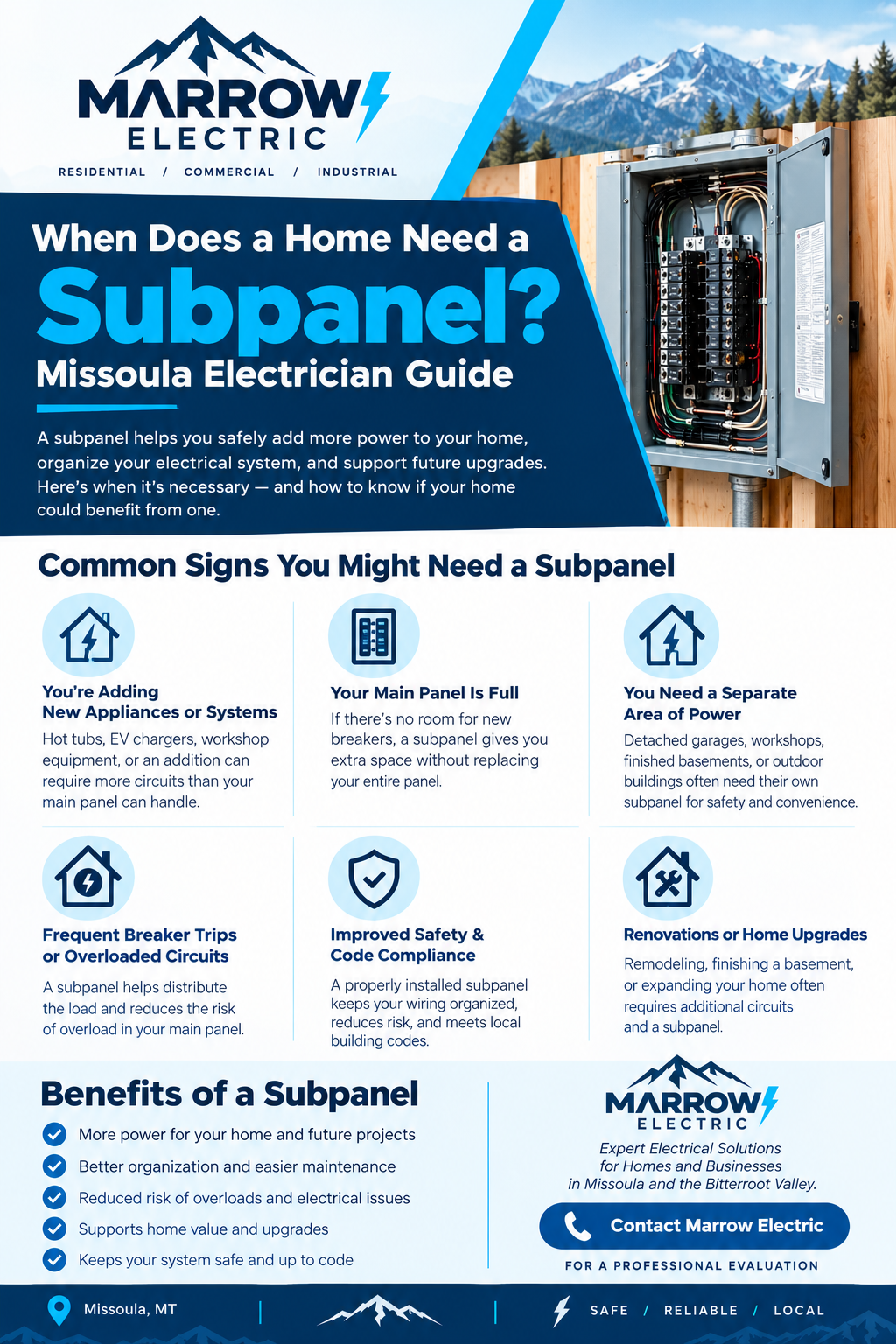
- The main panel is full. There are no open breaker spaces left for new circuits.
- You are adding a detached building. A garage, workshop, shed or barn needs its own local distribution point.
- You are finishing or adding space. A basement, attic conversion or addition adds many new lighting, outlet and heating circuits.
- You are adding high-demand equipment. EV chargers, hot tubs, saunas, welders and heat pumps often need a cluster of new breakers.
- Your service has spare capacity. A load calculation shows your total demand still fits within your 100-amp, 150-amp or 200-amp service.
If the last point is not true, a subpanel is not the answer. You need a service upgrade instead, which we cover below.
What Is an Electrical Subpanel?
A subpanel, sometimes called a sub-panel or auxiliary panel, is a smaller breaker box fed by a single large breaker in your main service panel. Think of the main panel as the front door of your electrical system. Everything coming in from the utility meter passes through it. A subpanel is a second distribution point that takes a share of that power and spreads it to a new area.
The feeder breaker in the main panel protects the wires running to the subpanel. The breakers inside the subpanel protect each individual circuit. A typical residential subpanel is rated for 60 amps, 100 amps or 125 amps, depending on what it needs to serve.
Subpanels are common, safe and code-compliant when installed correctly. The key phrase is “installed correctly.” The wiring, grounding and breaker sizing all matter, which is why this is a job for a licensed electrician and not a weekend project. If you are not sure what you are looking at in your own basement or garage, our electrical service and troubleshooting team can look it over.
Subpanel vs. Main Panel: What Is the Difference?
The main panel is where your electrical service enters the home and where the main disconnect lives. It is the one place in a typical residence where the neutral and ground wires are bonded together. A subpanel is downstream of the main panel and depends on it for power and for its connection to the grounding system.
| Feature | Subpanel | Main Panel or Service Upgrade |
|---|---|---|
| Primary job | Adds breaker spaces and local power distribution. | A service upgrade increases available electrical capacity from the utility when properly sized and approved. |
| Total home capacity | Does not increase the home’s overall service capacity. A 100-amp service remains 100 amps. | May increase service capacity from 100 amps to 200 amps or another approved rating. |
| Best for | Homes with sufficient service capacity but too few breaker spaces. | Homes where electrical demand exceeds the existing service’s available capacity. |
| Typical use | Garage, workshop, basement, or home addition. | Older homes adding major appliances, HVAC equipment, EV charging, or other substantial loads. |
| Neutral and ground | Kept separate in a typical downstream subpanel. | Bonding is handled at the service disconnect or other permitted bonding point, according to the applicable electrical code. |
5 Signs Your Home Needs a Subpanel
Most homeowners do not wake up and decide to install a subpanel. They hit a wall. Something does not fit, trips or cannot be connected. Here are the most common triggers we see around Missoula and the Bitterroot Valley.
1. Your Main Panel Has No Open Breaker Spaces
Older panels, especially 100-amp panels installed decades ago, often have a limited number of spaces. Open the door and count. If every slot is filled, you cannot add a new circuit without making a change.
Some homeowners get around this with tandem or “cheater” breakers that fit two circuits into one slot. That is acceptable only if your panel is listed for them. Many older panels are not. Overloading a panel with tandems can create heat and safety problems. If you have already used up your tandem allowance, a subpanel is usually the cleanest fix. For more on this kind of capacity problem, see our guide to flickering lights and tripping breakers.
2. You Are Finishing a Basement or Converting an Attic
A finished basement is not one circuit. It is lighting circuits, receptacle circuits, possibly a bathroom, a wet bar, heating and sometimes a laundry area. Code also requires specific protection, such as arc-fault and ground-fault devices, in many of these spaces. Those breakers take up room, and many older panels simply do not have it.
A subpanel placed in the basement gives the new space its own distribution point. It also shortens the wire runs, which makes the work cleaner and often easier to inspect.
3. You Are Building a Detached Garage, Shop or Barn
This is one of the most common reasons for a subpanel in western Montana. People here have workshops, outbuildings, hobby barns and detached garages. A subpanel in that building lets you power lights, outlets, a compressor, a table saw, a welder or a heater without running a separate long circuit for every device.
It also gives you a local shutoff point, which is a real safety benefit. If you are working on a tool or a light fixture in the shop, you can kill the power right there instead of walking back to the house.
4. You Are Adding Large Modern Loads
Electric vehicles, hot tubs, saunas, heat pumps and mini-split systems all draw serious power, and many need a dedicated breaker. If you are adding several of them over time, you may run out of slots long before you run out of amps. Our guides on hot tub electrical installation and which appliances need a dedicated circuit explain how those loads are wired.
5. Your Home Has Been Remodeled Over the Years
Kitchen remodels, new HVAC, bathroom additions and added outlets all pile onto the same panel. After a few projects, a panel that once had plenty of room is jammed. A subpanel can pull some of those loads off the main panel, which also leaves room for future work.
The Most Important Rule: A Subpanel Does Not Add Power
A subpanel divides your existing electrical pie differently. It does not bake a bigger pie. If your home has a 100-amp service, you still have 100 amps total after you install a subpanel. The subpanel only creates more places to connect circuits.
This matters because many people assume a full panel means they need “more power.” Often they simply need more slots. But sometimes the opposite is true: the panel has free spaces and the home is still overloaded. The answer depends on real numbers, not guesses.
How a Load Calculation Decides Subpanel vs. Service Upgrade
An electrician performs a load calculation, following the method in the National Electrical Code (NEC), to estimate your home’s total demand. It accounts for square footage, major appliances, heating, air conditioning, the kitchen, laundry and any new equipment you plan to add.
The result tells you which route makes sense:
- Demand fits inside your current service: a subpanel is a good, cost-effective choice.
- Demand is close to or above your service rating: a service upgrade is the correct fix, because adding a subpanel would only add more load to an already stressed system.
If you are leaning toward an upgrade, our breakdown of what a panel upgrade costs in Missoula will help you plan the budget.
Warning Signs That You Need More Than a Subpanel
Sometimes the symptoms are not about breaker slots at all. Watch for these:
- Lights dim when the furnace, dryer or well pump starts.
- Breakers trip repeatedly when two large appliances run at the same time.
- The panel feels warm, hums or shows discoloration.
- Your service is still an older 60-amp or 100-amp setup, and you are adding an EV charger or heat pump.
- Your panel brand has a known safety history and needs evaluation.
If you notice any of these, call a licensed electrician before adding anything. A scorching or buzzing panel is an urgent safety issue, and our team handles emergency electrical calls in Missoula when something cannot wait.
Subpanel vs. Panel Upgrade: Which One Is Right for You?
This is the decision most homeowners are really trying to make. Here is a practical way to think about it.
Choose a Subpanel When
- Your main panel is full, but a load calculation shows spare capacity.
- You are powering a detached building or a distant part of the house.
- You want to group related loads, such as a shop or an addition.
- Your existing main panel is in good condition and not a safety concern.
Choose a Panel or Service Upgrade When
- Your total demand exceeds or nearly reaches your service rating.
- Your main panel is old, damaged, overheating or a known problem model.
- You are adding multiple high-demand loads at once, such as an EV charger and a heat pump.
- The utility meter, service entrance or mast also need updating.
- You want a long-term fix and plan to keep the home for many years.
Sometimes You Need Both
It is common for a project to need an upgraded main panel and a subpanel. For example, a homeowner might move from a 100-amp to a 200-amp service, then add a subpanel in a new detached shop. The upgrade supplies the capacity. The subpanel supplies the distribution. That is a perfectly normal combination.
How Subpanel Installation Works in Missoula
Understanding the process helps you ask good questions and compare quotes fairly. Here is what a proper installation looks like from start to finish.
Step 1: Site Visit and Load Evaluation
A qualified electrician inspects your existing panel, checks the condition and brand, notes the meter location and measures the distance to the planned subpanel location. They then run a load calculation to confirm your service can support the new loads. This visit is why reputable electricians do not quote a subpanel blindly over the phone.
Step 2: Sizing the Feeder and Subpanel
The subpanel’s amperage rating, the feeder breaker and the wire size all have to match. A 60-amp subpanel is common for a small garage. A 100-amp subpanel suits a larger shop or a finished basement. The right size depends on the real loads, the distance and the wire material. Longer runs may require larger wire to limit voltage drop.
Step 3: Running the Feeder
The feeder is the set of wires that carries power from the main panel to the subpanel. For a detached building in Montana, that usually means trenching. Wire or conduit must be buried to the depth the NEC requires, and many electricians choose conduit for better protection against shifting soil, frost and future digging. Inside the house, the feeder may run through a basement, crawlspace or attic.
Step 4: Mounting and Wiring the Subpanel
The subpanel is mounted at a code-compliant height, with working clearance in front of it. It must not be installed in a bathroom, a closet or other prohibited locations. The feeder is connected to the lugs, and each branch circuit gets its own correctly sized breaker.
Step 5: Grounding and Bonding
Grounding is where the details matter most, and where do-it-yourself work most often goes wrong. We cover it in the next section.
Step 6: Permit, Inspection and Labeling
The work is permitted and inspected, the panel directory is labeled clearly and the homeowner gets a walk-through of what was installed and where the shutoffs are.
The Wiring Rules That Matter Most
If you remember nothing else from this guide, remember these rules. They are the difference between a safe subpanel and a hazard.
Use a 4-Wire Feeder
Subpanels require a four-wire feeder: two hot conductors, one neutral and one equipment ground. The older three-wire method, where the neutral also served as the ground, is no longer acceptable for subpanels in most homes. Four wires keep normal current and fault current on separate paths.
Keep the Neutral and Ground Separate
Inside the subpanel, the neutral bar and the ground bar must stay isolated from each other. Neutral and ground are bonded together only at the main service panel. If they are bonded in a subpanel, normal current can flow on the ground wires and metal enclosures. That creates shock risk and can cause erratic equipment behavior. Many subpanels ship with a bonding screw or strap that has to be removed.
Ground Detached Buildings Correctly
A subpanel in a detached garage or shop needs its own grounding electrode system, such as ground rods, connected to the ground bar. A local disconnect is also required at or near the building. These requirements are specific, and the rules differ depending on the structure. A licensed electrician handles them as a standard part of the job.
Use the Right Breakers and Protection
Modern code calls for ground-fault circuit interrupter (GFCI) protection in garages, outdoor areas, basements and other damp locations, and for arc-fault protection in many living spaces. Using the wrong breaker type is a common reason an installation fails inspection.
Do You Need a Permit for a Subpanel in Missoula?
Yes. A subpanel installation is electrical work that requires a permit and an inspection in Montana, and in Missoula it must follow the NEC as adopted by the state. The permit and inspection are not paperwork for its own sake. They provide a second set of professional eyes on the grounding, wire sizing and breaker protection, which are the hardest things for a homeowner to verify on their own.
Permit rules in Montana depend on the type of work and on who has jurisdiction, and there are narrow exceptions for owner-occupied property that still carry safety requirements. For a deeper look, read our guide on what electrical work requires a permit in Montana.
Unpermitted subpanels can also cause problems later. They may surface during a home inspection when you sell, trigger questions from your insurance company or require expensive corrections. If you are buying or selling, our home electrical inspection checklist explains what inspectors look for.
What Does Subpanel Installation Cost in Missoula?
We do not publish a flat price because no two jobs are the same, and any contractor who quotes a subpanel sight unseen is guessing. Here is what actually drives the cost:
- Feeder distance: A subpanel ten feet from the main panel is a very different job than a shop 150 feet away.
- Trenching and conduit: Digging through rock, frozen ground, driveways or landscaping adds labor and time.
- Subpanel size: A 60-amp panel costs less than a 100-amp or 125-amp panel, and larger feeder wire costs more per foot.
- Condition of the main panel: If the existing panel is outdated, damaged or full of tandem breakers, it may need work before a subpanel can be connected.
- Number and type of circuits: GFCI, AFCI and 240-volt breakers cost more than standard ones.
- Meter and service location: Where the meter and main disconnect sit affects routing and code requirements.
- Permits and inspections: Fees vary based on the scope of work and jurisdiction.
- Grounding and disconnects: Detached buildings need additional equipment.
The most useful step you can take is to ask for an on-site estimate that lists the feeder size, subpanel size, trenching plan and permit. That lets you compare quotes accurately instead of comparing only a bottom-line number.
Common Subpanel Mistakes to Avoid
We regularly see these problems when we are called to fix someone else’s work:
- Bonding the neutral and ground in the subpanel. This is the most common and most dangerous mistake.
- Undersized feeder wire. Wire that is too small for the breaker or the distance can overheat and cause voltage drop.
- Skipping the permit. It saves a little up front and costs a lot later.
- Installing a subpanel when the service is already maxed out. The panel fits, but the system cannot support the load.
- No local disconnect or grounding at a detached building.
- Poor labeling. An unlabeled panel is a hazard in an emergency.
- Using the wrong breaker type for the application.
- Buried cable without proper protection. Frost, rocks and future digging can all damage direct-buried wire.
Each of these can be avoided with a licensed professional and a clear plan before work begins.
Subpanel Planning Tips for Missoula and Bitterroot Valley Homeowners
Western Montana has some local factors worth planning around.
- Cold-weather work windows. Trenching is easier before the ground freezes. If you want a shop powered by winter, plan the project in late summer or early fall.
- Detached buildings are common. Properties in the Bitterroot Valley, Florence and Stevensville often have outbuildings, so ask about a feeder run early in your planning.
- Future loads. If you may add a generator, an EV charger or a hot tub later, size the subpanel with that in mind. Our generator installation guide shows how a transfer switch ties into your panels.
- Older homes. Many homes in Missoula’s established neighborhoods have original panels. It is worth having the main panel evaluated before you attach anything new to it.
For a full picture of the services we offer across the valley, visit the Marrow Electric homepage.
How to Choose a Missoula Electrician for a Subpanel Installation
A subpanel is not a high-risk job when done right, but it is unforgiving when done wrong. Here is what to look for.
- A Montana-licensed and insured electrician. Ask for proof.
- An on-site assessment. No serious contractor quotes by phone alone.
- A written estimate. It should list the subpanel size, feeder size, trenching, materials and permit.
- Permit and inspection included. The electrician should pull the permit.
- Clear communication. You should understand why they recommend a subpanel or an upgrade.
- Local reviews and references. Choose someone with a track record in your area.
A good electrician will tell you when you do not need a subpanel, too. Sometimes a few tandem-rated breakers or a circuit rearrangement is enough. Sometimes the honest answer is a service upgrade.
Frequently Asked Questions About Subpanels
When does a home need a subpanel?
A home needs a subpanel when the main panel is out of breaker spaces, or when power must be delivered to a distant area such as a detached garage, shop or addition. It also makes sense when you add several large loads, such as an EV charger or hot tub, as long as your overall service amperage is sufficient.
Does a subpanel increase my home’s electrical capacity?
No. A subpanel adds breaker slots and local distribution, but it does not increase the total amps supplied by the utility. A 100-amp service remains a 100-amp service. If your total demand is too high, you need a main service upgrade.
Can I install a subpanel myself?
In most cases you should not. A subpanel involves feeder sizing, grounding, bonding and permits, and mistakes can cause fire or shock hazards. Montana permit rules include narrow owner-occupant exceptions, but hiring a licensed electrician is the safest option.
How many amps should my subpanel be?
It depends on the loads. A small garage may use a 60-amp subpanel, while a larger shop or finished basement may need 100 amps or more. An electrician sizes it using a load calculation and the feeder distance.
What is the difference between a subpanel and a main panel?
The main panel receives power from the utility and contains the main disconnect and the neutral-ground bond. A subpanel is fed from the main panel through a feeder breaker and distributes power to a specific area. Its neutral and ground bars stay separate.
Do I need a permit for a subpanel in Missoula?
Yes, subpanel installation requires an electrical permit and an inspection to ensure it meets NEC requirements as adopted in Montana. Your electrician normally handles this.
Can a subpanel run a detached garage or workshop?
Yes. A detached garage or shop is one of the most common uses. The building needs a four-wire feeder, its own grounding electrode system and a local disconnect.
How much does subpanel installation cost in Missoula?
Cost depends on feeder length, trenching, subpanel size, panel condition, number of circuits and permit fees. Because these vary so much, a reliable electrician provides an on-site estimate instead of a phone quote.
Is a subpanel better than a panel upgrade?
Neither is better in general. A subpanel is the right choice when you have spare capacity but no open slots. A panel upgrade is right when your total demand exceeds your current service.
How long does a subpanel installation take?
A simple indoor subpanel can often be completed in a day. A detached building with trenching, grounding and inspections can take longer, depending on weather and inspection scheduling.
Final Thoughts: Do You Need a Subpanel?
If your panel is full, you are building a detached space, or you are adding major loads, a subpanel is often the practical answer, provided your service has capacity to spare. If your demand is already near the limit, a service upgrade protects your home and gives you room to grow.
The smartest first step is a professional evaluation. A load calculation, a look at your panel and a clear plan will tell you which path fits your home and your budget.
Talk to a Missoula Electrician About Subpanel Installation
Marrow Electric serves Missoula and the Bitterroot Valley with licensed, code-compliant electrical work. Whether you need a subpanel for a new shop, a panel upgrade for a growing household or a safety check on an aging system, we will give you a straight answer and a clear written estimate.
Need an Electrician?
Reliable electrical service in Stevensville and the Bitterroot Valley.
Call Marrow Electric65 Goose Ln, Stevensville, MT 59870