Every homeowner has flipped a breaker after running the microwave and the toaster at the same time. Most of the time it is an annoyance. Sometimes it is a warning that a circuit is being asked to do more than it was built to do. That is exactly the problem a dedicated circuit solves, and it is why a dedicated circuit electrician in Missoula gets calls from homeowners in older houses, new builds, and remodels alike.
The short answer: a dedicated circuit is a single circuit that feeds one appliance or one piece of equipment and nothing else. You generally need one for any high-wattage, motor-driven, or safety-critical appliance, such as an electric range, dryer, water heater, dishwasher, or sump pump. If you are unsure whether a specific appliance needs its own line, our licensed electricians can read the nameplate, check your panel, and give you a clear answer.
In this guide we explain what a dedicated electrical circuit is, walk through ten appliances that commonly need one, cover 120-volt and 240-volt requirements, show the warning signs of an overloaded circuit, break down typical installation costs, and explain when it is time to call a licensed electrician. If you would like to skip ahead and book a visit, you can contact Marrow Electric at any time.
What Is a Dedicated Circuit?
A dedicated circuit runs from a single breaker in your electrical panel to a single appliance or outlet. Nothing else shares that wire, that breaker, or that neutral. Most general-purpose circuits in a house are the opposite: one breaker feeds several outlets, lights, and sometimes an entire room or two. That is fine for lamps and phone chargers, but it is a poor match for equipment that pulls serious power. If you want to understand how your whole system fits together, our home electrical safety guide shows what a healthy setup looks like.
The idea is simple. Every circuit has a limit, set by the wire size and the breaker rating. A typical 15-amp circuit is meant to carry 15 amps, and a 20-amp circuit 20 amps. When several devices share one circuit, their combined draw can exceed that limit. The breaker is supposed to trip before the wire overheats, but repeated overloads stress breakers, outlets, and connections over time. A dedicated circuit gives the appliance all of the capacity, so nothing else competes with it. That is one reason we often recommend one during a panel upgrade.
Dedicated circuits also matter for a second reason: some appliances simply are not designed to share. Manufacturers list the required circuit size on the nameplate or in the installation manual, and the National Electrical Code (NEC), as adopted in Montana, backs that up for many common appliances. Following those requirements is part of keeping your home safe and your warranty valid. Our team covers these details in every electrical service and troubleshooting visit.
Why Dedicated Circuits Matter for Safety and Reliability
Overloaded circuits are one of the most common causes of home electrical problems. Wires that carry more current than they are rated for heat up, and heat is what damages insulation, loosens connections, and, in the worst cases, starts fires. A dedicated circuit takes away the guesswork by matching one wire, one breaker, and one appliance. If you have already noticed odd behavior, our article on flickering lights and tripping breakers explains what those symptoms usually mean.
There is also a practical rule electricians follow: continuous loads should not exceed 80 percent of a circuit’s rating. On a 15-amp circuit, that is 12 amps, or about 1,440 watts at 120 volts. A single 1,500-watt space heater already crosses that line by itself. Add a TV, a lamp, and a phone charger, and you have a circuit that trips or runs hot. Understanding this math is the fastest way to see why one appliance per circuit is often the smarter choice, and why a professional load check is valuable when buying or renovating a home.
Finally, dedicated circuits protect the things that must keep running. A freezer full of food or a sump pump during spring runoff should never lose power because someone plugged a hair dryer into the same line. In Missoula, where rapid snowmelt and cold snaps are part of life, that reliability matters. It also pairs well with a backup generator plan so critical loads stay powered when the grid does not.
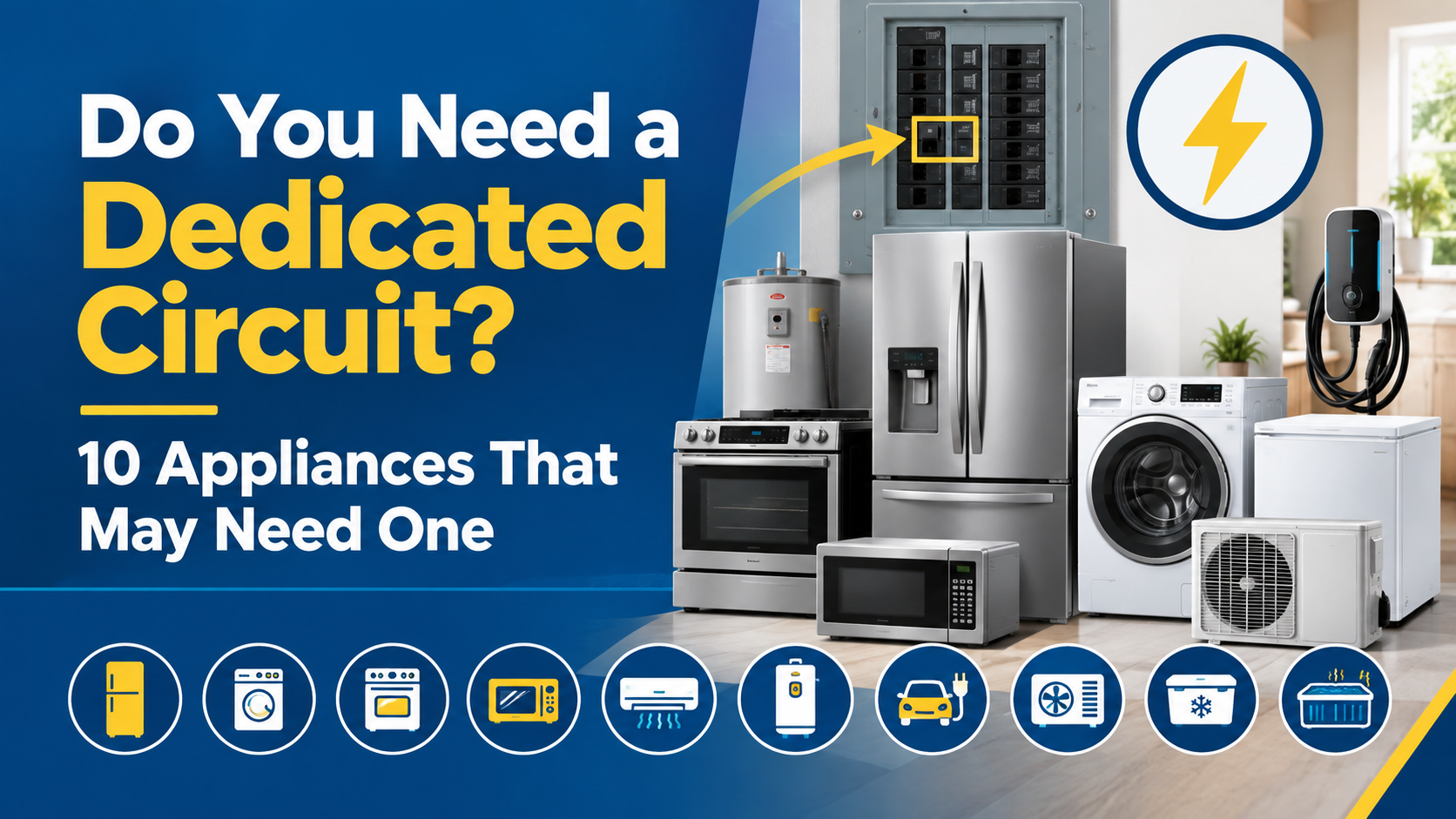
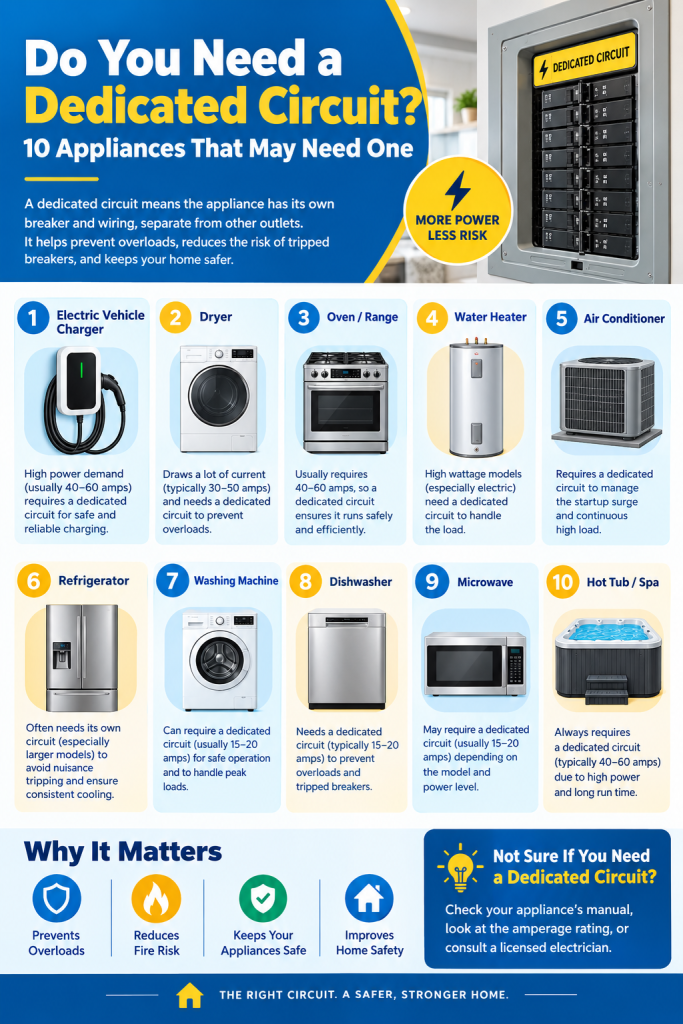
10 Appliances That May Need a Dedicated Circuit
The list below covers the appliances we are asked about most often. Exact requirements depend on the model, the wire size, your panel, and local code, so treat this as a guide, not a substitute for the nameplate or a licensed electrician. If you are planning to move or replace any of these, call us before you buy so the circuit is ready on installation day.
1. Refrigerator and Freezer
A refrigerator runs around the clock, and its compressor draws a surge of current every time it starts. On a shared circuit, a hair dryer or toaster can trip the breaker, and you may not notice until food has spoiled. A dedicated 15- or 20-amp, 120-volt circuit keeps the compressor steady. This is especially important for a garage or basement chest freezer, which often sits on an old, shared, ungrounded outlet. If your freezer keeps losing power, a quick circuit check is worth doing before you lose a season of groceries.
2. Electric Range and Oven
An electric range is one of the biggest loads in the house. Most need a dedicated 240-volt circuit, commonly rated 40 or 50 amps, with a heavy-gauge cable and the correct receptacle. This is not a place for shortcuts, because undersized wire on a range circuit is a real fire hazard. If you are switching from gas to electric, the panel may need extra capacity, and our guide to panel upgrade costs in Missoula explains what to expect.
3. Dishwasher
A dishwasher combines a motor, a pump, and a heating element, so it draws steady current for long cycles. Most manufacturers call for a dedicated 15- or 20-amp, 120-volt circuit, usually hard-wired or plugged in under the sink. Sharing it with the disposal or with kitchen counter outlets is a common cause of nuisance trips. When we troubleshoot kitchen circuits, an overloaded dishwasher line is one of the first things we check.
4. Built-In Microwave
Countertop microwaves are often fine on a regular outlet, but a built-in or over-the-range unit that draws over 1,000 watts typically needs its own 20-amp, 120-volt circuit. Running it alongside a toaster or coffee maker is a classic way to trip a breaker at breakfast. If your microwave dims the lights or shuts off mid-cycle, you can read about flickering lights and what causes them to see what may be happening.
5. Garbage Disposal
A disposal motor has high starting torque, which means a brief but heavy surge each time it kicks on. Depending on the model and local code, it may share a circuit with the dishwasher or need its own. In practice, a separate 15- or 20-amp circuit avoids the tripping and light dimming that come with sharing. If you are remodeling the kitchen, this is the ideal time to add it, especially alongside new kitchen lighting.
6. Washing Machine and Electric Dryer
Laundry needs two circuits. The washer needs a dedicated 20-amp, 120-volt circuit, which the NEC requires for the laundry area. The electric dryer needs its own 240-volt circuit, typically 30 amps, with a matching receptacle and cord. Older homes sometimes have a three-prong dryer outlet that no longer meets current standards. A safety review of your laundry area can catch outdated wiring before it becomes a problem.
7. Electric Water Heater
A tank water heater has heating elements that run for long stretches, which makes it a continuous load. Most electric models need a dedicated 240-volt circuit, often 30 amps, sized to the tank’s wattage. A tankless unit can require a much larger circuit, sometimes 40 to 60 amps or more, and may push an older panel past its limit. If your water heater trips breakers or takes forever to recover, our electrical troubleshooting team can pinpoint the cause.
8. HVAC Systems: Furnaces, Central AC, and Heat Pumps
A furnace blower and a central air conditioner both create startup surges. Furnaces usually need a dedicated 15- or 20-amp, 120-volt circuit, while an air conditioner or heat pump has its own 240-volt circuit sized to its nameplate. Heat pumps are increasingly popular in western Montana, and each one needs the correct breaker and disconnect. Cold weather makes a failed furnace circuit urgent, so know that emergency help is available if your heat goes out.
9. Sump Pump
A sump pump is your basement’s last line of defense during spring melt and heavy rain. If it shares a circuit and that circuit trips, you may not know until water is on the floor. Most pumps should be on a dedicated 15- or 20-amp, 120-volt circuit with proper ground-fault protection, and many homeowners add a battery backup. Pair the pump with a whole-home or standby generator for storms and outages, and have the setup reviewed if you are unsure.
10. Space Heaters and Window Air Conditioners
Portable heaters and window air conditioners are the appliances most likely to overload a shared circuit, because they run for hours and pull close to the limit. A 1,500-watt heater uses 12.5 amps on its own. If you rely on one to warm a bedroom or basement office, the room may need a dedicated circuit or a permanent heating solution. Our electrical safety checklist explains why extension cords and power strips are never the right fix.
Other Equipment That Often Needs Its Own Circuit
Beyond the ten above, several other loads commonly require dedicated wiring. Electric vehicle chargers are the biggest: a Level 2 home charger usually needs a dedicated 240-volt circuit, often 40 or 50 amps. Hot tubs, well pumps, in-wall heaters, mini-split systems, and workshop equipment such as table saws and compressors also tend to need their own lines. Each should be sized to its nameplate. If you are planning several of these at once, an electrical circuit upgrade in Missoula can be planned as one project.
Kitchens and bathrooms have their own code rules as well. The NEC calls for at least two 20-amp small-appliance circuits in the kitchen, and a 20-amp circuit for bathroom outlets. Ground-fault (GFCI) and arc-fault (AFCI) protection is required in many locations. Because these rules change with each code cycle, always confirm current requirements with a licensed electrician. It is also smart to ask about this during a pre-purchase electrical inspection.
120-Volt vs. 240-Volt Dedicated Circuits
Most household outlets deliver 120 volts, which is enough for lamps, TVs, computers, and small appliances. A 240-volt dedicated circuit uses two hot wires, and it is designed for heavy loads like ranges, dryers, water heaters, air conditioners, and EV chargers. Delivering power at 240 volts means the same wattage flows at half the current, which is how big appliances run efficiently without needing enormous wire. To understand the tradeoffs, see our panel upgrade guide.
The two types are not interchangeable. A 240-volt circuit needs a double-pole breaker, the correct wire gauge, and a receptacle whose shape matches the appliance plug, such as NEMA 14-30 for many dryers or 14-50 for ranges and EV chargers. Using the wrong outlet or adapter can damage the appliance and create a fire risk. If your home has a mix of old and new receptacles, an electrician can inspect and label every circuit to make sure everything matches.
Signs Your Existing Circuit May Be Overloaded
Your home usually tells you when a circuit is struggling. The most common warning signs are listed below, and any one of them is a reason to call a professional. Do not ignore them, especially in older houses with original wiring. If you notice more than one, book a service visit soon.
- Breakers that trip repeatedly, especially when a specific appliance runs.
- Lights that flicker or dim when a large appliance turns on.
- Outlets or switch plates that feel warm to the touch.
- Discolored, scorched, or blackened outlets.
- A burning or hot-plastic smell near an outlet, panel, or appliance cord.
- Buzzing, crackling, or sizzling sounds from outlets or the panel.
- Appliances that lose power or run poorly for no clear reason.
- Heavy reliance on extension cords or power strips.
Loose connections, worn breakers, and aging wire can cause many of these symptoms even without an overload, so the cause is not always obvious. Our article on common electrical problems helps you tell the difference, but a hands-on inspection is the only way to be sure. If you see scorching or smell burning, turn off the breaker and treat it as urgent: call an emergency electrician right away.
How Much Does a Dedicated Circuit Installation Cost in Missoula?
Dedicated circuit installation cost depends on the type of circuit, the distance from your panel, how easy the wire is to route, and whether the panel has room. As a general planning guide, a standard 120-volt dedicated circuit often falls in the low hundreds to several hundred dollars, while a 240-volt circuit for a range, dryer, or EV charger usually costs more, sometimes well over a thousand dollars in longer runs. These are rough estimates, not quotes, and your final price depends on your home. For a broader look at pricing, read our cost breakdown for panel work.
Several factors move the number. Finished walls, crawl spaces, and long distances take more labor. A full panel may need a subpanel or an upgrade before a new circuit can be added. Permit fees, inspections, and code-required protection such as AFCI or GFCI breakers add to the total. Older homes sometimes need wiring repairs first. The best way to get an accurate number is a free on-site estimate, where we can see your panel and the path the wire will take.
Dedicated Circuit Requirements: Code, Permits, and Manufacturer Specs
Three sources decide what a dedicated circuit must look like: the appliance manufacturer, the NEC as adopted in Montana, and your local permitting authority. The manufacturer’s nameplate lists the voltage, amperage, and minimum circuit size. The code sets rules for wire gauge, breaker sizing, grounding, and required protection. Your local jurisdiction requires permits and inspections for most new circuits. A licensed pro handles all three, and we build that into every service call.
Wire size and breaker size have to match. A 20-amp breaker on a wire rated only for 15 amps is a serious hazard, and it is a mistake we see in DIY work. Copper gauge, cable type, and conduit requirements vary by circuit and by where it runs. This is a core part of a good home electrical safety review.
Permits may feel like a hassle, but they protect you. An inspected circuit is documented, safe, and much easier to explain to insurers and future buyers. Unpermitted work can cause problems at resale, and buyers’ inspectors often find it. If you are buying or selling, our home electrical inspection checklist shows what inspectors look for.
Can You Install a Dedicated Circuit Yourself?
Many homeowners are handy, and it is tempting to run a new circuit on a weekend. But this work involves the inside of your panel, where parts of the service equipment stay energized even when the main breaker is off. Mistakes in wire sizing, torque, grounding, or breaker selection can cause overheating that shows up months later. That is why we recommend hiring a licensed electrician for dedicated circuit work.
A professional also brings the right tools and knowledge: load calculations to confirm your panel can handle the addition, torque screwdrivers to tighten terminals properly, and familiarity with current code. We handle the permit, the inspection, and the panel labeling so the job is finished right. If you would rather learn what is involved first, our electrical service overview explains our process.
When to Call a Dedicated Circuit Electrician in Missoula
Call a licensed electrician whenever you are adding a major appliance, replacing an old one with a larger model, converting from gas to electric, adding an EV charger, finishing a basement, or noticing any overload sign from the list above. It is also smart to call before you buy: a quick conversation can confirm the circuit you need so the appliance is not sitting in the driveway waiting for wiring. You can reach Marrow Electric here.
Marrow Electric serves Missoula and the Bitterroot Valley with residential wiring, panel work, and circuit upgrades. We arrive with a plan, explain your options in plain language, and give you a clear price before work begins. Whether you need one outlet or a full electrical circuit upgrade, we design it around your home and your budget. If the problem is urgent, our emergency electrical service is available.
Local conditions matter too. Missoula’s long, cold winters mean more space heaters, heated garages, and block heaters, while older neighborhoods often have wiring that predates modern appliances. In rural Bitterroot Valley homes, well pumps, shops, and outbuildings add more load. We take all of that into account and can also help with lighting and outdoor circuits while we are on site.
Frequently Asked Questions About Dedicated Circuits
What is a dedicated circuit?
A dedicated circuit powers only one appliance or outlet and runs directly from its own breaker in your panel. It prevents overloads because nothing else shares that capacity. Learn more about our circuit services.
When do you need a dedicated circuit?
You need one when an appliance draws high wattage, has a large motor, or must stay on reliably. Common examples are ranges, dryers, water heaters, dishwashers, microwaves, and sump pumps. The appliance nameplate and code decide the exact requirement, and an electrician can confirm it for you.
Which appliances need a dedicated circuit?
The most common are refrigerators and freezers, electric ranges, dishwashers, built-in microwaves, garbage disposals, washers and dryers, water heaters, HVAC equipment, sump pumps, and space heaters or window air conditioners. EV chargers, hot tubs, and well pumps also usually do. See the full list in our home electrical safety guide.
How much does a dedicated circuit installation cost?
A basic 120-volt circuit typically costs a few hundred dollars, and a 240-volt circuit costs more depending on distance, panel capacity, and permits. Older homes can add cost if wiring or the panel needs work. Get an exact price from a Missoula electrician after an on-site look.
What is a 240-volt dedicated circuit used for?
It powers heavy appliances such as electric ranges, dryers, water heaters, central air conditioners, heat pumps, and EV chargers. It uses two hot wires and a double-pole breaker. If your panel is full, a panel upgrade may be needed first.
Can I put a microwave on a regular outlet?
A small countertop microwave often works on a regular outlet, but a built-in or over-the-range model usually needs its own 20-amp circuit. Check the nameplate, and if it trips the breaker, get it looked at by a professional.
How do I know if my circuit is overloaded?
Warning signs include tripping breakers, flickering lights, warm outlets, burning smells, buzzing sounds, and heavy use of extension cords. If you see scorching or smell smoke, shut off the breaker and call for urgent help.
Do I need a permit for a new dedicated circuit?
In most cases, yes. New circuits generally require an electrical permit and inspection through your local jurisdiction. A licensed electrician pulls the permit and schedules the inspection, so you can rely on our electrical team to handle it.
Can I add a dedicated circuit myself?
It is not recommended. Working in a live panel and sizing wire and breakers correctly requires training, and mistakes can cause fires. Hire a licensed electrician and keep your home protected.
How long does it take to install a dedicated circuit?
A simple circuit with an accessible route can take a few hours. Longer runs, finished walls, or panel upgrades can take a full day or more, plus inspection time. We give a timeline when we schedule your visit.
Ready to Add a Dedicated Circuit? Call Marrow Electric
A dedicated circuit is one of the simplest ways to make your home safer and your appliances more reliable. If you are planning a new appliance, tired of tripping breakers, or unsure what your panel can handle, we can help. Reach out to Marrow Electric in Missoula, tell us which appliance you are installing and the wattage or amp rating on its nameplate, and we will tell you exactly what circuit it needs. Request your estimate today.
Need an Electrician?
Reliable electrical service in Stevensville and the Bitterroot Valley.
Call Marrow Electric65 Goose Ln, Stevensville, MT 59870