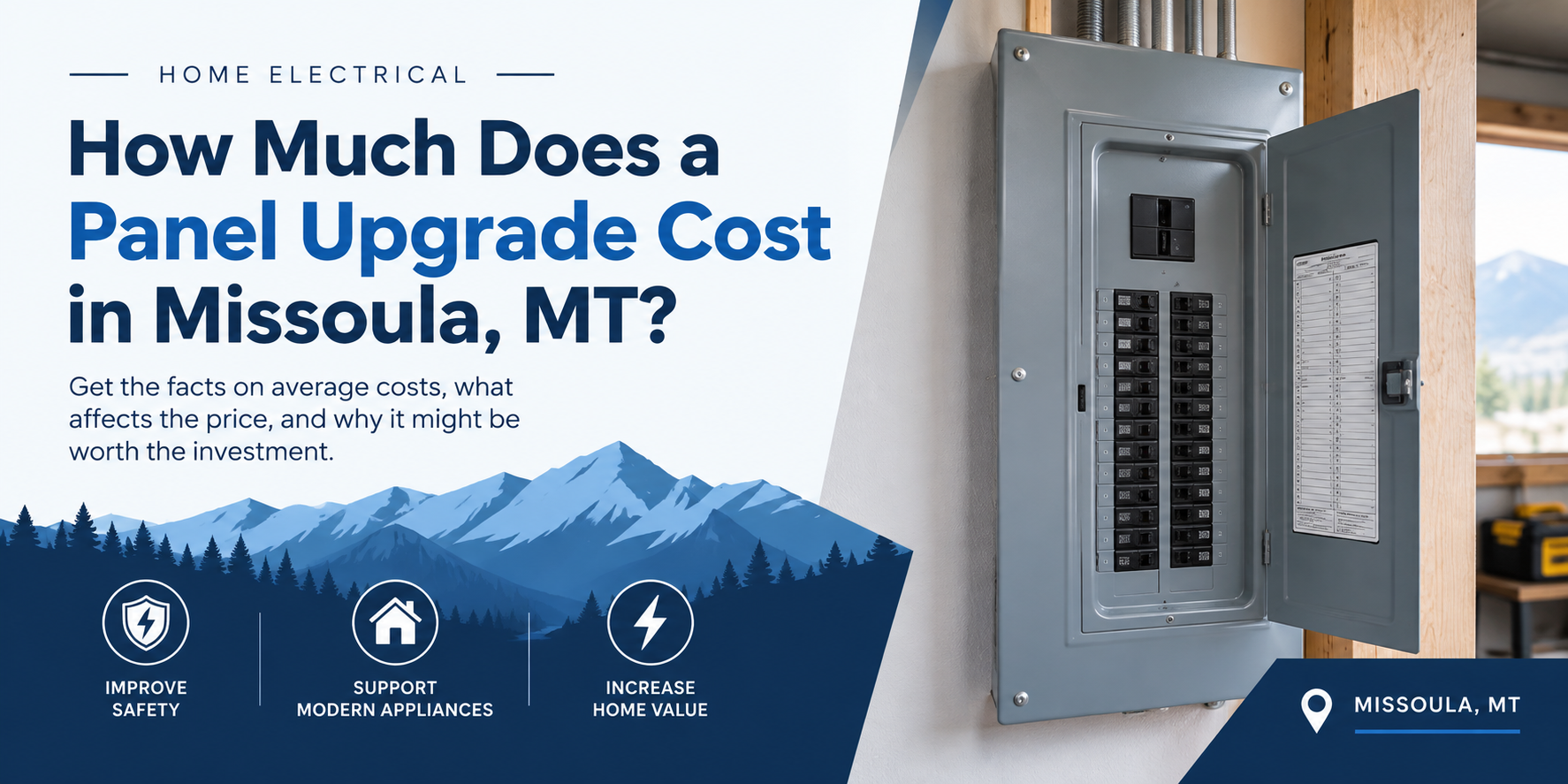
If your electrician just told you that your home needs a new “panel,” you probably have one question: what is this going to cost? The honest answer is that a panel upgrade cost in Missoula, MT usually falls between about $2,000 and $6,500 for a typical house, with most standard 200-amp panel upgrades landing around $2,500 to $5,500. Older homes, extra service equipment, and utility work can push that number higher.
That range is wide because “panel upgrade” describes very different jobs. Swapping a worn-out breaker box for a new one of the same size is a small project. Replacing the meter base, service mast, and panel so your house can safely handle a heat pump, an EV charger, and a hot tub is a much bigger one. This guide explains what electrical panel replacement and electrical service upgrade projects cost, why prices vary across Missoula and the Bitterroot Valley, and how to get a quote you can trust.
Marrow Electric is a family-owned electrical contractor serving Missoula and the Bitterroot Valley, led by master electrician T.J. Marrow. Every number below is a planning estimate, not a bid, so ask for a written estimate before any work begins.
Quick answer: A typical electrical panel upgrade in Missoula, MT costs about $2,000 to $6,500. A same-size panel swap often runs $1,500 to $3,000, a 200-amp upgrade with new service equipment runs about $2,500 to $5,500 or more, and a 400-amp service costs $5,000 to $12,000. Your price depends on the service equipment, utility coordination, permits, panel location, and the condition of your existing wiring. Learn more about panel upgrades.
Panel Upgrade Cost in Missoula at a Glance
Before we get into the details, here is a simple snapshot of what homeowners in western Montana can expect to budget for the most common panel projects. These ranges cover labor, the panel and breakers, and typical small materials. Permit fees and any utility charges are sometimes listed separately, so ask what your quote includes. If you want to see how Marrow Electric approaches these jobs, our electrical service and panel upgrade page is a good place to start.
What Is an Electrical Panel Upgrade?
Your electrical panel, sometimes called a breaker box or service panel, is the control center of your home’s electrical system. Power enters through the meter, passes through the main breaker, and is divided into circuits for lights, outlets, appliances, and equipment. An upgrade changes some or all of that equipment so it can carry more power, work more safely, or meet current code. Our electrical repair and troubleshooting team sees the difference between these two project types almost every week.
Electrical panel replacement cost in Missoula
A panel replacement swaps the panel itself, and often the breakers, without changing the size of your service. Homeowners choose this when the panel is damaged, corroded, overheating, or from a brand with a poor safety record. It is the least expensive option because the meter, service wires, and utility connection generally stay in place. It still requires a permit, a shutoff of power, and a careful inspection of the wiring that connects to the new panel, so it is not a casual weekend fix. You can read more about why circuit protection matters in our GFCI vs. AFCI breaker guide.
Electrical service upgrade cost in Missoula
A service upgrade increases the amperage coming into the house, for example from 100 amps to 200 amps. That usually means a new panel plus a new meter base, service conductors, mast or conduit, grounding equipment, and coordination with the utility. Because more components and more people are involved, a service upgrade costs more than a simple panel swap. In Missoula, the utility work is coordinated with NorthWestern Energy, and we walk through what that looks like on our Montana electrical code and permit guide.
Panel Upgrade Cost by Amperage
Amperage is the biggest single driver of equipment cost, because larger panels, heavier wire, and bigger service equipment all cost more and take longer to install. Here is how each common size breaks down for a typical Missoula-area home. If you are unsure which size fits your house, our licensed electricians can run the numbers during an on-site visit.
100 to 150 amp upgrades: about $1,500 to $3,500
A 100-amp panel is still common in older homes, and it is often enough for a small house with gas heat and modest appliances. Moving to 125 or 150 amps, or simply replacing a worn 100-amp panel, tends to cost less because the utility connection and service wires may not need to change. These projects make sense when the goal is safety and reliability, not adding big new loads. Our team often recommends this option after a troubleshooting visit reveals a damaged panel rather than an overloaded one.
200 amp panel upgrade cost: about $2,500 to $5,500
A 200-amp service is the modern standard for single-family homes, and it is the upgrade most Missoula homeowners ask about. It gives you room for electric ranges, dryers, heat pumps, and an EV charger without constantly tripping the main breaker. Simple jobs with an overhead service and the panel staying in the same spot land near the lower end. Jobs that need a new meter base, a new mast, or longer wire runs move toward the higher end. If your home already shows signs of strain, such as the flickering lights and tripping breakers we cover in a companion guide, a 200-amp upgrade is often the long-term fix.
400 amp service: about $5,000 to $12,000 or more
A 400-amp service is built for large homes, detached shops, and properties with heavy electrical demand. Think multiple EV chargers, electric heat, big well pumps, hot tubs, saunas, or a full solar array. The equipment is more expensive, the labor is more involved, and the utility may have requirements of its own. Most homes do not need this much capacity, so a good electrician will run a load calculation before recommending it. Marrow Electric has wired everything from custom homes to commercial properties, which helps when sizing a service for a large or unusual property.
What Affects the Cost of a Panel Upgrade in Missoula?
Two homes with the same amperage can receive very different quotes. Understanding the variables helps you compare bids fairly and avoid surprises. Here are the factors that matter most in Missoula and the surrounding valleys, and you can always ask us about your specific situation.
Electrical labor is the largest part of most panel quotes. Licensed electricians in western Montana commonly bill somewhere between $100 and $160 per hour, and many charge a service fee that is credited toward the project. A panel change often takes a full day for two people, and more complicated service upgrades can run longer. Paying for a master electrician and a licensed contractor is not just about quality. It also keeps the work inspectable and insurable, which we explain further on our Montana electrical code page.
Service equipment: meter base, mast, and conduit
When you go to a higher amperage, the equipment outside your house may also need to change. The meter base, weatherhead, mast, and conduit are rated for a specific service size, and older components may not meet current standards. In Missoula’s winters, ice and snow can also stress an overhead service mast, so damaged or leaning equipment is worth fixing during the upgrade. This is one of the most common reasons a quote lands above the average, and our electrical service team will point it out during the walkthrough.
Labor and licensing
Utility coordination with NorthWestern Energy
Any upgrade that changes your service size involves the utility. NorthWestern Energy typically needs to disconnect power at the meter before the work and reconnect it after the inspection passes. Your electrician usually handles the scheduling, but timing is not always in our control, and utility-side work such as a line or transformer change can add cost and delay. Ask early whether your project needs anything from the utility. We explain what to expect in our Montana electrical permit and code overview.
Permits and inspections
A panel replacement or service upgrade requires an electrical permit and an inspection. The permit fee itself is usually modest, often well under a couple hundred dollars, but the amount and the process depend on whether your property is inside the city of Missoula or in the county or another jurisdiction. Always ask whether the permit is included in your quote and who pulls it. A licensed contractor should handle it as a standard part of the job, and you can see how we think about compliance on our electrical code guide.
Old and hazardous panels
Homes in Missoula’s older neighborhoods, including the Slant Streets and the University District, often have fuse boxes, knob-and-tube remnants, or panels from brands such as Federal Pacific and Zinsco that are widely regarded as safety concerns. Replacing them can uncover damaged wiring, overcrowded breakers, or aluminum branch circuits that need extra attention. That can increase the scope, but it also removes a real fire risk. If you notice warning signs like flickering lights or breakers that trip, do not wait for the next storm to find out how much your panel can handle.
Overhead vs. underground service
Overhead services are usually simpler and less expensive to upgrade than underground ones. If your home has an underground service and the wire size needs to increase, trenching, conduit, and restoration of landscaping or pavement can add thousands of dollars. Rural properties in the Bitterroot Valley, from Lolo and Florence to Stevensville and Hamilton, are more likely to have longer service runs. That distance affects both price and wire size, and it is one reason we serve the whole Missoula and Bitterroot region with on-site estimates.
Missoula-Specific Things to Know Before You Budget
Missoula has a mix of historic homes, mid-century builds, and new construction, and each type has its own quirks. Older houses often have smaller services, limited panel space, and plaster walls that make new wire runs harder. Newer homes are more likely to have a 200-amp panel already, but they may still need a service upgrade when owners add a heat pump, EV charger, or accessory dwelling unit. Our residential electrical work covers both.
100-Amp vs. 200-Amp Panels: Which Do You Need?
The right size depends on how much power your home actually uses and how much you plan to add. A 100-amp service can be perfectly fine for a small house with gas appliances. A 200-amp service gives you the headroom that modern households need. The decision should be based on a load calculation that adds up your lighting, receptacles, major appliances, heating, and planned additions. Our licensed electricians can run that calculation on-site.
- Consider staying at 100 amps if: your home is small, you use gas for heat, cooking, and hot water, and you do not plan major additions.
- Consider 200 amps if: you have electric heat, a heat pump, an electric range or dryer, or you plan to add an EV charger, hot tub, or workshop.
- Consider 400 amps if: you have a very large home, a detached shop, multiple large loads, or a full solar system with battery storage.
Signs You Need a Panel Upgrade
Many homeowners only think about their panel when something goes wrong. These are the most common warning signs that a panel replacement or service upgrade is due. If you see any of them, it is worth having an electrician take a look, and our electrical troubleshooting page explains how we diagnose them.
- Breakers that trip repeatedly, or lights that flicker or dim when appliances turn on. See our guide to flickering lights and tripping breakers.
- A fuse box, or a panel from Federal Pacific or Zinsco, which are widely considered safety risks.
- Burning smells, buzzing sounds, warm panel doors, rust, or scorch marks around the breakers.
- No open slots for new circuits, or a panel full of double-tapped breakers and “tandem” workarounds.
- Plans to add an EV charger, heat pump, hot tub, sauna, generator, or solar system.
- An insurance company or home inspector flagging your panel during a sale or renewal.
If your panel is hot to the touch, smells like burning, or shows any sign of arcing, treat it as an emergency, turn off nonessential loads, and call an electrician right away. Do not open the panel cover yourself.
Adding an EV Charger, Heat Pump, Hot Tub, or Generator
Some of the most common reasons Missoula homeowners upgrade are new loads. A Level 2 EV charger can draw 40 to 50 amps for hours at a time, a heat pump can add a large continuous load, and a hot tub or sauna is often a dedicated high-amperage circuit. Together they can push an older 100-amp service beyond its limit. Marrow Electric installs EV chargers, generators, and smart home systems and can size the panel for all of them at once.
What Happens During a Panel Upgrade? Step-by-Step Timeline
Knowing what to expect makes the day less stressful. Most residential panel replacements take one day, while full service upgrades can take a day or two plus the time needed for inspection and utility reconnection. Here is what the process typically looks like with a licensed contractor, and you can see our approach to communication on the Marrow Electric home page.
- Evaluation and estimate. Your electrician inspects the panel, service equipment, and wiring, and calculates the electrical load.
- Permit and utility scheduling. The contractor files the permit and schedules any required NorthWestern Energy disconnect.
- Power shutoff. Power is turned off, usually for several hours, while the old panel is removed.
- Installation. The new panel, breakers, grounding, and any new service equipment are installed and every circuit is labeled.
- Inspection. The local inspector checks the work. Corrections, if any, are made right away.
- Reconnection and testing. Power is restored, circuits are tested, and we walk you through the new panel.
Sample Panel Upgrade Costs for Missoula Homes
Real-world examples make the ranges easier to understand. The scenarios below are illustrative estimates, not quotes, and your project could land above or below them. For an exact figure, contact Marrow Electric for an on-site evaluation.
- Replacing a failing panel, same size: A 1970s home with a corroded 100-amp panel and a healthy service. Estimated range: $1,800 to $3,500.
- Standard 200-amp upgrade: A mid-century home moving from 100 to 200 amps with an overhead service and the panel staying put. Estimated range: $3,000 to $5,500.
- Complex upgrade with relocation: An older home that needs a new meter base, a new mast, and a panel moved to the garage to make room for an EV charger and heat pump. Estimated range: $5,500 to $9,000 or more.
How to Get an Accurate Electrical Panel Upgrade Estimate
The best way to avoid a bad surprise is to ask good questions before you sign. A written, itemized estimate should describe the scope, the amperage, the equipment being replaced, the permit, and the utility coordination. Marrow Electric believes in upfront expectations, meaning we discuss scope, timeline, and cost before any work begins.
- Are you a licensed Montana electrical contractor, and is a master electrician overseeing the work?
- Does your price include the permit, inspection, and utility coordination?
- Will the meter base, mast, or grounding need to be replaced?
- What is the expected timeline, and how long will the power be off?
Be cautious of very low bids that skip the permit, leave out service equipment, or are offered without seeing the house. A low number that grows through change orders is not a bargain. If you want a second opinion on an existing quote, our team is happy to review it with you.
Can You Upgrade an Electrical Panel Yourself?
Ways to Save Money on a Panel Upgrade
You cannot cut corners on safety, but you can make the project more efficient. Bundling work is the most effective strategy, because the mobilization, permit, and shutoff are shared across the tasks. Here are practical ways to keep the total down, and our electricians can help you plan them.
- Bundle projects. Combine the panel upgrade with an EV charger, generator hookup, or remodel wiring.
- Clear the area. Make sure the panel and meter are accessible and that there is clear working space.
- Ask about incentives. Some utilities and programs offer rebates for efficient equipment such as heat pumps or EV chargers, so check what is available before you buy.
Commercial Panel Upgrades in Missoula
Business owners face similar questions, with larger equipment and different code requirements. Restaurants, offices, medical spaces, and warehouses often need higher-capacity three-phase service, and tenant improvements frequently trigger panel changes. Marrow Electric’s commercial tenant improvement electrical work covers these projects, and one reviewer called us “the best electrician for business panel upgrades.” Commercial pricing depends heavily on the building, so an on-site evaluation is essential.
Explore More Electrical Guides From Marrow Electric
A panel upgrade is often one piece of a bigger home electrical picture. If you are still deciding what your house needs, these related guides may help. Start with how AFCI and GFCI breakers protect your home, then read our explanation of Montana electrical code and permits, and finally see how flickering lights and tripping breakers can point to a panel that is nearing its limit.
Frequently Asked Questions About Panel Upgrade Costs in Missoula
How much does it cost to upgrade an electrical panel in Missoula, MT?
Most homeowners pay about $2,000 to $6,500. A same-size panel swap can cost $1,500 to $3,000, while a 200-amp upgrade with new service equipment is often $2,500 to $5,500 or more. Get an itemized estimate from a licensed electrician through our electrical service page.
How much does a 200-amp panel upgrade cost?
A 200-amp upgrade typically costs $2,500 to $5,500 for a standard home. It can exceed that if you need a new meter base, mast, underground service, or a relocated panel. Details vary by property, so ask for a written estimate.
How long does a panel upgrade take?
A panel replacement usually takes about one day, and a full service upgrade can take one to two days plus inspection and utility reconnection. Power is normally off for several hours. See the step-by-step process in our upgrade timeline.
Do I need a permit to replace my electrical panel in Montana?
Yes. Panel replacements and service upgrades require an electrical permit and inspection, and a licensed contractor should pull it. Requirements can vary by jurisdiction, which we explain in our Montana electrical code guide.
Does NorthWestern Energy charge for a panel upgrade?
Not always. A simple panel swap may only need a scheduled disconnect and reconnect, but changes to the service, meter, or utility lines can involve fees. Your electrician should tell you early, and you can ask our team about your situation.
What is the difference between a panel replacement and a service upgrade?
A panel replacement swaps the panel at the same amperage. A service upgrade increases capacity and usually involves a new meter base, service wires, and utility coordination, which makes it more expensive. Our troubleshooting and upgrade page explains both.
How do I know if my panel is unsafe?
Warning signs include frequent trips, burning smells, buzzing, rust, scorch marks, a fuse box, or a Federal Pacific or Zinsco panel. If you notice any of these, call an electrician. Learn more about tripping breakers and flickering lights.
Need an Electrician for a Panel Upgrade in Missoula?
A panel upgrade is one of the most valuable improvements you can make to a Missoula home. It improves safety, supports modern appliances, and prepares your property for EV charging, heat pumps, generators, and solar. The cost depends on the size of the service, the equipment involved, and the condition of your existing system, which is why a licensed electrician’s on-site evaluation beats any online estimate.
Marrow Electric provides clear communication, reliable scheduling, and upfront pricing for homeowners and businesses in Missoula, Bonner, Clinton, Frenchtown, Lolo, Florence, Stevensville, Victor, Corvallis, Hamilton, and the rest of the Bitterroot Valley. To get started, request a free estimate or call (406) 360-8071. If your panel is already showing warning signs, contact us today so we can take a look before a small problem becomes a big one.
If your electrician just told you that your home needs a new “panel,” you probably have one question: what is this going to cost? The honest answer is that a panel upgrade cost in Missoula, MT usually falls between about $2,000 and $6,500 for a typical house, with most standard 200-amp panel upgrades landing around $2,500 to $5,500. Older homes, extra service equipment, and utility work can push that number higher.
That range is wide because “panel upgrade” describes very different jobs. Swapping a worn-out breaker box for a new one of the same size is a small project. Replacing the meter base, service mast, and panel so your house can safely handle a heat pump, an EV charger, and a hot tub is a much bigger one. This guide explains what electrical panel replacement and electrical service upgrade projects cost, why prices vary across Missoula and the Bitterroot Valley, and how to get a quote you can trust.
Marrow Electric is a family-owned electrical contractor serving Missoula and the Bitterroot Valley, led by master electrician T.J. Marrow. Every number below is a planning estimate, not a bid, so ask for a written estimate before any work begins.
Quick answer: A typical electrical panel upgrade in Missoula, MT costs about $2,000 to $6,500. A same-size panel swap often runs $1,500 to $3,000, a 200-amp upgrade with new service equipment runs about $2,500 to $5,500 or more, and a 400-amp service costs $5,000 to $12,000. Your price depends on the service equipment, utility coordination, permits, panel location, and the condition of your existing wiring. Learn more about panel upgrades.
Panel Upgrade Cost in Missoula at a Glance
Before we get into the details, here is a simple snapshot of what homeowners in western Montana can expect to budget for the most common panel projects. These ranges cover labor, the panel and breakers, and typical small materials. Permit fees and any utility charges are sometimes listed separately, so ask what your quote includes. If you want to see how Marrow Electric approaches these jobs, our electrical service and panel upgrade page is a good place to start.
Your electrical panel, sometimes called a breaker box or service panel, is the control center of your home’s electrical system. Power enters through the meter, passes through the main breaker, and is divided into circuits for lights, outlets, appliances, and equipment. An upgrade changes some or all of that equipment so it can carry more power, work more safely, or meet current code. Our electrical repair and troubleshooting team sees the difference between these two project types almost every week.
Electrical panel replacement cost in Missoula
A panel replacement swaps the panel itself, and often the breakers, without changing the size of your service. Homeowners choose this when the panel is damaged, corroded, overheating, or from a brand with a poor safety record. It is the least expensive option because the meter, service wires, and utility connection generally stay in place. It still requires a permit, a shutoff of power, and a careful inspection of the wiring that connects to the new panel, so it is not a casual weekend fix. You can read more about why circuit protection matters in our GFCI vs. AFCI breaker guide.
Electrical service upgrade cost in Missoula
A service upgrade increases the amperage coming into the house, for example from 100 amps to 200 amps. That usually means a new panel plus a new meter base, service conductors, mast or conduit, grounding equipment, and coordination with the utility. Because more components and more people are involved, a service upgrade costs more than a simple panel swap. In Missoula, the utility work is coordinated with NorthWestern Energy, and we walk through what that looks like on our Montana electrical code and permit guide.
Panel Upgrade Cost by Amperage
Amperage is the biggest single driver of equipment cost, because larger panels, heavier wire, and bigger service equipment all cost more and take longer to install. Here is how each common size breaks down for a typical Missoula-area home. If you are unsure which size fits your house, our licensed electricians can run the numbers during an on-site visit.
100 to 150 amp upgrades: about $1,500 to $3,500
A 100-amp panel is still common in older homes, and it is often enough for a small house with gas heat and modest appliances. Moving to 125 or 150 amps, or simply replacing a worn 100-amp panel, tends to cost less because the utility connection and service wires may not need to change. These projects make sense when the goal is safety and reliability, not adding big new loads. Our team often recommends this option after a troubleshooting visit reveals a damaged panel rather than an overloaded one.
200 amp panel upgrade cost: about $2,500 to $5,500
A 200-amp service is the modern standard for single-family homes, and it is the upgrade most Missoula homeowners ask about. It gives you room for electric ranges, dryers, heat pumps, and an EV charger without constantly tripping the main breaker. Simple jobs with an overhead service and the panel staying in the same spot land near the lower end. Jobs that need a new meter base, a new mast, or longer wire runs move toward the higher end. If your home already shows signs of strain, such as the flickering lights and tripping breakers we cover in a companion guide, a 200-amp upgrade is often the long-term fix.
400 amp service: about $5,000 to $12,000 or more
A 400-amp service is built for large homes, detached shops, and properties with heavy electrical demand. Think multiple EV chargers, electric heat, big well pumps, hot tubs, saunas, or a full solar array. The equipment is more expensive, the labor is more involved, and the utility may have requirements of its own. Most homes do not need this much capacity, so a good electrician will run a load calculation before recommending it. Marrow Electric has wired everything from custom homes to commercial properties, which helps when sizing a service for a large or unusual property.
What Affects the Cost of a Panel Upgrade in Missoula?
Two homes with the same amperage can receive very different quotes. Understanding the variables helps you compare bids fairly and avoid surprises. Here are the factors that matter most in Missoula and the surrounding valleys, and you can always ask us about your specific situation.
Labor and licensing
Electrical labor is the largest part of most panel quotes. Licensed electricians in western Montana commonly bill somewhere between $100 and $160 per hour, and many charge a service fee that is credited toward the project. A panel change often takes a full day for two people, and more complicated service upgrades can run longer. Paying for a master electrician and a licensed contractor is not just about quality. It also keeps the work inspectable and insurable, which we explain further on our Montana electrical code page.
Service equipment: meter base, mast, and conduit
When you go to a higher amperage, the equipment outside your house may also need to change. The meter base, weatherhead, mast, and conduit are rated for a specific service size, and older components may not meet current standards. In Missoula’s winters, ice and snow can also stress an overhead service mast, so damaged or leaning equipment is worth fixing during the upgrade. This is one of the most common reasons a quote lands above the average, and our electrical service team will point it out during the walkthrough.
Utility coordination with NorthWestern Energy
Any upgrade that changes your service size involves the utility. NorthWestern Energy typically needs to disconnect power at the meter before the work and reconnect it after the inspection passes. Your electrician usually handles the scheduling, but timing is not always in our control, and utility-side work such as a line or transformer change can add cost and delay. Ask early whether your project needs anything from the utility. We explain what to expect in our Montana electrical permit and code overview.
Permits and inspections
A panel replacement or service upgrade requires an electrical permit and an inspection. The permit fee itself is usually modest, often well under a couple hundred dollars, but the amount and the process depend on whether your property is inside the city of Missoula or in the county or another jurisdiction. Always ask whether the permit is included in your quote and who pulls it. A licensed contractor should handle it as a standard part of the job, and you can see how we think about compliance on our electrical code guide.
Old and hazardous panels
Homes in Missoula’s older neighborhoods, including the Slant Streets and the University District, often have fuse boxes, knob-and-tube remnants, or panels from brands such as Federal Pacific and Zinsco that are widely regarded as safety concerns. Replacing them can uncover damaged wiring, overcrowded breakers, or aluminum branch circuits that need extra attention. That can increase the scope, but it also removes a real fire risk. If you notice warning signs like flickering lights or breakers that trip, do not wait for the next storm to find out how much your panel can handle.
Overhead vs. underground service
Overhead services are usually simpler and less expensive to upgrade than underground ones. If your home has an underground service and the wire size needs to increase, trenching, conduit, and restoration of landscaping or pavement can add thousands of dollars. Rural properties in the Bitterroot Valley, from Lolo and Florence to Stevensville and Hamilton, are more likely to have longer service runs. That distance affects both price and wire size, and it is one reason we serve the whole Missoula and Bitterroot region with on-site estimates.
Missoula-Specific Things to Know Before You Budget
Missoula has a mix of historic homes, mid-century builds, and new construction, and each type has its own quirks. Older houses often have smaller services, limited panel space, and plaster walls that make new wire runs harder. Newer homes are more likely to have a 200-amp panel already, but they may still need a service upgrade when owners add a heat pump, EV charger, or accessory dwelling unit. Our residential electrical work covers both.
100-Amp vs. 200-Amp Panels: Which Do You Need?
The right size depends on how much power your home actually uses and how much you plan to add. A 100-amp service can be perfectly fine for a small house with gas appliances. A 200-amp service gives you the headroom that modern households need. The decision should be based on a load calculation that adds up your lighting, receptacles, major appliances, heating, and planned additions. Our licensed electricians can run that calculation on-site.
- Consider staying at 100 amps if: your home is small, you use gas for heat, cooking, and hot water, and you do not plan major additions.
- Consider 200 amps if: you have electric heat, a heat pump, an electric range or dryer, or you plan to add an EV charger, hot tub, or workshop.
- Consider 400 amps if: you have a very large home, a detached shop, multiple large loads, or a full solar system with battery storage.
Signs You Need a Panel Upgrade
Many homeowners only think about their panel when something goes wrong. These are the most common warning signs that a panel replacement or service upgrade is due. If you see any of them, it is worth having an electrician take a look, and our electrical troubleshooting page explains how we diagnose them.
- Breakers that trip repeatedly, or lights that flicker or dim when appliances turn on. See our guide to flickering lights and tripping breakers.
- A fuse box, or a panel from Federal Pacific or Zinsco, which are widely considered safety risks.
- Burning smells, buzzing sounds, warm panel doors, rust, or scorch marks around the breakers.
- No open slots for new circuits, or a panel full of double-tapped breakers and “tandem” workarounds.
- Plans to add an EV charger, heat pump, hot tub, sauna, generator, or solar system.
- An insurance company or home inspector flagging your panel during a sale or renewal.
If your panel is hot to the touch, smells like burning, or shows any sign of arcing, treat it as an emergency, turn off nonessential loads, and call an electrician right away. Do not open the panel cover yourself.
Adding an EV Charger, Heat Pump, Hot Tub, or Generator
Some of the most common reasons Missoula homeowners upgrade are new loads. A Level 2 EV charger can draw 40 to 50 amps for hours at a time, a heat pump can add a large continuous load, and a hot tub or sauna is often a dedicated high-amperage circuit. Together they can push an older 100-amp service beyond its limit. Marrow Electric installs EV chargers, generators, and smart home systems and can size the panel for all of them at once.
What Happens During a Panel Upgrade? Step-by-Step Timeline
Knowing what to expect makes the day less stressful. Most residential panel replacements take one day, while full service upgrades can take a day or two plus the time needed for inspection and utility reconnection. Here is what the process typically looks like with a licensed contractor, and you can see our approach to communication on the Marrow Electric home page.
- Evaluation and estimate. Your electrician inspects the panel, service equipment, and wiring, and calculates the electrical load.
- Permit and utility scheduling. The contractor files the permit and schedules any required NorthWestern Energy disconnect.
- Power shutoff. Power is turned off, usually for several hours, while the old panel is removed.
- Installation. The new panel, breakers, grounding, and any new service equipment are installed and every circuit is labeled.
- Inspection. The local inspector checks the work. Corrections, if any, are made right away.
- Reconnection and testing. Power is restored, circuits are tested, and we walk you through the new panel.
Sample Panel Upgrade Costs for Missoula Homes
Real-world examples make the ranges easier to understand. The scenarios below are illustrative estimates, not quotes, and your project could land above or below them. For an exact figure, contact Marrow Electric for an on-site evaluation.
- Replacing a failing panel, same size: A 1970s home with a corroded 100-amp panel and a healthy service. Estimated range: $1,800 to $3,500.
- Standard 200-amp upgrade: A mid-century home moving from 100 to 200 amps with an overhead service and the panel staying put. Estimated range: $3,000 to $5,500.
- Complex upgrade with relocation: An older home that needs a new meter base, a new mast, and a panel moved to the garage to make room for an EV charger and heat pump. Estimated range: $5,500 to $9,000 or more.
How to Get an Accurate Electrical Panel Upgrade Estimate
The best way to avoid a bad surprise is to ask good questions before you sign. A written, itemized estimate should describe the scope, the amperage, the equipment being replaced, the permit, and the utility coordination. Marrow Electric believes in upfront expectations, meaning we discuss scope, timeline, and cost before any work begins.
- Are you a licensed Montana electrical contractor, and is a master electrician overseeing the work?
- Does your price include the permit, inspection, and utility coordination?
- Will the meter base, mast, or grounding need to be replaced?
- What is the expected timeline, and how long will the power be off?
Be cautious of very low bids that skip the permit, leave out service equipment, or are offered without seeing the house. A low number that grows through change orders is not a bargain. If you want a second opinion on an existing quote, our team is happy to review it with you.
Can You Upgrade an Electrical Panel Yourself?
Ways to Save Money on a Panel Upgrade
You cannot cut corners on safety, but you can make the project more efficient. Bundling work is the most effective strategy, because the mobilization, permit, and shutoff are shared across the tasks. Here are practical ways to keep the total down, and our electricians can help you plan them.
- Bundle projects. Combine the panel upgrade with an EV charger, generator hookup, or remodel wiring.
- Clear the area. Make sure the panel and meter are accessible and that there is clear working space.
- Ask about incentives. Some utilities and programs offer rebates for efficient equipment such as heat pumps or EV chargers, so check what is available before you buy.
Commercial Panel Upgrades in Missoula
Business owners face similar questions, with larger equipment and different code requirements. Restaurants, offices, medical spaces, and warehouses often need higher-capacity three-phase service, and tenant improvements frequently trigger panel changes. Marrow Electric’s commercial tenant improvement electrical work covers these projects, and one reviewer called us “the best electrician for business panel upgrades.” Commercial pricing depends heavily on the building, so an on-site evaluation is essential.
Explore More Electrical Guides From Marrow Electric
A panel upgrade is often one piece of a bigger home electrical picture. If you are still deciding what your house needs, these related guides may help. Start with how AFCI and GFCI breakers protect your home, then read our explanation of Montana electrical code and permits, and finally see how flickering lights and tripping breakers can point to a panel that is nearing its limit.
Frequently Asked Questions About Panel Upgrade Costs in Missoula
How much does it cost to upgrade an electrical panel in Missoula, MT?
Most homeowners pay about $2,000 to $6,500. A same-size panel swap can cost $1,500 to $3,000, while a 200-amp upgrade with new service equipment is often $2,500 to $5,500 or more. Get an itemized estimate from a licensed electrician through our electrical service page.
How much does a 200-amp panel upgrade cost?
A 200-amp upgrade typically costs $2,500 to $5,500 for a standard home. It can exceed that if you need a new meter base, mast, underground service, or a relocated panel. Details vary by property, so ask for a written estimate.
How long does a panel upgrade take?
A panel replacement usually takes about one day, and a full service upgrade can take one to two days plus inspection and utility reconnection. Power is normally off for several hours. See the step-by-step process in our upgrade timeline.
Do I need a permit to replace my electrical panel in Montana?
Yes. Panel replacements and service upgrades require an electrical permit and inspection, and a licensed contractor should pull it. Requirements can vary by jurisdiction, which we explain in our Montana electrical code guide.
Does NorthWestern Energy charge for a panel upgrade?
Not always. A simple panel swap may only need a scheduled disconnect and reconnect, but changes to the service, meter, or utility lines can involve fees. Your electrician should tell you early, and you can ask our team about your situation.
What is the difference between a panel replacement and a service upgrade?
A panel replacement swaps the panel at the same amperage. A service upgrade increases capacity and usually involves a new meter base, service wires, and utility coordination, which makes it more expensive. Our troubleshooting and upgrade page explains both.
How do I know if my panel is unsafe?
Warning signs include frequent trips, burning smells, buzzing, rust, scorch marks, a fuse box, or a Federal Pacific or Zinsco panel. If you notice any of these, call an electrician. Learn more about tripping breakers and flickering lights.
Need an Electrician for a Panel Upgrade in Missoula?
A panel upgrade is one of the most valuable improvements you can make to a Missoula home. It improves safety, supports modern appliances, and prepares your property for EV charging, heat pumps, generators, and solar. The cost depends on the size of the service, the equipment involved, and the condition of your existing system, which is why a licensed electrician’s on-site evaluation beats any online estimate.
Marrow Electric provides clear communication, reliable scheduling, and upfront pricing for homeowners and businesses in Missoula, Bonner, Clinton, Frenchtown, Lolo, Florence, Stevensville, Victor, Corvallis, Hamilton, and the rest of the Bitterroot Valley. To get started, request a free estimate or call (406) 360-8071. If your panel is already showing warning signs, contact us today so we can take a look before a small problem becomes a big one.