
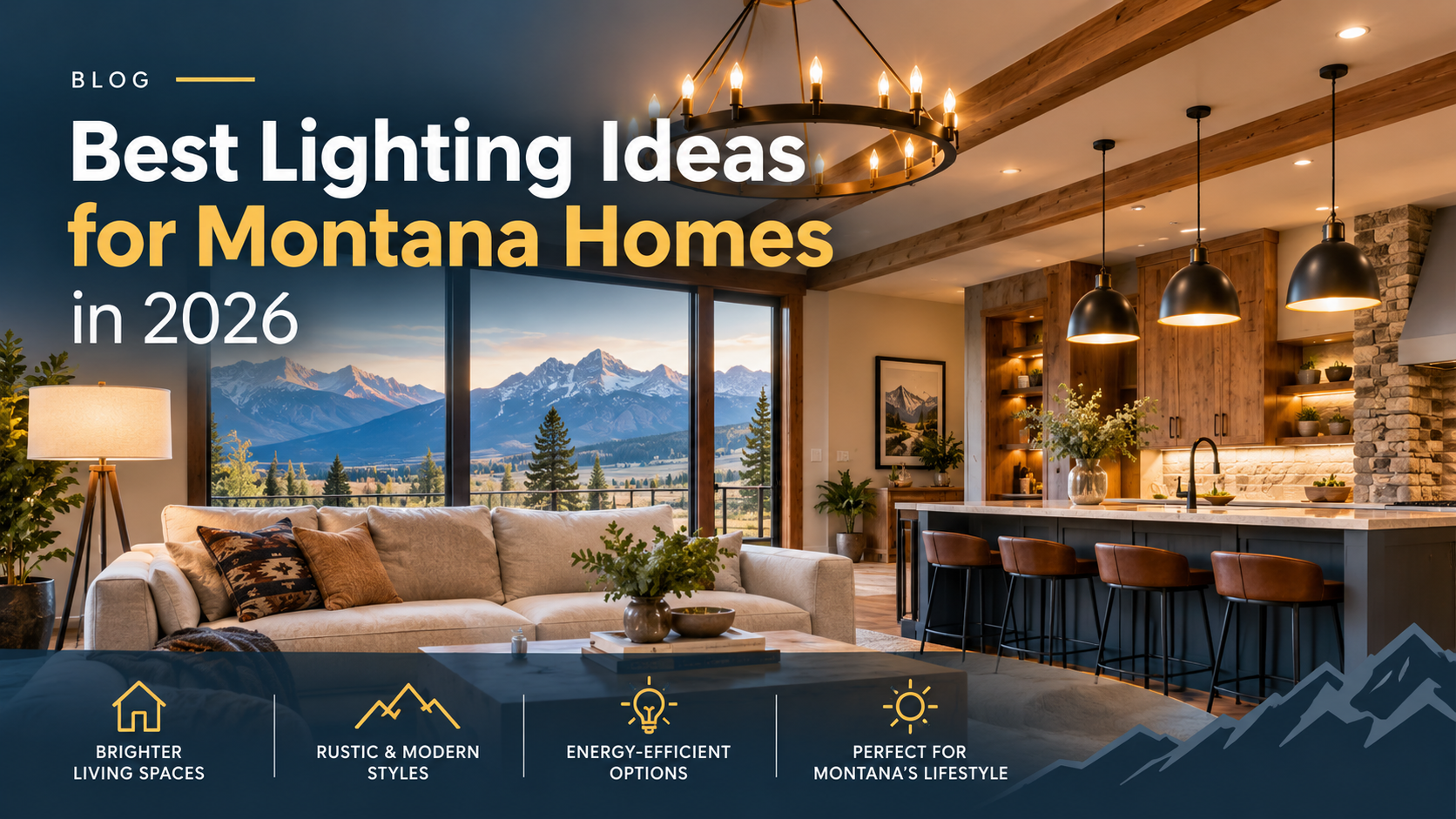
Montana winters are long, dark and beautiful, and the right lighting is what makes a home feel warm through all of it. In Missoula and the Bitterroot Valley, the sun can set before 5 p.m. for months, so your fixtures carry more of the daily load than they would in a sunnier state. This guide covers the best lighting ideas for Montana homes in 2026, from cozy layered interiors to safe, snow-ready outdoor lighting, written from the point of view of a licensed local electrician at Marrow Electric.
Quick answer: The best lighting ideas for Montana homes in 2026 combine warm, layered light (floor lamps, sconces and dimmable overheads), organic nature-inspired fixtures, mixed metal finishes like brushed brass and matte black, and weatherproof LED lighting for decks, stairs and landscapes. Use warm white bulbs around 2700K, put everything on dimmers, and have a licensed electrician handle any new wiring.
Below you will find practical ideas room by room, plus honest guidance on what you can safely do yourself and when to call a pro. If you are planning a larger project, our lighting installation services cover both indoor and outdoor work across western Montana.
Why Montana Homes Need a Different Lighting Plan
A lighting plan that works in Phoenix or Miami will not necessarily work here. Short winter days mean you rely on artificial light for the early morning and long evening hours, and that makes color temperature and layering far more important. Cold white light at 4000K or higher can feel harsh and clinical against timber, stone and snow-reflected darkness, while warm light around 2700K feels like a fire in the hearth.
Montana homes also tend to have features that challenge basic lighting: vaulted great rooms, exposed beams, log or tongue-and-groove walls that absorb light, big windows that turn into black mirrors at night, and detached garages, barns or shops. Each of these needs a specific approach, and an experienced electrician for troubleshooting and service calls can tell you quickly what your existing wiring will support before you buy a single fixture.
2026 Lighting Trends at a Glance
Designers and lighting brands are pointing in a surprisingly consistent direction for 2026, and it suits mountain homes well. The big movements are softer, layered light instead of one bright ceiling source, organic and biomorphic fixture shapes, warm mixed metals, sculptural statement pieces, and subtle low-level LED accents. If you want to see how these trends translate into real installs, our lighting installation guide for Florence, MT is a good companion read.
1. Build Layered Lighting for a Cozy Cabin Glow
The single best upgrade you can make is moving from one bright overhead light to three layers: ambient, task and accent. Ambient light fills the room softly, task light helps you read, cook or work, and accent light adds depth by washing a stone fireplace, a beam or a piece of art. Together they create the cabin-chic glow that defines mountain living.
In practice, that means pairing sculptural floor lamps and fabric-shaded wall sconces with a dimmable ceiling source and a few indirect LED strips tucked into coves or behind trim. Fabric shades diffuse the light and keep it warm, which works especially well against wood walls. If your room has few outlets or no wall switch for lamps, a qualified electrician can add switched outlets or new sconce circuits so the plan actually works day to day.
2. Kitchen Lighting Ideas for Mountain Homes
Kitchens are where layered lighting matters most, because they are both workspaces and gathering places. Searches for kitchen lighting ideas keep climbing, and the 2026 answer is a blend of practical and beautiful: under-cabinet LED strips for countertop tasks, statement pendants over the island, and a gentle ambient layer from dimmable ceiling lights.
Pendants and islands
Choose two or three pendants in warm brass, aged bronze or matte black, spaced evenly over the island and hung roughly 30 to 36 inches above the counter. Organic shapes such as seeded glass, woven textures and pod forms soften the hard lines of cabinetry. Make sure they are on a dimmer, and if you are changing the island layout, an electrician can move the junction boxes to match. Our electrical safety checklist is worth a skim before you cut into ceilings or walls.
Under-cabinet and toe-kick lighting
Under-cabinet LED tape or bars remove the shadows your own body casts while you chop and cook. Add a low toe-kick strip for a gentle night light that means you never need to flip on the full kitchen at 3 a.m. Quality matters here: cheap strips can flicker or fail early, and persistent flicker can also point to wiring problems, which we explain in our guide to flickering lights and tripping breakers.
If you are remodeling, plan for the load too. Modern kitchens add induction ranges, wall ovens and more, and a lighting upgrade is a good moment to check whether you need a dedicated circuit for a major appliance.
3. Can Light Ideas: Doing Recessed Lighting Right
Recessed can lights have a bad reputation lately, and for good reason: too many, spaced in a grid, at cool color temperatures, they create a flat, interrogation-room feel. But used with intention, cans are still one of the most useful tools in the box. The 2026 approach is fewer cans, aimed deliberately, and always dimmable.
Use cans as accent and wall-wash lighting rather than the main source. Place them to graze a stone wall or highlight artwork, to light a hallway evenly, or to supply task light over a sink or desk. In vaulted ceilings, use sloped-ceiling housings and adjustable gimbal trims so the beam points where you need it. Leave the heavy lifting to lamps and sconces, then let the cans fill gaps. A licensed lighting installer can lay these out on a plan before anyone cuts drywall.
Insulation matters in Montana. If cans penetrate an insulated attic or vaulted ceiling, use IC-rated, airtight housings so you do not create a heat leak or a fire hazard. Airtight LED cans also reduce the warm indoor air that escapes in January, which saves energy. For related guidance on whether your wiring is up to the job, see our home electrical inspection checklist.
4. Can Light Replacement Ideas That Actually Improve a Room
If your home already has dozens of old can lights, you do not need to rip everything out. Can light replacement is one of the most cost-effective upgrades in a Montana home, and there are three common routes.
- LED retrofit trims: These screw into your existing housing and swap out old incandescent or halogen bulbs. They run cooler, last far longer and are usually dimmable. This is the fastest way to cut your energy use.
- Slim wafer lights: Ultra-thin LED discs that install with a junction box and no deep housing. They are ideal for remodels, low-clearance ceilings and replacing damaged cans.
- Pendant or flush-mount conversions: Remove a can and replace it with a decorative fixture, using a conversion adapter or a new box. This is great for dining rooms and entries where you want character, not just light.
Before you retrofit, check whether the old cans are IC-rated and whether they are rated for the insulation around them. Older housings in Montana homes built in the 1980s and 1990s may have aging wiring or brittle insulation near the junction box. If you find scorched wires, buzzing dimmers or lights that cut out, stop and have it checked, because warning signs in your home’s wiring should be dealt with before any cosmetic upgrade.
5. Biomorphic and Nature-Inspired Fixtures
One of the strongest 2026 trends is biomorphic design: undulating, pod-like and organic shapes that echo pine cones, seed pods, river stones and water ripples. It is a natural fit for Montana, where homes already borrow from the landscape. Think rippled glass pendants, woven or rattan shades, and sculptural forms that look like they grew rather than were manufactured.
These fixtures work best as a focal point rather than a set. A single organic pendant over a dining table, or a trio at varying heights over an island, is more effective than repeating the same shape everywhere. They also pair beautifully with natural materials such as reclaimed wood, live-edge tables and stone. Because many are larger and heavier than standard fixtures, make sure the electrical box and ceiling framing are rated to support the weight, which is a job for a professional installer.
6. Mixed Metals and Durable Finishes
Matching every fixture to a single finish is going out of style. In 2026 the look is mixed metals: warm brass or aged bronze alongside soft matte black, sometimes with natural wood or glass. The contrast adds depth without feeling fussy, and it makes a mountain home feel collected over time instead of ordered from one catalog page.
A simple rule keeps it balanced: choose one dominant metal, one secondary metal and one accent. For example, matte black as the main finish on window frames and cabinet hardware, brushed brass on pendants and sconces, and a touch of bronze in a faucet or lamp base. Lighting finishes should echo the hardware elsewhere in the room, which is easier to coordinate when you plan your fixtures before the electrical rough-in.
7. Statement Chandeliers for Vaulted Entries and Great Rooms
High ceilings are a Montana signature, and they need a statement. An oversized, sculptural chandelier acts as art even when the lights are off, and it gives a tall room a human-scale focal point. Antler-inspired forms, forged iron rings, layered glass and wood-and-metal combinations are all popular for 2026, but the best choice is the one proportioned to your space.
A common rule: add the room’s length and width in feet, and use that number in inches as a rough chandelier diameter. In a two-story entry, hang the bottom of the fixture so that it clears sight lines on the stairs and landing. Installation is the tricky part. Tall ceilings mean ladder or lift work, heavy fixtures need proper blocking, and you may want a winch or lowering system so the fixture can be lowered for bulb changes. This is exactly the kind of job to hand to an experienced electrician rather than attempt alone.
8. Stair and Wayfinding Lighting for Dark Winters
When it is dark by late afternoon and still dark at 7 a.m., safe movement through the house becomes a real concern. Low-level wayfinding lighting is one of the most practical ideas on this list. Slim LED strips under stair treads, along baseboards, or beneath floating vanities guide your steps without waking anyone or flooding the room with light.
9. Deck Lighting Ideas for Montana Evenings
Montana summers are short and precious, so a deck that is usable after dark is worth the investment. Deck lighting ideas range from simple to dramatic, but the best designs are subtle: you want to see the steps and the view, not light up the entire neighborhood.
- Step and riser lights: Small recessed LEDs on stair risers make steps safe and visually define the deck’s shape.
- Post cap lights: Solar or low-voltage caps on railing posts add a soft perimeter glow.
- Under-rail strip lighting: A hidden LED strip beneath the handrail washes the deck surface with gentle, glare-free light.
- Overhead string or pendant lighting: Weatherproof string lights or outdoor-rated pendants over a dining area create an inviting gathering spot.
Use fixtures rated for wet locations, with gaskets and corrosion-resistant hardware, and plan for snow load and ice on exposed strands. Low-voltage systems are easier and safer to install, but they still need a properly protected power source. Deck outlets and transformers should be GFCI protected, and any new circuit should follow code, which is why many homeowners bring in a licensed electrician for deck and outdoor wiring. If you are also adding a spa to the deck, read our guide to hot tub electrical installation to plan power for both at once.
10. Landscape Lighting Ideas for Snow, Trees and Driveways
Good landscape lighting does three jobs: it keeps people safe, it deters trouble, and it shows off the property. In Montana, add a fourth job: working reliably through snow and deep cold. Landscape lighting ideas that suit the region include path lights along walkways, uplights on mature pines and aspens, wall washes on stone or timber, and downlighting from eaves or trees that mimics moonlight.
Driveways and entrances deserve special attention. Illuminated house numbers, motion-activated lights at the garage and a lit path from the car to the front door make arriving home on a dark January evening far safer. For rural properties with longer runs, voltage drop and trenching depth matter, so it is smart to talk with an electrician about the layout before you buy a kit. And if winter storms regularly knock out power at your place, consider pairing outdoor lighting with a standby generator installation so your exterior lights, and your whole home, stay on.
11. Do It Yourself Lighting Ideas: What Is Safe and What Is Not
Many homeowners love a project, and there are plenty of do it yourself lighting ideas that are genuinely safe and satisfying. Plug-in sconces, battery or rechargeable picture lights, plug-in LED strips, lamp shade upgrades, and swapping a bulb for a warmer color temperature all need no wiring at all. Replacing an existing fixture with a similar one is also popular, as long as you do it carefully.
If you do replace a fixture, always switch off the circuit at the breaker, not just the wall switch, and confirm the power is off with a non-contact voltage tester. Make sure the electrical box is secure and rated for the weight of the new fixture, match wire connections correctly, and never exceed the fixture’s wattage rating. Our home electrical safety guide lists the red flags that mean it is time to stop and call someone.
Here is where DIY should end: adding new circuits, running cable inside walls, cutting in new recessed lights, installing exterior lighting wiring, working near the main panel, or anything involving aluminum wiring, knob-and-tube or an overloaded panel. Mistakes in these areas can cause fires and shocks, and they can void your homeowner’s insurance. Permits and inspections are often required too. When you are unsure, a short visit from a licensed electrician costs far less than a repair.
12. Smart Dimming and Controls
Smart controls turn a good lighting plan into a great one. Smart dimmer switches, scenes and schedules let you shift an entire house from bright morning mode to a warm evening glow with one tap. Circadian-style settings that gradually warm the light at night are particularly helpful in Montana winters, when so much of the day is spent under artificial light.
The best approach is to choose controls at the same time as fixtures. Not every LED bulb or fixture dims smoothly on every dimmer, and a mismatch causes buzzing, flicker or limited range. Use dimmers rated for LED loads, and confirm that your wiring has a neutral conductor at the switch box if your smart switches need one, since many older homes do not. If you are not sure, it is worth having an electrician evaluate your switch boxes before you purchase a whole-house set.
Planning Your Project: Budget, Power and Permits
Before you buy anything, walk through the house at night and note where you struggle with light. Decide what you want to change first, set a budget for fixtures and labor separately, and ask an electrician what your wiring can handle. Costs vary widely depending on the type of fixture, ceiling height, access, and whether new wiring is needed, so always get a written quote after a site visit.
Power capacity is the part people forget. LED lighting uses little energy, but a major renovation that adds lighting, appliances, a hot tub or an EV charger can push an older service to its limit. If your panel is original to a 1970s or 1980s house, it may be worth reviewing what a panel upgrade costs in Missoula while you are planning. Doing it all at once is usually cheaper than opening walls twice.
Lighting Ideas by Room: A Quick Reference
Related Guides From Marrow Electric
Lighting rarely stands alone. These related guides cover the electrical topics homeowners most often run into while upgrading their space:
- Lighting Installation in Florence, MT: Indoor and Outdoor Guide
- Home Electrical Safety in Florence, MT: 12 Problems to Check
- Flickering Lights and Tripping Breakers: Common Electrical Problems Explained
- How Much Does a Panel Upgrade Cost in Missoula, MT?
- Do You Need a Dedicated Circuit? 10 Appliances That May Need One
- Hot Tub Electrical Installation in Missoula and the Bitterroot Valley
- Generator Installation in Florence, MT: Homeowner’s Guide
Frequently Asked Questions
What is the best lighting idea for Montana homes in 2026?
The best idea is layered, warm lighting: combine floor lamps, fabric-shaded sconces and dimmable overhead lights at about 2700K, then add one organic or sculptural focal fixture. This counters long, dark winters and gives a cozy cabin feel. Pair it with weatherproof LEDs outdoors for safety. Our lighting installation team can plan it for you.
What color temperature is best for a Montana home?
Warm white around 2700K suits most living spaces, bedrooms and outdoor areas, and 3000K works well in kitchens and bathrooms. Avoid mixing temperatures within the same room, and put lights on dimmers so you can fine-tune the mood. Cool white above 4000K usually feels harsh in wood-heavy mountain homes.
What are good kitchen lighting ideas for a mountain home?
Use three layers: under-cabinet LED strips for tasks, two or three warm-metal or organic pendants over the island, and dimmable ambient ceiling lights. Add a toe-kick strip for night use. Keep all fixtures on one color temperature for a consistent look, and review your kitchen circuits and wiring before remodeling.
Are recessed can lights still in style in 2026?
Yes, but used sparingly. Designers now favor fewer, well-aimed cans for wall washing and task lighting, combined with lamps, sconces and pendants for ambient glow. Choose dimmable, airtight, IC-rated LED cans, especially in insulated ceilings, and avoid evenly spaced grids that flatten a room.
How do I replace old can lights with LEDs?
The easiest option is an LED retrofit trim that screws into your existing housing. Slim wafer lights are another option for remodels. Always turn off power at the breaker, check the housing is IC-rated where insulation touches it, and consider hiring an electrician if you see damaged wiring. See our electrical safety checklist for warning signs.
What deck lighting works best in cold, snowy climates?
Choose wet-location rated, corrosion-resistant LED fixtures such as recessed step lights, post cap lights and under-rail strips, powered by a GFCI-protected low-voltage system. Mount them where snow and ice will not bury them. Weatherproofing and proper wiring are key, so have a licensed electrician install outdoor circuits.
Can I install landscape or outdoor lighting myself?
Plug-in or solar path lights are fine for DIY, but any hardwired exterior lighting, buried cable, new outdoor outlets or transformer connections should be handled by a licensed electrician. This ensures proper depth, GFCI protection and permits where required. It also protects your insurance coverage.
When should I call an electrician instead of doing lighting projects myself?
Call a pro for new circuits, in-wall wiring, new recessed lights, panel work, outdoor wiring, or whenever you see flickering, buzzing, warm switches or scorch marks. You can also request an electrician through our contact page, and for urgent issues use our emergency electrician service.
Ready to Light Up Your Montana Home?
Whether you are building, remodeling or simply tired of dark winter evenings, Marrow Electric can help you plan and install lighting that is beautiful, safe and built for Montana conditions. We serve Missoula, the Bitterroot Valley and surrounding communities with licensed, professional work. Contact Marrow Electric today to schedule a visit and get a clear quote, or explore our full range of electrical services.
Need an Electrician?
Reliable electrical service in Stevensville and the Bitterroot Valley.
Call Marrow Electric65 Goose Ln, Stevensville, MT 59870