
Quick Answer: What Is a Tenant Improvement Electrician?
A tenant improvement electrician is a licensed electrical contractor who upgrades a commercial space to meet a new tenant’s needs. Services include checking panel capacity, adding circuits and subpanels, installing lighting and controls, wiring outlets and equipment, obtaining permits, and completing electrical inspections.
- Who does it: A licensed commercial electrical contractor.
- What it covers: Power distribution, lighting, controls, outlets, dedicated equipment circuits, and emergency lighting.
- Who pays: The landlord and tenant, depending on lease terms and any tenant improvement allowance (TIA).
- Typical timeline: Small build-outs may take a few weeks, while larger projects can take longer.
- Best first step: Schedule a site walk-through and panel capacity review before signing the lease.
If you are planning a commercial build-out in Missoula or the Bitterroot Valley, Marrow Electric can assess your space and help determine the electrical work required.
Phone: (406) 360-8071
Business Hours: Monday–Friday, 8:00 AM–5:00 PM
Website: www.marrowelectric.com
What Is Tenant Improvement Electrical Work?
Tenant improvement electrical work is every electrical change made to a leased commercial space so it works for the tenant’s business. The shell may have outlets and a few fluorescent fixtures. A dental clinic, a coffee shop, or a law office needs very different power, lighting, and data.
The work is usually described by what the building looks like when you start:
- Raw shell (cold shell): Bare walls and a slab. The electrician builds almost everything new, from the panel to the last outlet.
- Vanilla shell: Basic finishes and a minimal electrical system. The electrician extends and upgrades it.
- Second-generation space: A previous tenant’s layout is in place. The electrician demolishes, caps, reuses what is safe, and builds what is new.
As a tenant electrician, the job is to make the electrical system match the tenant’s plans, the building’s limits, and the code, all at once.
What Does a Commercial Tenant Improvement Electrician Actually Do?
A commercial tenant improvement electrician handles five core jobs. Each one affects your budget and your opening date.
1. Plan Review and Code Compliance
The electrician works from the architect’s and engineer’s drawings and checks them against the National Electrical Code (NEC) and local requirements. Good contractors flag problems on paper, such as an undersized feeder or a missing dedicated circuit, because changes are cheap before walls close.
2. Power Distribution and Panel Capacity
This is where many projects are won or lost. The electrician verifies whether the existing panel and service can carry the new load. If not, they install new sub-panels, add feeders, or recommend a service upgrade. Kitchen equipment, HVAC units, medical devices, and server racks all demand dedicated circuits. For a deeper look at capacity limits, read our guide on when a business should upgrade its electrical service capacity.
3. Lighting and Lighting Controls
TI lighting is more than hanging fixtures. It includes energy-efficient LED lighting, dimmers, occupancy sensors, emergency lighting, illuminated exit signs, and architectural or accent lighting. Many jurisdictions require lighting controls that meet energy codes.
4. Outlets, Data Drops, and Workstations
The electrician places receptacles, floor boxes, and furniture power feeds, and often runs low-voltage pathways for network cabling, phones, security, and point-of-sale (POS) systems. Planning these with your furniture layout prevents the classic problem of outlets in the wrong place.
5. Permits and Inspections
Commercial work requires permits, and inspections must pass before you can get a certificate of occupancy. A tenant improvement electrical contractor pulls the permit, schedules inspections, and fixes anything an inspector flags. Learn what triggers a permit in our post on what electrical work requires a permit in Montana.
Tenant Improvement Examples by Business Type
Searchers often ask for tenant improvement examples. Here is what the electrical scope looks like for common commercial tenants.
| Business Type | Typical Electrical Scope |
|---|---|
| Office | Open-plan lighting and controls, floor and wall outlets, data drops, server or IT closet power, and break-room circuits. |
| Retail Store | Display and track lighting, point-of-sale (POS) wiring, signage circuits, storefront power, and emergency lighting. |
| Restaurant or Café | Dedicated circuits for ovens, fryers, refrigeration, dishwashers, hood controls, exhaust interlocks, and three-phase power where required. |
| Medical or Dental Clinic | Dedicated equipment circuits, specialty power, backup power planning, treatment-room lighting, and data or imaging wiring. |
| Salon or Spa | High-demand outlets, water-heater circuits, GFCI protection near sinks, and dimmable lighting. |
| Fitness Studio | HVAC and ventilation power, sound-system circuits, lighting, and dedicated circuits for showers or saunas where applicable. |
| Light Industrial or Shop | Three-phase power where needed, heavy-machinery circuits, high-bay lighting, and compressor or welder circuits. |
TI work can also include non-electrical improvements, such as new walls, flooring, ceilings, plumbing, and HVAC. The electrician coordinates with all of those trades.
Tenant Improvement vs. Renovation: What’s the Difference?
People often use the terms interchangeably, but they are not the same.
- Tenant improvement (TI) refers to changes a tenant makes, or has made for them, inside a leased commercial space. The lease governs who pays, who owns the improvements, and what must be restored when the lease ends.
- Renovation is a broader term. It can apply to any remodel of any property, including one the owner lives in or operates.
In practice, a TI project usually has a landlord approval process, a defined allowance, and a lease clause that a typical renovation does not. The electrical work itself is similar, but the paperwork and approvals are different. That is why hiring a contractor with real commercial TI experience matters.
Who Pays for Tenant Improvements?
Who usually pays for tenant improvements? There is no single rule. It depends on the lease, the market, and how badly the landlord wants the tenant. Three arrangements are common:
- Landlord-funded (turnkey): The landlord builds out the space to agreed specifications. This is more common with larger, long-term tenants.
- Tenant improvement allowance (TIA): The landlord contributes a set dollar amount per square foot toward construction. The tenant pays anything above that.
- Tenant-funded: The tenant pays for everything, sometimes in exchange for lower rent or free rent months.
What Is a Typical Tenant Improvement Allowance?
Allowances vary widely by market, building class, lease length, and space condition. Rather than trusting a rule of thumb, ask your broker or attorney what comparable leases in your area have offered, and get the allowance terms in writing before you sign. Also confirm what the allowance can be spent on. Some leases only count hard construction costs, such as electrical, and exclude furniture, signage, or low-voltage cabling.
Tenant Improvement Law and Lease Terms to Watch
People search for tenant improvement law because the rules are mostly contractual rather than statutory. Before work starts, check your lease for:
- Who must approve plans and contractors, and how long approval takes
- Whether the landlord requires its own approved vendor list
- Who owns the improvements when the lease ends
- Whether you must remove or restore the improvements at move-out
- Payment timing for the allowance (up front, progress payments, or reimbursement after completion)
- Insurance and licensing requirements for contractors
Tenant Improvement Requirements: What Has to Be in Place Before Electrical Work Starts?
Searches for tenant improvement requirements usually lead to the same checklist. Before a tenant improvement electrical contractor can start, you generally need:
- Landlord approval of plans and the contractor
- Stamped or approved drawings, depending on project size and local rules
- Permits, pulled by the licensed contractor
- Proof of license and insurance from your electrical contractor
- A load calculation showing the building can support the new demand
- Coordination with other trades so conduit, ductwork, plumbing, and framing do not collide
- Inspection milestones scheduled in advance
Skipping any of these can stall the project or force costly rework. A good electrician helps you work through each item instead of leaving you to discover them one at a time.
The Tenant Improvement Electrical Process, Step by Step
Most commercial TI electrical projects follow the same sequence.
Step 1: Site Walk-Through and Capacity Audit
The electrician inspects the space, the main service, and the panel. The key question is whether the existing panel can handle the new tenant’s electrical load. If it cannot, the project may need a new sub-panel, a larger feeder, or a service upgrade.
Step 2: Design Coordination and Estimate
The electrician reviews the drawings, flags conflicts, and provides a written estimate that spells out what is included. Ask whether fixtures, controls, and permit fees are in the number.
Step 3: Permitting
The contractor submits the permit application with the required documents. Permit timelines vary by jurisdiction, so start early.
Step 4: Demolition and Capping
Old, unsafe, or unused circuits are safely disconnected, removed, or capped. This is also when surprises show up, such as undocumented wiring, overloaded panels, or splices hidden above ceilings.
Step 5: Rough-In Wiring
New conduit, boxes, and branch circuits go in before drywall closes the walls. A rough-in inspection usually happens at this stage.
Step 6: Trim-Out and Fixtures
After framing, drywall, and painting, the electrician installs devices, switches, light fixtures, and panel covers, then labels the panel schedule.
Step 7: Testing, Final Inspection, and Turnover
The electrician tests every circuit, passes the final inspection, and hands over documentation so the space can be cleared for occupancy.
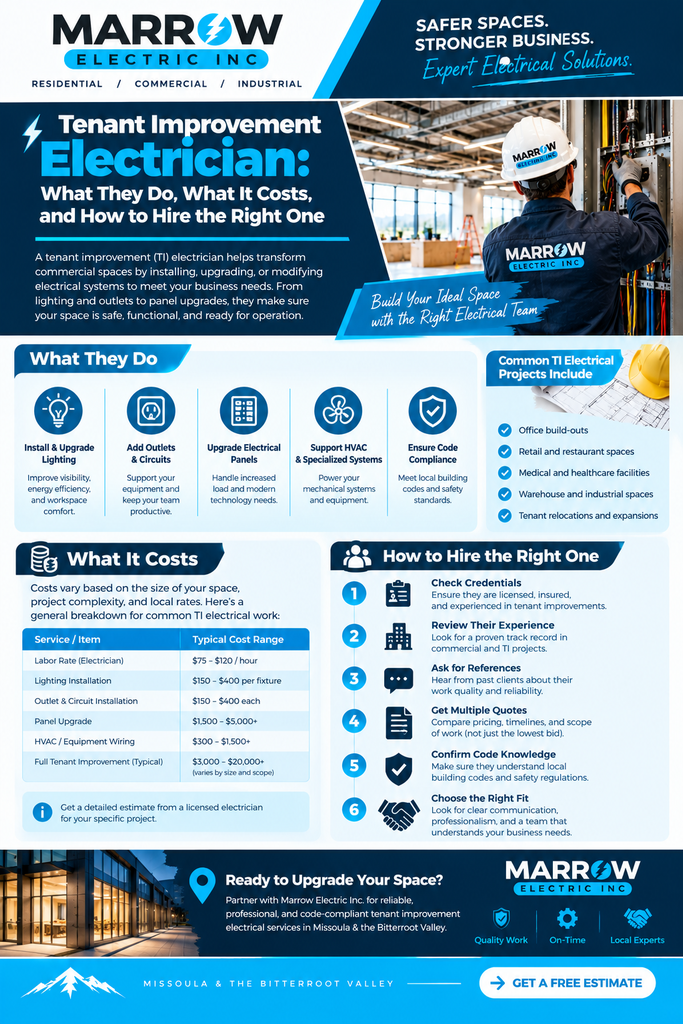
How Much Does a Tenant Improvement Electrician Charge?
People commonly ask, “What do most electricians charge per hour?” Hourly rates vary by region, license level, and job type, and commercial work is often quoted as a fixed bid rather than hourly. Prices also swing with project size, material costs, and the condition of the space.
The main factors that move a TI electrical price are:
- Square footage and the density of outlets, fixtures, and circuits
- Raw shell vs. second-generation (starting from scratch costs more, but a second-generation space can hide surprises)
- Panel and service work needed to supply the new load
- Specialty equipment such as kitchen, medical, or 3-phase machinery
- Lighting design, including controls and decorative fixtures
- Permit and inspection fees
- Schedule pressure and after-hours work in occupied buildings
The only reliable number is a written estimate based on a walk-through. Be cautious of any contractor who quotes a firm price over the phone without seeing the space. Our guide on how much a panel upgrade costs in Missoula shows how we break down pricing on related work.
Common TI Electrical Problems (and How to Avoid Them)
Most delays and overruns trace back to a short list of issues.
- Underestimated panel capacity. The new tenant’s equipment exceeds what the existing panel can supply. Fix it by doing a load calculation before lease signing.
- Plans that ignore the existing building. Drawings assume conditions that are not there. A site walk-through catches this early.
- Late changes to the layout. Moving a wall after rough-in means moving wiring. Lock the plan before electrical starts.
- Permit delays. Incomplete applications slow everything down. Experienced contractors submit complete packages.
- Trade conflicts. Conduit, ductwork, and plumbing compete for ceiling space. Coordination meetings prevent clashes.
- Inspection failures. Missed code details lead to re-inspections. Quality work and a pre-inspection walk-through reduce this risk.
How to Find Tenant Improvement Contractors Near Me
Many business owners start with a search for tenant improvement contractors near me. Here is how to turn a list of search results into a short list of contractors you can trust.
- Verify the license. Confirm the contractor holds the correct Montana electrical contractor license and that it is active.
- Check insurance. Ask for general liability and workers’ compensation certificates. Landlords often require them.
- Look for commercial experience. Residential work is not the same thing. Ask for recent commercial TI projects similar to yours.
- Check local code and permit knowledge. A contractor who knows your local building department saves weeks.
- Read reviews and ask for references. Call at least two past commercial clients.
- Get at least two written estimates. Compare scope, not just price.
See our broader checklist in what to know before hiring an electrician in Stevensville, MT and our guide to electrical contractors near me.
What to Ask When Hiring an Electrician for a Tenant Improvement
People search “what to ask for when hiring an electrician” and “what is a good question to ask an electrician.” For a TI project, these questions separate experienced contractors from the rest:
- Are you licensed and insured for commercial work in Montana?
- How many tenant improvement projects like mine have you completed recently?
- Will you pull the permits and handle inspections?
- Can you review my plans and flag problems before construction?
- How will you determine whether my panel can handle the new load?
- What is included in your estimate, and what could change the price?
- Who will be on site, and who will be my point of contact?
- How do you handle change orders?
- What is the expected schedule, and what could delay it?
- What warranty do you offer on your work?
Tips to Keep Your TI Electrical Project on Budget and on Schedule
- Bring in the electrician early. Ideally, before the lease is signed, so you know the true cost of the space.
- Finalize your equipment list. Every appliance and machine affects circuits and panel size.
- Plan outlets with your furniture layout. Not just the architect’s plan.
- Ask about LED and controls. Efficient lighting can lower operating costs and meet energy code.
- Plan for growth. Add spare conduit, spare breaker space, and extra capacity so you do not have to reopen walls later.
- Confirm allowance rules in writing. Know what the landlord will and will not reimburse.
- Schedule inspections early. Inspector availability can control your opening date.
Frequently Asked Questions About Tenant Improvement Electricians
What does a tenant improvement electrician do?
A tenant improvement electrician modifies a commercial space’s electrical system for a new tenant. They evaluate panel capacity, install circuits and sub-panels, wire lighting and outlets, run low-voltage pathways, pull permits, and pass inspections.
Who usually pays for tenant improvements?
It depends on the lease. Landlords often contribute a tenant improvement allowance, and tenants pay the remainder. In some cases the landlord funds a full turnkey build-out, or the tenant pays everything, sometimes in exchange for rent concessions.
What is a typical tenant improvement allowance?
Allowances vary by market, building class, lease length, and the space’s condition. Ask your broker for comparable leases and get the amount and allowed uses in writing before signing.
What are some examples of tenant improvements?
Common examples include new walls and ceilings, flooring, lighting upgrades, additional outlets and data drops, dedicated equipment circuits, new sub-panels, plumbing changes, HVAC modifications, and signage. Electrical examples include commercial kitchen circuits, medical equipment wiring, and POS system power.
What is the difference between tenant improvement and renovation?
Tenant improvement refers to changes made inside a leased commercial space, governed by the lease and often funded in part by the landlord. Renovation is a broader term for remodeling any property.
Do I need a permit for tenant improvement electrical work?
In most cases, yes. Commercial electrical work usually requires permits and inspections. Your licensed contractor should pull the permit and schedule inspections. Requirements depend on your local jurisdiction.
How long does tenant improvement electrical work take?
Small suites may take a few weeks. Larger build-outs, raw shells, and projects needing a service upgrade take longer. Permit approval and inspection scheduling often drive the timeline more than the physical work.
Can a tenant hire their own electrician?
Often yes, but the lease may require landlord approval or use of an approved vendor list. Check the lease before you hire anyone.
What should I ask for when hiring an electrician?
Ask for proof of license and insurance, recent commercial references, a written estimate with clear scope, who handles permits and inspections, and the warranty terms.
What do most electricians charge per hour?
Rates vary by location, license level, and job. Commercial TI work is usually quoted as a fixed bid after a site walk-through, which is more useful than comparing hourly rates.
Is it better to hire a tenant improvement electrician or a general contractor?
Both are often involved. A general contractor manages the whole build-out, while the electrician handles the electrical scope. You can hire the electrician through the general contractor or directly, depending on the project and lease.
Can the panel in my commercial space handle my equipment?
Only a load calculation can say for sure. Your electrician reviews the panel, the service size, and your equipment list to find out whether you need a new sub-panel or a service upgrade.
Why Choose Marrow Electric for Your Tenant Improvement Project
A tenant improvement project lives and dies on communication, code knowledge, and schedule discipline. At Marrow Electric, we serve commercial clients in Missoula and the Bitterroot Valley with licensed electricians who know local permitting and inspection practices. We start with a real walk-through and a panel capacity review, so you learn the true electrical cost of a space before you commit to it. We coordinate with your landlord, architect, and general contractor, pull the permits, and stand behind our work with clear written estimates and a single point of contact from start to finish. If you need a tenant improvement electrician who treats your opening date as seriously as you do, contact Marrow Electric to schedule a site visit. You can also explore our commercial electrical services and our electrical service and troubleshooting page.
Need an Electrician?
Reliable electrical service in Stevensville and the Bitterroot Valley.
Call Marrow Electric65 Goose Ln, Stevensville, MT 59870
Marrow Electric
Professional Electrician in Stevensville, Montana
Serving Missoula, Stevensville, Ravalli County, and the Bitterroot Valley with residential and commercial electrical services.
Phone: (406) 360-8071
View on Google Maps