If you’re planning a kitchen remodel, a basement finish, or a full renovation of an older Missoula or Bitterroot Valley home, electrical code compliance is one of the parts of the project that’s easy to underestimate, right up until it stalls your permit, your inspection, or your closing. Montana electrical code isn’t one single document sitting on a shelf; it’s a layered system built from the National Electrical Code (NEC), state amendments, and local jurisdiction rules that apply differently depending on whether you’re inside Missoula city limits, in unincorporated Missoula County, or out in the Bitterroot Valley.
That layering is exactly where most remodel headaches start. A homeowner in the Rattlesnake neighborhood, a homeowner in unincorporated Missoula County, and a homeowner in Hamilton or Stevensville are all technically working under “Montana electrical code,” but the office that issues their permit, reviews their plans, and shows up for inspection is different in each case. None of that is obvious from the outside, and it’s rarely spelled out clearly anywhere a homeowner would naturally look before hiring a contractor.
This guide walks through what Montana electrical code actually requires for a remodel: which edition of the code is currently enforced, when you legally need a permit, when the work has to be done by a licensed electrician rather than a general contractor, the violations we most commonly find in older Missoula and Bitterroot homes, and what happens if unpermitted electrical work surfaces during a home sale. If you’re at the stage of comparing bids or scoping a project, this pairs well with our residential remodel electrical services page, which covers how we handle remodel wiring day to day.
By the end of this guide, you should be able to walk into a conversation with a contractor, a permitting office, or a real estate agent and ask the right questions, which is usually enough to avoid the expensive surprises that come from finding out the rules after the work is already done.
Which Electrical Code Does Montana Use?
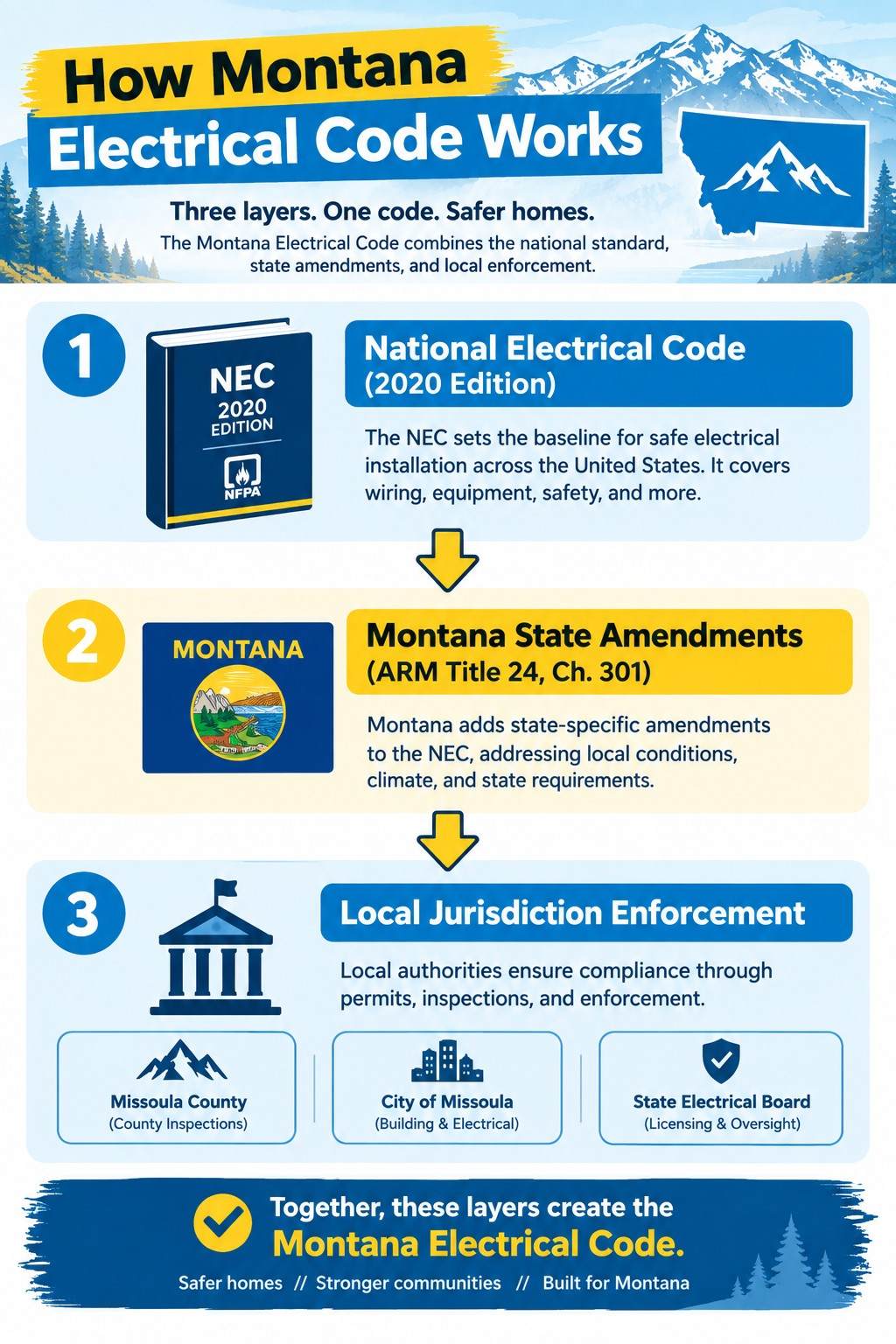
Montana’s statewide electrical code is based on the 2020 edition of the National Electrical Code (NFPA 70), adopted through the Administrative Rules of Montana (ARM Title 24, Chapter 301) and effective June 11, 2022, with state-specific amendments layered on top [Source: Montana DLI Building & Safety Bureau; ARM 24.301.401]. That means a remodel permitted today in Missoula or the Bitterroot Valley is reviewed against the 2020 NEC plus Montana’s amendments, not whatever edition a contractor may have trained on in another state, and not necessarily the newest nationally published NEC edition, since states typically lag behind national code cycles by one or more revisions.
This matters more than it might seem. The NEC is revised every three years, and each revision tends to expand safety requirements rather than relax them, more circuits requiring GFCI protection, more rooms requiring AFCI protection, tighter rules around outdoor and wet-location wiring. A contractor who last worked under an older edition, or who’s used to a neighboring state’s more recent adoption, can genuinely misjudge what Montana currently requires. It’s a common source of failed inspections that has nothing to do with the quality of the work itself, the work may be perfectly safe, just built to the wrong reference edition.
A few of Montana’s amendments homeowners run into most often during a remodel:
- Supplementary wiring-diagram requirements under NEC Article 110.2 when requested by an inspector
- Modified clearance and feed requirements for manufactured and mobile homes (NEC Articles 550.32 and 550.33)
- State-specific smoke and carbon monoxide alarm requirements tied to any permitted remodel, under ARM 24.301.411(1)(d)
That last point catches a lot of people off guard. Homeowners often think of smoke and CO alarm requirements as a fire-department issue, separate from electrical permitting. In Montana, they’re tied directly to permitted remodel work, meaning a kitchen or bedroom remodel can trigger alarm placement and interconnection requirements you weren’t necessarily budgeting for when you scoped the wiring itself.
Because code amendments and enforcement can shift between legislative sessions, it’s worth confirming the current edition and any recent amendments with your electrical contractor in Missoula before finalizing remodel plans, especially on older homes where several code cycles’ worth of changes may apply to the same panel. A panel installed in the 1990s, for example, may have been fully compliant at the time but would not meet current requirements if it were installed today; a remodel is often the point where that gap has to be addressed, at least for the portion of the system being touched.
Who Enforces Electrical Code in Missoula and the Bitterroot Valley
Enforcement in Montana is split between the state and certified local jurisdictions, which trips up a lot of homeowners who assume one office handles everything.
- Missoula County is one of the jurisdictions certified by the Montana Department of Labor & Industry to issue its own electrical permits and conduct its own inspections, rather than routing through the state [Source: Missoula County Building Division; DLI certified-jurisdiction list]. If your remodel is in unincorporated Missoula County, your permit and inspections go through the county.
- Inside Missoula city limits, the City of Missoula Building Division handles building permits, though for 1–2 family dwellings, electrical work is field-verified at inspection rather than plan-reviewed in advance [Source: City of Missoula Building Division FAQ]. Commercial electrical scopes do require plans from a licensed professional or master electrician.
- Outside a certified jurisdiction, including much of the Bitterroot Valley, electrical permits and inspections are handled directly by the state through the Building Codes Bureau and State Electrical Inspectors [Source: Montana DLI Electrical Permits page].
The practical effect of this split shows up most when a remodel spans property lines or when a homeowner assumes their neighbor’s permitting experience applies to their own address. Two houses a few miles apart, one inside city limits, one in unincorporated county land, can go through entirely different permitting offices with different turnaround times, different inspection scheduling systems, and in some cases different fee structures. None of that is a red flag on its own; it’s just how Montana’s certified-jurisdiction system works, and it’s worth confirming early rather than assuming.
Not sure which bucket your remodel falls into? That’s a five-minute call to your local building department, and it’s a step our team confirms as part of scoping any residential remodel before work starts, pulling a permit through the wrong office is a common (and avoidable) cause of remodel delays. In our experience, the delay isn’t usually caused by the correct office being slow; it’s caused by a permit application sitting in the wrong queue for days or weeks before anyone notices it was filed with the wrong jurisdiction.
When You Actually Need an Electrical Permit for a Remodel
Under Montana law, an electrical permit is required for “any installation in any new construction, remodeling or repair,” with limited statutory exceptions [Source: MCA 50-60-602; Montana DLI Electrical Permits]. In practical terms, that covers most of what happens during a real remodel:
- Adding, moving, or replacing circuits or outlets
- Upgrading or replacing an electrical panel or service
- Rewiring any portion of a room during a kitchen, bathroom, or basement remodel
- Installing new lighting circuits, including recessed lighting during a ceiling remodel
- Adding dedicated circuits for appliances, EV chargers, or HVAC equipment
- Any work tied to a required smoke or carbon monoxide alarm update
Cosmetic work, swapping a light fixture for a similar one on existing wiring, or replacing a switch plate, generally doesn’t require a separate permit, but the line gets blurry fast once a remodel touches wiring, panels, or new circuits. A useful rule of thumb: if the work involves opening a wall to run new cable, adding load to the panel, or changing how power reaches a fixture rather than just what the fixture looks like, assume a permit is required and confirm rather than guessing.
If your project also involves structural or plumbing changes, it’s worth reviewing our guide on electrical inspection checklists to see how electrical permitting typically overlaps with the rest of a remodel timeline. Electrical permit holders in Missoula County are generally required to call for rough-in and final inspections before work is covered up [Source: Missoula County Building Projects Guide], so permitting isn’t a one-time step, it’s built into the sequence of the remodel itself.
This sequencing point trips up a surprising number of remodels, particularly ones managed by homeowners coordinating multiple trades themselves. Drywall crews want to move fast once framing is done, and it’s easy to let insulation or drywall go up before a rough-in inspection has actually happened. Covering wiring before it’s been inspected is one of the more expensive mistakes in a remodel, because the fix is rarely a quick patch, it typically means opening the wall back up.
When a Licensed Electrician Is Legally Required — Not a General Contractor
This is one of the most common points of confusion for Missoula homeowners planning a remodel through a general contractor: a general contractor’s license does not authorize electrical work in Montana. Under Montana Code Annotated Title 37, Chapter 68, a person may not perform electrical work, or hold themselves out as able to perform it, without a license issued by the Montana State Electrical Board, a separate licensing body from general contractor licensing [Source: MCA 37-68-103; Montana State Electrical Board]. The board issues several distinct license types:
- Residential Electrician, residential-scope work, typically requiring a completed apprenticeship or 4,000 hours of documented residential experience
- Journeyman Electrician, broader scope under supervision of a master electrician or contractor
- Master Electrician, the credential required to serve as the responsible electrician for an electrical contracting business
- Electrical Contractor (Limited or Unlimited), the business-level license required to contract for and pull permits for electrical work, which must designate a licensed Master Electrician as the responsible party [Source: Montana DLI; Montana State Electrical Board]
There is one narrow exception: Montana’s Homeowner Electrical Permit allows an owner to wire their own primary residence, garage, and premises for their own personal use, but this exemption is strictly limited to owner-occupied primary residences. It does not extend to rental properties, properties being flipped for resale, or any situation where someone other than the titled owner is doing the work Source: Montana DLI; Missoula County Electrical Permit Application.
If a general contractor on your remodel offers to “handle the electrical” without bringing in a licensed electrician or pulling a separate electrical permit, that’s a compliance gap worth catching before drywall goes up, not after. In practice, this usually isn’t malicious; it’s more often a GC who’s used to jurisdictions where licensing boundaries are looser, or who genuinely believes their crew’s experience is enough to cover it. Montana’s licensing structure doesn’t leave room for that assumption, and the homeowner is the one left holding the risk if unlicensed electrical work is later discovered, whether through a failed inspection, an insurance claim, or a future sale.
This is one of the clearer differences between how residential and commercial projects get staffed, which we cover in more depth in our residential vs. commercial electrician breakdown. A useful habit when hiring for a remodel: ask directly which license the electrical portion will be performed under, and ask to see the number. It’s a normal question, and any licensed contractor will have it ready without hesitation.
Common Code Violations We Find in Older Missoula and Bitterroot Homes
Missoula and the Bitterroot Valley have a lot of housing stock built well before current code existed, and remodels are usually the first time some of these issues surface. The most common violations our team finds when we open up an older home:
- Knob-and-tube wiring still active in walls or attics, often undocumented until a remodel exposes it, this alone typically requires a broader whole-house rewiring scope rather than a spot repair
- Two-prong, ungrounded outlets throughout older rooms, which don’t meet current grounding requirements and can’t safely support modern appliances or GFCI protection
- Aluminum branch-circuit wiring from certain construction eras, which requires specific connectors and terminations to remain code-compliant and safe
- Undersized or fuse-based electrical panels, commonly 60-amp or 100-amp services that can’t support a modern remodel’s load without a panel upgrade
- Missing GFCI protection in kitchens, bathrooms, and other wet locations required under current code
- Missing AFCI protection on bedroom and living-area circuits, a newer code requirement many older homes were never updated to meet
- Double-tapped breakers and DIY panel additions from past owners, often the most immediate safety concern we flag during an inspection
- Junction boxes buried behind drywall from past remodels that were never inspected or permitted
None of these automatically mean a full rewire is required, but they do mean the remodel scope, and the electrical permit, need to account for what’s actually behind the walls rather than what the original permit (if one exists) assumed. A remodel that was quoted based on a walkthrough alone, without opening a wall or pulling a panel cover, is always a rougher estimate than one where the electrician has actually seen what’s inside, and that gap tends to show up as a change order partway through the project rather than as a surprise up front, which is worse for everyone involved.
If your bills or breaker behavior have you wondering whether something’s already wrong before you even start a remodel, our guide on signs you need electrical repair covers the warning signs worth checking first. Catching these issues before a remodel is scoped, rather than during demolition, tends to produce a more accurate bid and fewer surprises once work is underway.
What Happens If Unpermitted Electrical Work Is Found During a Home Sale
This is where code compliance stops being an abstract concern and starts affecting real money and real timelines. Unpermitted electrical work, whether from a past remodel, a DIY panel change, or work done by an unlicensed contractor, tends to surface at one of a few points during a sale:
- Home inspection. A general home inspector isn’t an electrical code expert, but visible red flags (double-tapped breakers, missing grounds, obviously non-standard panel work) routinely show up in inspection reports and become negotiating points or repair conditions.
- Appraisal. Appraisers can flag unpermitted additions or systems that don’t match county permit records, which can affect valuation or trigger a request for permit documentation before financing closes.
- Title and closing. In some cases, unpermitted work discovered late in the process delays closing while the seller scrambles to get retroactive permits or repairs completed, a much more stressful and expensive process than permitting the work correctly the first time.
- Insurance. Homeowners insurance claims tied to electrical fires or damage can be complicated or denied if the underlying work was unpermitted or done by an unlicensed party, particularly if the work is found to be a contributing cause.
- Buyer walk-aways. In a competitive market, buyers and their agents increasingly ask directly about permit history on any visible electrical or panel work, an unanswered question here can cost a sale outright.
The timing of when this surfaces matters a lot for how painful it is. Found during pre-listing prep, it’s a line item, get it inspected, corrected if needed, and documented before the sign goes in the yard. Found during a buyer’s inspection, it becomes a negotiation, often at a point where the seller has less leverage than they did before the property was under contract. Found at appraisal or closing, it can delay or jeopardize the transaction entirely, with far less time to fix it calmly.
None of this is legal or real estate advice, a real estate attorney or your agent can speak to the specifics of disclosure obligations and contract contingencies in your transaction. What we can speak to is the electrical side: getting retroactive permits and inspections on past unpermitted work, correcting it to current code, and documenting it clearly enough that it’s a non-issue by the time a buyer’s inspector shows up. If you’re planning to sell in the next year or two, it’s worth having your panel and past remodel work reviewed well before you list, not after an inspection report comes back with surprises. Our electrical inspection checklist is a useful starting point for sellers and buyers alike.
Getting Ahead of It: A Code-Compliance Consultation
Whether you’re remodeling, buying an older Missoula home, or preparing to list one, the cheapest point to deal with electrical code issues is before permits are pulled or before a buyer’s inspector arrives, not after. A code-compliance consultation typically covers:
- A panel and visible-wiring assessment against current Montana-adopted NEC requirements
- Identification of any past unpermitted work and a plan to bring it up to code and properly permitted
- A load calculation if your remodel adds circuits, appliances, or an EV charger
- A clear scope and cost estimate before the remodel or listing timeline is locked in
Related to the load-calculation planning above, our EV charger installation guide covers that process in more detail. Beyond these four items, a consultation is also the point where a homeowner can ask the questions that are hard to ask mid-project, whether a panel upgrade makes sense now versus later, whether a phased approach to rewiring an older home is realistic on their budget, or whether a specific renovation plan (say, finishing a basement or adding a home office) is going to trigger a full service upgrade. Getting those answers before a contract is signed tends to save both money and scheduling headaches later.
This is the same groundwork we do on every residential remodel project we take on in Missoula and the Bitterroot Valley, it’s just as valuable as a standalone step if you’re not ready to start construction yet but want to know where you stand.
Frequently Asked Questions
What edition of the National Electrical Code does Montana use?
Montana currently enforces the 2020 edition of the National Electrical Code (NFPA 70), adopted through state administrative rule and effective since June 11, 2022, along with Montana-specific amendments.
Can I do my own electrical work on my house in Montana?
Yes, under a Homeowner Electrical Permit, but only for your own owner-occupied primary residence, garage, and premises, not for rental properties, properties being sold or flipped, or any work done by someone other than the titled owner.
Can a general contractor legally do electrical work during my remodel?
No. Electrical work in Montana requires a license issued specifically by the Montana State Electrical Board, separate from general contractor licensing. A GC managing your remodel still needs to bring in a licensed electrician or electrical contractor for any electrical scope.
Do I need a permit for a small electrical job during a remodel?
Most work beyond a like-for-like fixture swap, new circuits, panel changes, added outlets, rewiring, requires a permit under Montana law. When in doubt, it’s worth confirming with your local building department or your electrical contractor before starting.
What happens if unpermitted electrical work is found when I sell my house?
It can surface during the home inspection, appraisal, or closing process, and may lead to repair requests, valuation questions, or delays. Getting past work properly inspected and permitted before listing is the most reliable way to avoid surprises.
Is Missoula County electrical permitting different from the City of Missoula or the state?
Yes. Missoula County is a certified jurisdiction that issues its own electrical permits, the City of Missoula handles building permits within city limits with electrical field-verified at inspection, and areas outside certified jurisdictions, including much of the Bitterroot Valley, go through the state directly.
How do I know if my home’s wiring is old enough to be a concern?
Age alone isn’t a perfect predictor, but homes built before the 1970s are the most likely to have knob-and-tube wiring, ungrounded outlets, or undersized panels. A visible-wiring assessment during a remodel or code-compliance consultation is the most reliable way to know what you’re actually working with, rather than guessing from the home’s build date.
Talk to a Licensed Missoula Electrical Contractor Before You Remodel
Montana electrical code isn’t something you need to memorize, it’s something your electrical contractor should already know cold, for your specific address and jurisdiction. If you’re planning a remodel, buying an older home, or getting ready to sell one, Marrow Electric provides code-compliance consultations across Missoula and the Bitterroot Valley, backed by licensed electrical contractor Missoula expertise and hands-on residential remodel experience in exactly this kind of older housing stock.
What Our Customers Say About US
Paul Walters
TJ electrified my custom sauna and outbuilding. The project was completed professionally and in a timely manner – I’m enjoying the sauna immensely. Thanks TJ for the great work – come over and sweat sometime…
Jonathan Stoops
TJ and Thomas installed a new light for my wife and I during our bathroom remodel. They were thorough and walked us through our options. TJ also took the time to advise on some other electrical needs in our home. We greatly appreciated the care taken during the install and are very pleased with the final product.
Kevin Piazza
We love to support small / family businesses. This is a great one. Marrow Electric is top notch quality and communication. Incredible knowledge. High integrity. Would recommend.
LeVogue
The best electrician for business panel upgrades. We needed more power and TJ came out with his son and helped make it happen. System works great and looks great as well, thanks guys!
Daniel Burns
TJ is a man of high moral character and puts quality and commitment into everything he does. Easy to work with and very personable. Highly recommend.
Steven Dulkevich
Wow, I was totally impressed. They came out extremely quickly, did an amazing job and cleaned up perfectly afterward. This is hands down the best Electrical company. They did great work, quickly and at a good price. This was hands down the easiest construction project we have had thanks to this extremely professional company.
Leave a Reply