
If you’ve owned a home in Missoula or the Bitterroot Valley for more than a few years, you’ve probably had at least one electrical moment that made you pause, a breaker that trips for no obvious reason, an outlet that feels warm, or a contractor who took one look at your panel and asked how old the house is. Whole-house rewiring is one of the biggest electrical decisions a homeowner can make, and it’s also one of the most misunderstood. This guide covers the real warning signs, what actually gets replaced, what it costs in this market, and how the process works from first inspection to final walkthrough.
Why So Many Older Missoula & Bitterroot Valley Homes Need Rewiring
Missoula’s housing stock spans a huge range, turn-of-the-century homes in the University District and Northside, mid-century ranches throughout the valley, and a wave of construction from the 60s through the 80s in Hamilton, Stevensville, and Corvallis. A lot of that housing was wired to the standards of its era, and those standards haven’t aged well.
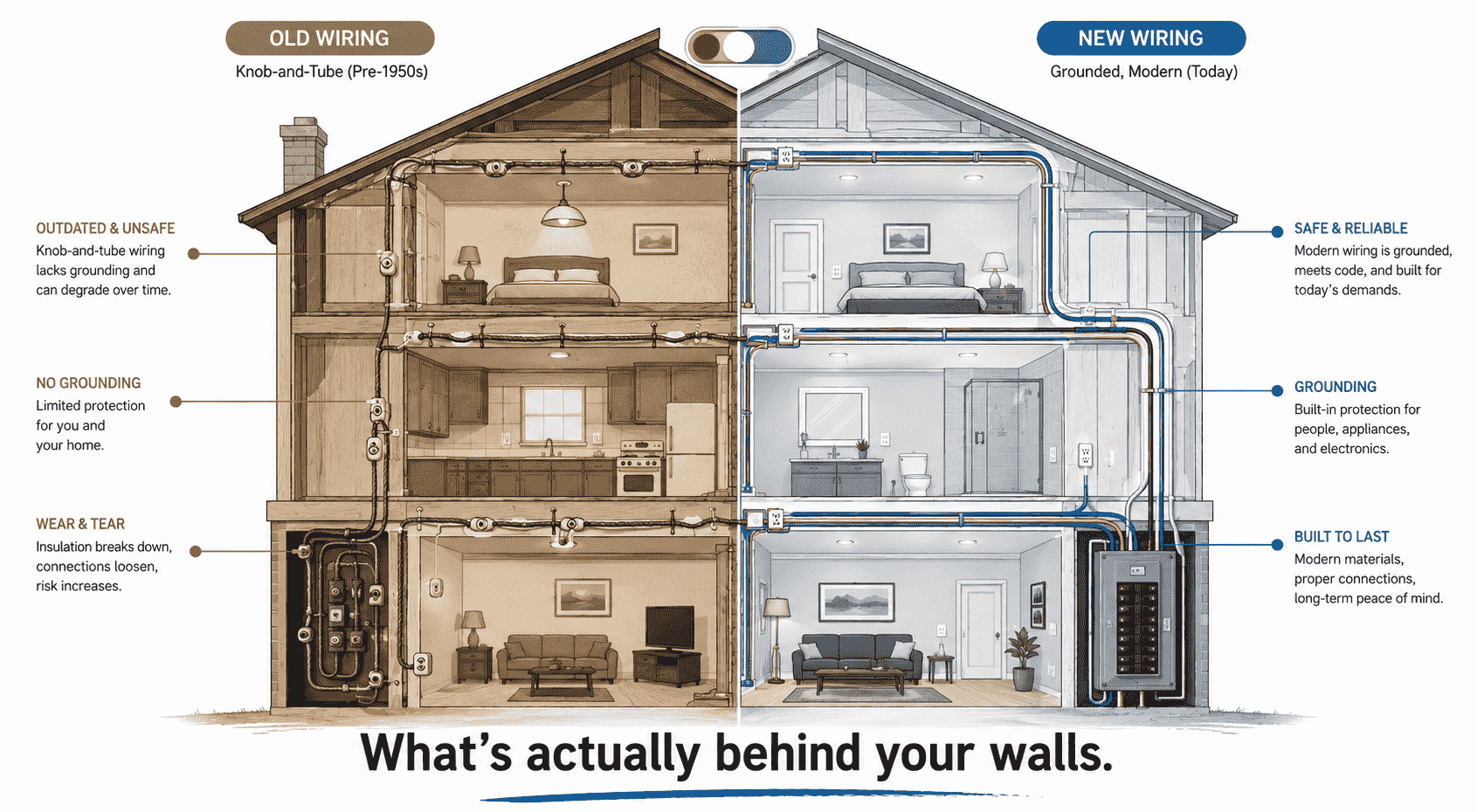
Homes built before the 1960s often still have knob-and-tube wiring, ceramic knobs and tubes running ungrounded wire through the walls. It wasn’t a bad system for its time, but it has no ground wire, can’t safely handle modern loads, and many insurance carriers in Montana now flag it outright or require replacement before writing or renewing a policy.
Homes from the 1960s and 70s frequently used aluminum branch wiring instead of copper, which was cheaper at the time but expands and contracts differently at wire connections, leading to loose connections that overheat over years of normal use. Even homes without either of those specific issues often have undersized panels, two-prong ungrounded outlets, or wiring that was never intended to run a modern kitchen, a home office setup, and an EV charger at the same time.
None of this means every older home needs a full rewire immediately. It means the older the home, the more worth it is to have a licensed electrician actually look at what’s behind the walls before assuming the existing wiring can keep up.
There’s also a distinctly Montana wrinkle to this. A lot of homes and cabins throughout the Bitterroot Valley and rural Missoula County were added onto over the decades, a sunporch here, a finished basement there, a detached shop wired by a previous owner or a well-meaning DIYer. Each addition often got tied into the existing electrical system rather than planned as part of it. That means a home’s wiring can be a patchwork of different eras, gauges, and installation quality, even if the original build looks fine on paper.
This is one of the most common surprises we run into during an inspection: the main house wiring is passable, but a detached garage, workshop, or add-on room is carrying a load it was never designed for.
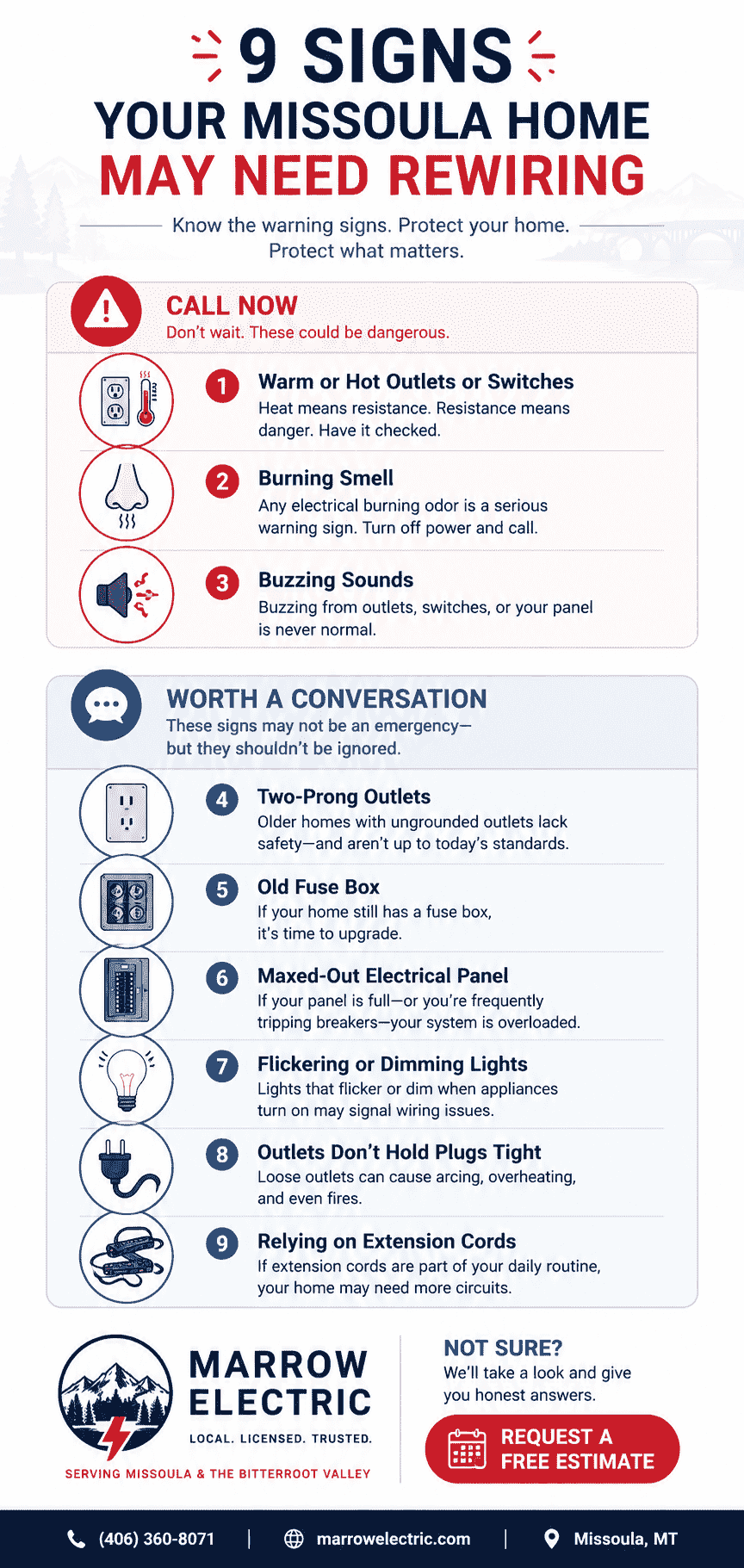
9 Signs Your Missoula Home May Need Rewiring
Some of these are urgent. Some are just worth a conversation at your next remodel. Here’s how to tell the difference.
1. Frequent breaker trips with no clear cause
An occasional trip when you run the microwave and the toaster at once is normal. Breakers tripping regularly, on multiple circuits, with nothing unusual plugged in, usually points to wiring that’s struggling to handle the load it’s carrying.
2. Lights that flicker or dim when appliances kick on
If your lights dim every time the fridge compressor or the furnace blower kicks on, that’s a sign of a voltage drop somewhere in the circuit, often a loose connection or wire that’s undersized for the load.
3. Warm outlets, switch plates, or a persistent burning smell
This one isn’t a “watch and wait” sign. A warm outlet plate, discoloration around a switch, or any burning smell near your panel or outlets means there’s active heat buildup in the wiring, and it’s worth an immediate inspection rather than a scheduled one.
4. Buzzing or crackling sounds from outlets or the panel
Wiring should be silent. Any audible buzzing, crackling, or humming from an outlet, switch, or panel is a sign of arcing, electricity jumping a gap it shouldn’t be jumping, which is one of the leading causes of electrical fires in older homes.
5. Two-prong, ungrounded outlets throughout the house
If most of your outlets are the older two-slot style instead of three-prong grounded outlets, your home likely predates modern grounding requirements. That’s not just an inconvenience for plugging in newer electronics, it’s a real safety gap for anything that needs a ground path.
6. A fuse box instead of a breaker panel
Fuse boxes were phased out for a reason. If you’re still replacing screw-in fuses instead of flipping a breaker, your entire system predates decades of electrical code updates, and a rewire conversation should probably include a panel upgrade too.
7. Insurance company pushback or a home inspection flag
Increasingly, Montana insurers are requesting documentation on knob-and-tube or aluminum wiring before renewing a policy, and home inspectors routinely flag both during a sale. If either has come up for you, it’s worth getting ahead of it rather than dealing with it during closing.
8. You’re planning a remodel or addition
Any time walls are already opening for a kitchen remodel, an addition, or a larger renovation, it’s the cheapest possible moment to address old wiring, since the labor to access it is already part of the project. We’ve covered this in more detail on our
page for residential remodel electrical work, which is the most common way whole-house rewiring actually gets scheduled.
9. Your panel is already maxed out
If your panel has no open slots left, or a previous electrician has told you it’s at capacity, that’s often the first sign that the rest of the wiring behind it is due for a look too. That’s a slightly different problem than a full rewire, and it’s worth understanding the distinction, covered next.
Why This Isn’t Just a Cosmetic Issue
It’s easy to file old wiring under “annoying but manageable” until something forces the issue. Wiring failures are one of the more common causes of residential electrical fires, and the mechanism is almost always one of the signs above showing up quietly for months or years before it becomes a visible problem: a loose aluminum connection running slightly hot every time a large appliance kicks on, a knob-and-tube run buried in insulation it was never rated to be near, or a breaker that keeps tripping because it’s doing its job, protecting a circuit that’s being asked to carry more than it safely can.
The reason we spend so much time on the warning signs in this post isn’t to be alarmist. It’s that unlike a lot of home maintenance issues, electrical problems don’t always announce themselves clearly, and by the time they do, heat, smoke, or a tripped breaker that won’t reset, the cost of addressing them has usually gone up. Catching these signs early is what keeps a wiring issue a planned project instead of an emergency call.
Full Rewire vs. Partial Rewire vs. Panel Upgrade: What’s the Difference
These three get lumped together constantly, and they’re not the same project.
A panel upgrade replaces the breaker box itself, swapping an outdated or undersized panel for one with more capacity and modern breakers. It doesn’t touch the wiring running through your walls. We’ve written a full breakdown of this specific project on our
electrical panel upgrade post, including cost ranges for the Bitterroot Valley specifically.
A partial rewire replaces wiring in specific problem areas, a kitchen with undersized circuits, a section of knob-and-tube in an accessible attic, or a run of aluminum wiring feeding a few rooms, without touching the entire house. This is often the right call when a home is mostly fine but has one clearly outdated section.
A full rewire replaces essentially all of the wiring in the home, from the panel out to every outlet, switch, and fixture. It’s the most disruptive and expensive option, but it’s the only one that fully resolves a home built on knob-and-tube or heavily degraded aluminum wiring, and it typically comes with a fresh set of properly grounded, code-current circuits sized for how homes actually use power today.
For most homeowners, the right starting point is an inspection that tells you honestly which category your home falls into, not every older home needs the full version of this project.
What Whole-House Rewiring Actually Costs in Missoula
Rewiring cost depends heavily on a handful of factors, and it’s worth understanding them before comparing quotes.
Home size and layout matter most. A single-story ranch with an accessible crawlspace or basement is far less labor-intensive to rewire than a two-story home with finished ceilings and no attic access, since accessible wiring runs mean less wall opening and patching.
Accessibility is the biggest cost driver beyond square footage. Open stud walls during a remodel or new construction make rewiring dramatically cheaper than fishing wire through finished walls and ceilings in an occupied home. This is the single biggest reason we tell homeowners to time rewiring with other renovation work whenever possible.
Scope matters too, in line with the distinction above, a partial rewire targeting one or two problem circuits costs a fraction of a full-house rewire, and a lot of homes only need the partial version.
Finish work adds up. Every wall that gets opened needs to be patched, textured, and repainted afterward. Some electricians include basic patching, others don’t, always confirm this is priced clearly before work starts, since it can be a meaningful chunk of the total project cost.
Because the range between a small partial rewire and a full two-story rewire is genuinely wide, we don’t publish a single number for this project, anyone who quotes a whole-house rewire without seeing the home first is guessing. A walkthrough and load assessment is the only way to get an accurate number for your specific house.
As a general frame of reference: a partial rewire limited to one or two rooms is typically closer in cost to a mid-size repair project, while a full rewire on a larger, multi-story home with limited attic or crawlspace access is a significant renovation-level investment, often comparable to a mid-size remodel project on its own. Homes with good attic and crawlspace access, single-story layouts, or unfinished basements tend to land well below that upper range, since less of the work involves opening finished walls. The only way to know where your specific home falls is a walkthrough, but understanding that range going in helps set realistic expectations before you start collecting quotes.
The Rewiring Process: What to Expect
Whole-house rewiring sounds intimidating, but it follows a predictable sequence.
Inspection and assessment
An electrician walks the home, checks the panel, inspects accessible wiring in the attic, crawlspace, or basement, and identifies what type of wiring is present and how much of it needs to be replaced. This is also when you’ll get an honest read on full rewire vs. partial rewire vs. panel upgrade.
Permitting
Rewiring requires an electrical permit through the City of Missoula or Ravalli County, depending on where the home is located. A licensed electrician handles this as part of the project, it’s not something a homeowner should skip, since it protects you if the work is ever reviewed during a future sale or insurance claim.
Wire pulling and rough-in
This is the most disruptive phase in an occupied home. New wire gets run to every circuit that’s being replaced, which may mean small access holes in walls or ceilings if attic and crawlspace access isn’t sufficient on its own.
Panel connection and device installation
New wiring gets landed at the panel, and outlets, switches, and fixtures get reconnected or replaced with grounded, code-current hardware.
Inspection and closeout
A local building inspector signs off on the completed work before walls are closed up for good, and any patching or finish work happens last.
Depending on scope, a partial rewire might take a few days, while a full two-story home rewire can take one to two weeks of active work, plus additional time if it’s coordinated with a larger remodel timeline.
Need an Electrician?
Reliable electrical service in Stevensville and the Bitterroot Valley.
Call Marrow Electric65 Goose Ln, Stevensville, MT 59870
How to Prepare for a Rewiring Project
A few things make the process smoother once you’ve decided to move forward.
Clear access to the areas that will be worked on, attic, crawlspace, basement, and the rooms with circuits being replaced. If closets or storage areas back up to walls that will be opened, it’s worth clearing them ahead of time.
Plan around the disruption, not just the calendar. Certain rooms will lose power for portions of a day while their circuits are actively being rewired. For most households this is a minor inconvenience, but if you work from home or have equipment that can’t lose power unexpectedly, flag that during scheduling so it can be planned around.
Ask about patching and finish work up front. Confirm in writing whether wall and ceiling patching is included in your quote or billed separately, and whether that includes texture matching and paint, or just a patched drywall surface ready for your own painter.
If the rewire is part of a larger remodel, loop your electrician in early. Coordinating wiring with your general contractor’s framing and drywall schedule, rather than as an afterthought, is what keeps the project on time and avoids opening a wall twice.
Rewiring During a Remodel vs. as a Standalone Project
If you’re already planning a kitchen remodel, an addition, or a whole-home renovation, that’s almost always the smartest time to rewire, since walls are already open and the incremental labor cost is far lower than opening them again later purely for wiring. Our
residential new construction and remodel teams coordinate rewiring directly into the framing and drywall schedule so it doesn’t add a separate disruption to the project.
If a remodel isn’t on the horizon but the wiring issues are urgent, warm outlets, buzzing, a fuse box, or an insurance deadline, a standalone rewire is still the right call. It costs more than bundling it with other work, but waiting on active safety issues isn’t the place to save money.
When It’s a Repair, Not a Rewire
Not every electrical issue means your whole house needs new wiring. A single dead outlet, a tripped GFCI that won’t reset, or one bad switch is usually a straightforward repair, not evidence of systemic wiring problems. We’ve put together a full list of specific
signs you need electrical repair that walks through the smaller issues worth a service call versus the bigger patterns, recurring trips, heat, multiple ungrounded outlets, that point toward rewiring instead.
Frequently Asked Questions
How do I know if my home has knob-and-tube or aluminum wiring?
The clearest way is a professional inspection, but common clues include a home built before 1960 (knob-and-tube) or between roughly 1965–1973 (aluminum branch wiring), ceramic knobs visible in an unfinished attic or basement, or dull gray (rather than dull orange copper) wire visible at outlets and switches.
Can I rewire just part of my house instead of the whole thing?
Yes, a partial rewire targeting specific rooms, circuits, or wiring types is common and often the right scope, especially if most of the home’s wiring is in good condition.
Will rewiring my home lower my homeowners insurance?
It can. Many Montana insurers charge higher premiums, or decline coverage outright, for homes with active knob-and-tube or aluminum wiring, so replacing it can open up better rates or coverage options. Confirm specifics with your insurance provider once work is complete.
How long does whole-house rewiring take?
A partial rewire can often be completed in a few days. A full rewire on a larger or multi-story home typically takes one to two weeks of active work, longer if it’s coordinated with a broader remodel.
Do I need to move out during a rewire?
Most homeowners stay in the home during a rewire, though certain rooms may be without power for portions of a day while circuits are actively being worked on. Your electrician will walk through the schedule with you before work starts.
Is rewiring required to sell my home in Missoula?
Not automatically, but knob-and-tube wiring and aluminum branch wiring are common findings in a home inspection and can become a negotiating point or insurance hurdle during a sale, which is why many sellers choose to address it proactively.
What’s the difference between rewiring and a panel upgrade if my breaker box already looks modern?
A modern-looking panel doesn’t guarantee the wiring feeding it is modern too. It’s common for a home to have had a panel swap at some point without the branch wiring running to each room ever being touched, which means the panel and the wiring behind the walls can be from two completely different eras. An inspection is the only way to confirm both are in good shape.
Can rewiring be done in phases instead of all at once?
Yes, for many homes. If budget is a concern, it’s often possible to prioritize the highest-risk areas first, knob-and-tube sections, the kitchen, or a maxed-out panel, and phase the remaining rooms in over time, as long as each phase is planned with the full picture in mind rather than as isolated fixes.
Get a Free Estimate
Old wiring doesn’t announce itself until it becomes a problem, and by then, it’s usually more expensive to deal with than it would have been on your timeline. If any of the signs above sound familiar, or you’re planning a remodel and want wiring handled as part of it, request a free estimate and we’ll walk your home, tell you honestly whether you need a full rewire, a partial rewire, or just a panel upgrade, and give you a real number to work with.