
It’s 9 PM, the power just cut out in half your house, and you’re standing in the kitchen trying to decide: is this a “call someone right now” situation, or a “deal with it in the morning” situation?
That question is harder than it sounds. Most people have never had to make it before, and electrical problems don’t come with an obvious severity label. A tripped breaker and a melting outlet can look almost the same from across the room — one is an inconvenience, the other can burn your house down.
This guide is about drawing that line clearly. Not a general list of electrical warning signs — we’ve already covered that in Signs You Need an Electrical Repair in Missoula, MT — but specifically what separates a genuine electrical emergency from something that can wait for a scheduled appointment, what to do in the minutes before help arrives, and why the answer matters more in a Montana winter than it does almost anywhere else.
The Real Test: Is It Getting Worse, or Is It Dangerous Right Now?
Strip away all the specific scenarios and every true electrical emergency comes down to one of two questions:
- Is there an active, immediate danger — fire, shock, or smoke — happening in your home right now?
- Is a safety system failing in a way that will get worse the longer it’s left alone, especially overnight or in freezing temperatures?
If the answer to either is yes, it’s an emergency. If neither applies, it can almost always wait for a scheduled visit — even if it’s annoying, even if it’s been happening for a few days, even if it’s a little unsettling.
That test matters because a lot of homeowners default to the opposite instinct: they downplay obvious danger signs (“it’s probably fine, I’ll keep an eye on it”) and panic over things that are genuinely low-risk (“the power’s out next door too, is my house about to catch fire?”). Getting this test right is what keeps you safe without paying emergency rates for something that didn’t need them.
True Emergencies: Call Immediately
These are the situations where you stop what you’re doing, take the safety steps below, and call for emergency electrical service — not in the morning, not after you’ve Googled it for twenty minutes, right away.
Sparking Outlets or Switches
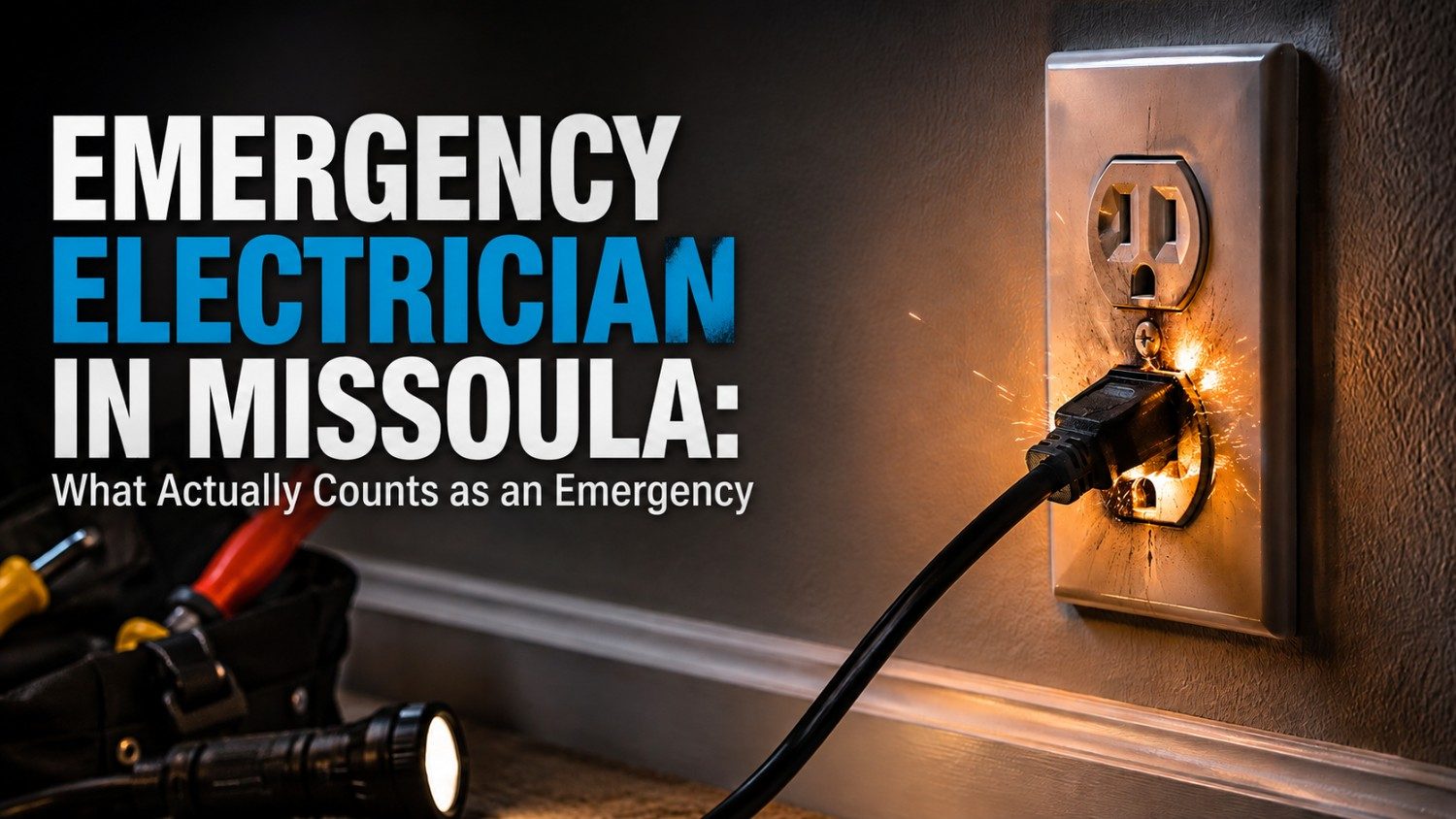
A visible spark from an outlet, switch, or appliance cord is arcing electricity — current jumping across a gap it shouldn’t be jumping across. That arc generates heat far in excess of what the wiring around it was built to handle, and it’s one of the most direct causes of electrical fires in residential homes. A single spark when you plug something in, followed by nothing, can sometimes be static or a worn plug. Repeated sparking, or sparking paired with any smell or discoloration, is not something to observe and wait on.
A Burning Smell With No Obvious Source
If you smell something like hot plastic, melting rubber, or an ozone-like electrical odor and you can’t immediately trace it to food on the stove or a space heater that’s too close to something, treat it as serious. That smell means insulation, wiring, or a component somewhere in your system is overheating, and by the time it’s strong enough to notice, the heat has usually been building for a while. This is one of the few situations where the right move is to shut off power to the affected area first and ask questions second.
Exposed or Damaged Wiring
Wiring that’s visibly exposed — chewed by rodents, frayed from age, damaged during a renovation, or hanging loose after storm damage — is a live shock and fire hazard whether or not it’s actively sparking. This comes up more than people expect in older Bitterroot Valley homes with knob-and-tube remnants, or after a tree branch or falling ice damages a service line. If you can see bare copper, exposed insulation, or wiring that’s come loose from where it should be secured, that’s not a wait-and-see situation.
Complete Power Loss in Winter
Losing power to part of your house is inconvenient. Losing power to your whole house, or losing the circuit that runs your furnace, boiler, or well pump during a Montana winter, is a different category of problem entirely.
A home without heat can drop into the danger zone for frozen pipes within hours once outdoor temperatures fall into the teens or below. Pipe damage from a hard freeze can cost more to repair than the emergency electrical call would have.
If the outage is isolated to your property, check whether your neighbor’s lights are on. This is especially important if you’re on a well and have lost water pressure along with power.
In that situation, this counts as an emergency, not a scheduling question.
A Hot, Buzzing, or Burning Panel
Your electrical panel is the one place in your home where every circuit converges. It should be cool and silent. A panel that’s warm to the touch, humming audibly, smoking, or smells like it’s burning is showing you a fault at the source rather than a single downstream outlet, and it’s arguably the most serious version of everything on this list. Don’t open the panel yourself. Get everyone clear of it and call.
Not an Emergency (Even Though It Feels Like One)
A few situations get people reaching for the phone in a panic when the actual risk is low. Knowing these in advance saves you an unnecessary after-hours callout.
A neighborhood-wide outage. If your neighbors’ power is out too, this is almost always a utility issue, not something happening inside your home’s wiring. Check NorthWestern Energy’s outage map or give them a call before assuming it’s an electrician’s problem — a residential electrician can’t restore power that’s out at the pole or substation.
A single GFCI trip in a bathroom or kitchen. GFCI outlets are designed to trip easily as a safety feature, especially in humid spaces. If resetting it (the small button between the plug slots) holds and the outlet works normally afterward, you’re fine. If it trips again immediately or won’t reset at all, that’s worth a scheduled call, not an emergency one.
A brief flicker during a storm or high wind. Utility-side voltage fluctuation during severe weather is common and usually resolves on its own. Persistent flickering with no storm happening is a different matter and worth a scheduled inspection.
A breaker that trips once when you’re running a lot of appliances. That’s the breaker doing exactly what it’s supposed to do. A breaker that won’t stay reset, or trips repeatedly on the same circuit with nothing unusual plugged in, deserves a look — but generally not an emergency-rate look.
The distinction that separates all of these from the true emergencies above: nothing is actively dangerous, and nothing is likely to get meaningfully worse by morning.
Also Read: https://www.marrowelectric.com/2026/08/31/standby-generator-missoula/
What to Do While You’re Waiting for Help
If you’ve determined it’s a real emergency, a few steps in the meantime keep everyone safe and make the electrician’s job faster once they arrive.
- Cut power to the affected area if you can do so safely. If you know which breaker controls the problem circuit, switch it off at the panel. If you’re not sure, or the panel itself is the issue, don’t approach it — shut off the home’s main breaker instead if it’s accessible without risk, or leave that step to the electrician.
- Don’t touch the source. Don’t unplug a sparking device with wet hands, don’t touch a warm outlet to “check” it, and don’t attempt to inspect exposed wiring yourself.
- Keep water away from the area. Water and electricity are a dangerous combination; if the issue is anywhere near a sink, a leak, or melting snow tracked indoors, keep the area dry and clear.
- Get everyone, including pets, out of the immediate area if there’s smoke, a strong burning smell, or visible flame. If you see actual fire, call 911 first — an electrician handles the electrical cause after the fire department has handled the fire itself.
- Note what you observed and when. A quick mental (or written) timeline — when the smell started, what was plugged in, whether it coincided with a storm or a specific appliance — helps the electrician diagnose the actual cause faster instead of starting from zero.
- If it’s a winter power loss affecting heat, protect your pipes in the meantime. Open cabinet doors under sinks along exterior walls, let faucets drip slightly if you still have water pressure, and keep interior doors open to let residual heat circulate while you wait.
Why Response Time Matters More Here Than Almost Anywhere Else
An electrical emergency in Missoula or the Bitterroot Valley carries a different weight than the same emergency somewhere with a mild climate, for a fairly simple reason: winter here doesn’t give you much of a grace period.
A furnace or boiler that goes down because of an electrical fault doesn’t just mean a cold house — once temperatures drop, unheated pipes can freeze and burst within a matter of hours, turning an electrical problem into a plumbing and drywall problem on top of it. Well pumps that lose power stop delivering water at all, which matters even more if you’re also trying to manage a frozen-pipe risk. And rural properties throughout the valley — Stevensville, Florence, Hamilton, Victor, Corvallis — are often far enough from town that a slow response isn’t just annoying, it’s the difference between catching a problem early and coming home to real damage.
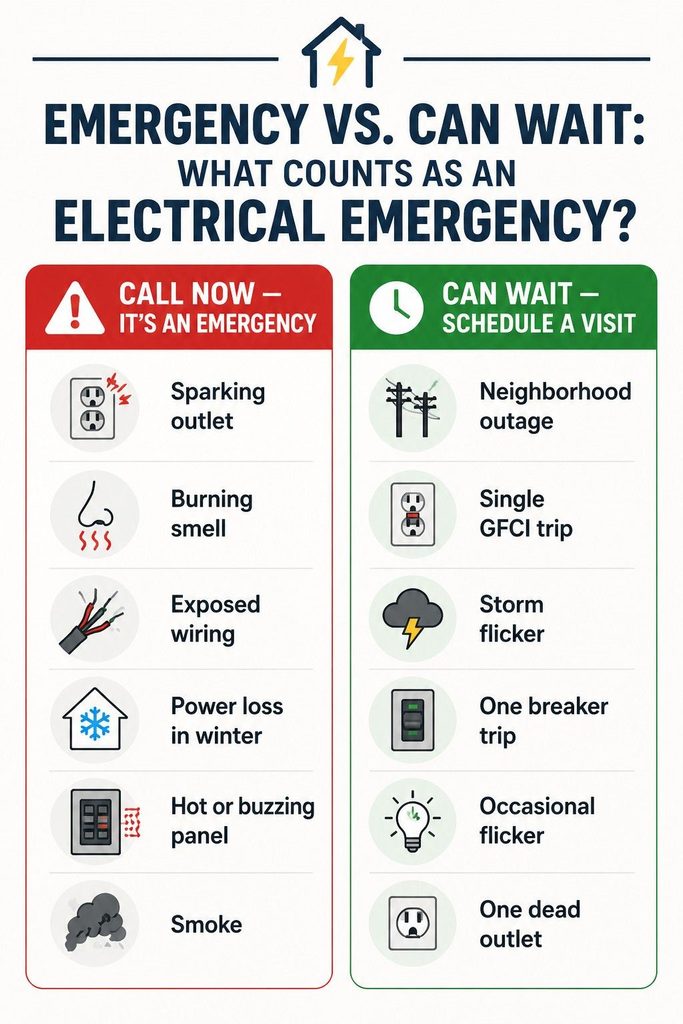
Call Now — It’s an Emergency
- Sparking outlets or switches
- Burning smell with no clear source
- Exposed or damaged wiring
- Complete power loss in winter (esp. heat/well pump)
- Hot, buzzing, or burning panel
- Smoke of any kind
Can Wait — Schedule a Visit
- Neighborhood-wide power outage
- A single GFCI trip that resets and holds
- Brief flicker during a storm
- One breaker trip during heavy appliance use
- Occasional flickering in one room
- A single outlet that stopped working
Not sure which one applies? Call (406) 360-8071 — a quick conversation costs nothing.
Road conditions add another layer that people in milder climates don’t have to think about. A contractor who can normally reach a property in twenty minutes might need twice that after a snowstorm, which is exactly why choosing an electrician who treats emergency calls as a priority — not an inconvenience worked in around the regular schedule — matters more here than it does in a lot of the country.
What Happens When You Call
A legitimate emergency electrician isn’t just going to show up and start guessing. Expect a short round of questions first: what you’re seeing or smelling, whether you’ve been able to safely isolate the circuit, whether anyone is in immediate danger, and how old the home’s wiring or panel is if you know it. That triage step is what lets a electrician show up prepared with the right tools and parts instead of diagnosing from scratch on-site, and it’s also how they’ll tell you honestly if what you’re describing sounds like it can actually wait until morning.
Once they arrive, the goal isn’t just to make the immediate danger go away — it’s to find out what caused it. A spark or a warm panel is a symptom; the job is tracing it back to the loose connection, the overloaded circuit, or the failing component behind it. That’s the same kind of root-cause electrical troubleshooting work we do on non-emergency calls too — the difference in an emergency is just how fast it needs to happen.
When in Doubt, Call
If you’ve gone through the checklist above and you’re still not sure which side of the line your situation falls on, that uncertainty is itself a reason to call. A quick phone conversation costs you nothing, and a reputable electrician would rather talk you through a false alarm than have you sit on a real one overnight because you weren’t sure it counted.
Frequently Asked Questions
Is it really an emergency if the power is only out to part of my house?
It depends what that part controls. Losing power to a bedroom outlet is an inconvenience. Losing power to your furnace, boiler, or well pump in winter is an emergency, regardless of how much of the rest of the house still has power.
Should I try to reset the breaker myself before calling?
If you know which breaker it is and it resets and holds without any smell, sparking, or heat, that’s a reasonable first step. If it trips again immediately, don’t keep flipping it — that repeated resetting can mask a fault that’s getting worse.
What if I smell something burning but can’t find where it’s coming from?
Treat it as an emergency. Cut power to the area you suspect if you can do so safely, and call rather than waiting to see if the smell goes away on its own.
Does calling after hours cost more than a scheduled visit?
Emergency and after-hours calls typically carry a different rate than a scheduled daytime appointment, which is standard across the trade. Ask when you call, and the electrician should be upfront about it before dispatching.
What should I do if I see actual sparks or flame?
Get everyone clear of the area. If there’s visible fire, call 911 first. Cut power at the main breaker only if you can reach it without putting yourself at risk.
If Something on This List Sounds Familiar, Don’t Wait It Out
Marrow Electric handles emergency electrical calls throughout Missoula and the Bitterroot Valley — Stevensville, Florence, Hamilton, Victor, Corvallis, and the surrounding area. If you’re dealing with sparking outlets, a burning smell, exposed wiring, or a winter power loss, don’t spend the night waiting to see if it gets worse.
Call (406) 360-8071 for a free estimate, or to get emergency help on the way.
Leave a Reply