
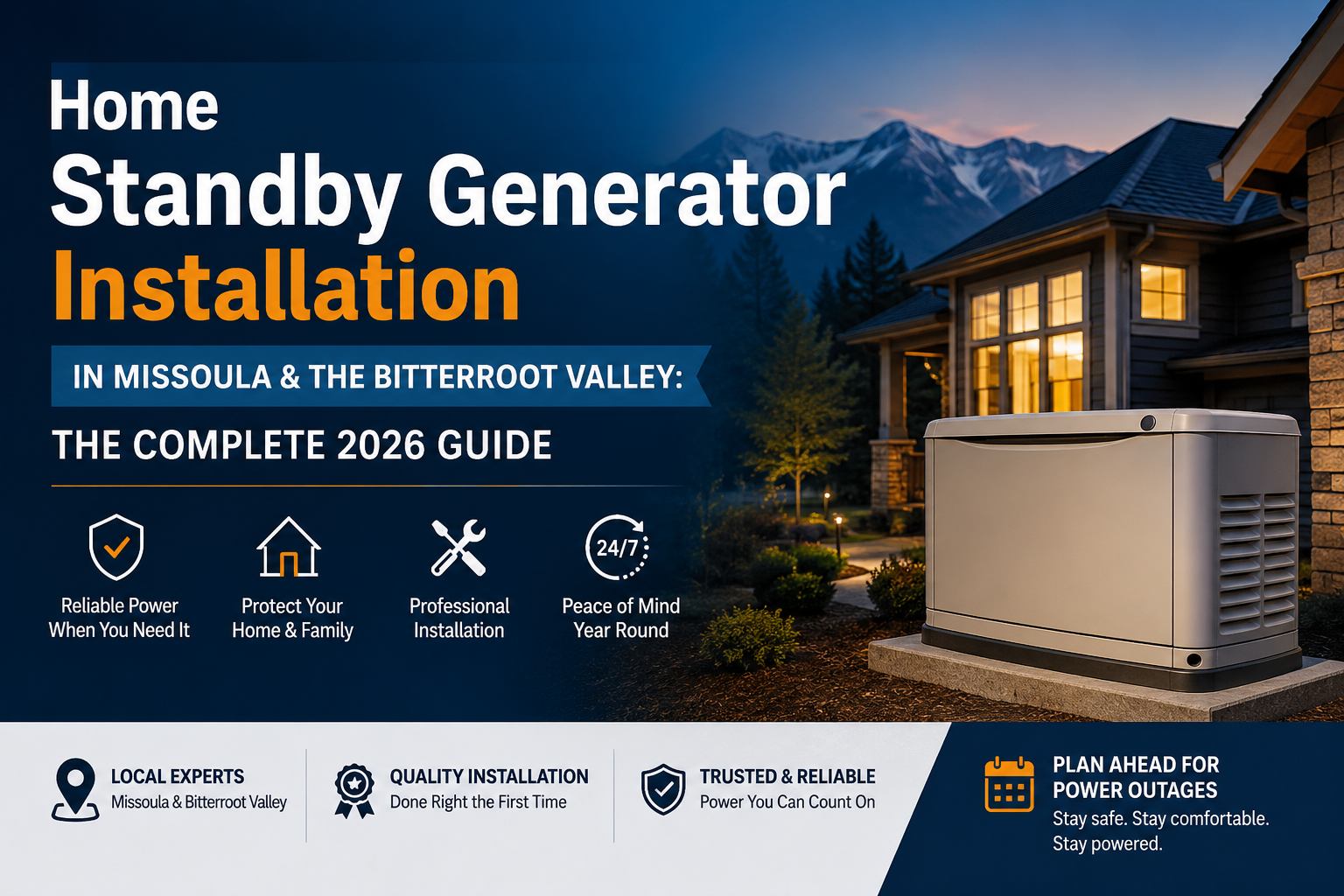
- Introduction To Intall Standby Generator in Missoula:
- Why Missoula and Bitterroot Valley Homeowners Are Installing Standby Generators
- A Growing Trend Across Western Missoula, Montana
- Portable Generators vs. Whole-Home Standby Generators
- How a Standby Generator System Works
- The Standby Generator Installation Process
- Step 1 — Site Assessment and Electrical Load Calculation
- Step 2 — Permitting and Utility Coordination
- Step 3 — Pad Placement and Setback Requirements
- Step 4 — Electrical Panel and Transfer Switch Installation
- Step 5 — Gas Line Connection
- Step 6 — Startup, Testing, and Homeowner Walkthrough
- How Much Does Standby Generator Installation Cost in Missoula?
- New Construction & Remodel Generator Planning
- Commercial Standby Power for Missoula Businesses
- Choosing a Licensed Electrician for Your Installation
- Maintenance Tips to Keep Your Generator Ready Year-Round
- Frequently Asked Questions
- How long does standby generator installation take?
- Can a standby generator power my whole house, including central air?
- Do I need a permit to install a standby generator in Missoula?
- How much does a whole-home generator cost installed in Missoula, MT?
- Natural gas or propane — which is better for a standby generator?
- Ready to Install a Standby Generator in Missoula or the Bitterroot Valley?
Introduction To Intall Standby Generator in Missoula:
When a Bitterroot Valley, Missoula windstorm knocks out power for six hours, or a winter system dumps snow on the lines outside Stevensville, the homes that stay warm, lit, and running aren’t lucky, they’re prepared. A properly sized, professionally installed standby generator turns a multi-hour outage into a non-event: your well pump keeps running, your furnace keeps cycling, your sump pump keeps up, and your fridge never misses a beat.
At Marrow Electric, we’ve spent 20 years working on homes and businesses across Missoula and the Bitterroot Valley, and standby generator installation has become one of the most requested projects on our schedule. This guide walks through why demand is growing, how the installation process actually works, what size generator your home needs, what it costs, and how to choose the right licensed electrician for the job.
Why Missoula and Bitterroot Valley Homeowners Are Installing Standby Generators
Western Montana’s power reliability challenges are different from a big city’s. Rural distribution lines run for miles through timber and open country, which means a single fallen tree, heavy wet snow, or high-wind event can take out power to an entire stretch of road, and restoration can take longer than it would in a dense urban grid.
Homeowners we work with in Bonner, Clinton, Frenchtown, Lolo, Florence, Stevensville, Victor, Corvallis, Hamilton, Darby, Connor, and Sula consistently point to the same triggers when they decide to invest in a standby system:
- Winter ice and heavy snow loads that bring down tree limbs and power lines
- High-wind events funneling through the valley, especially in fall and spring
- Public Safety Power Shutoffs (PSPS) during dry, high-fire-danger conditions
- Aging rural infrastructure with longer repair and restoration times
- Well pumps that leave a household without running water the moment the power drops
- Remote work, medical equipment, and home offices that can’t tolerate downtime
Read: https://www.marrowelectric.com/2026/08/24/signs-you-need-electrical-repair-missoula/
A Growing Trend Across Western Missoula, Montana
Standby generators used to be reserved for hospitals and large commercial buildings. That’s changed. We’re now installing whole-home systems on new construction projects from the first day of framing, and retrofitting them onto existing homes and remodels where a homeowner has been through one outage too many. If you’re already planning electrical work for a remodel, it’s worth reading our guide on residential remodel electrical work in Missoula and the Bitterroot Valley, since panel and service upgrades often go hand-in-hand with a generator install.
Portable Generators vs. Whole-Home Standby Generators
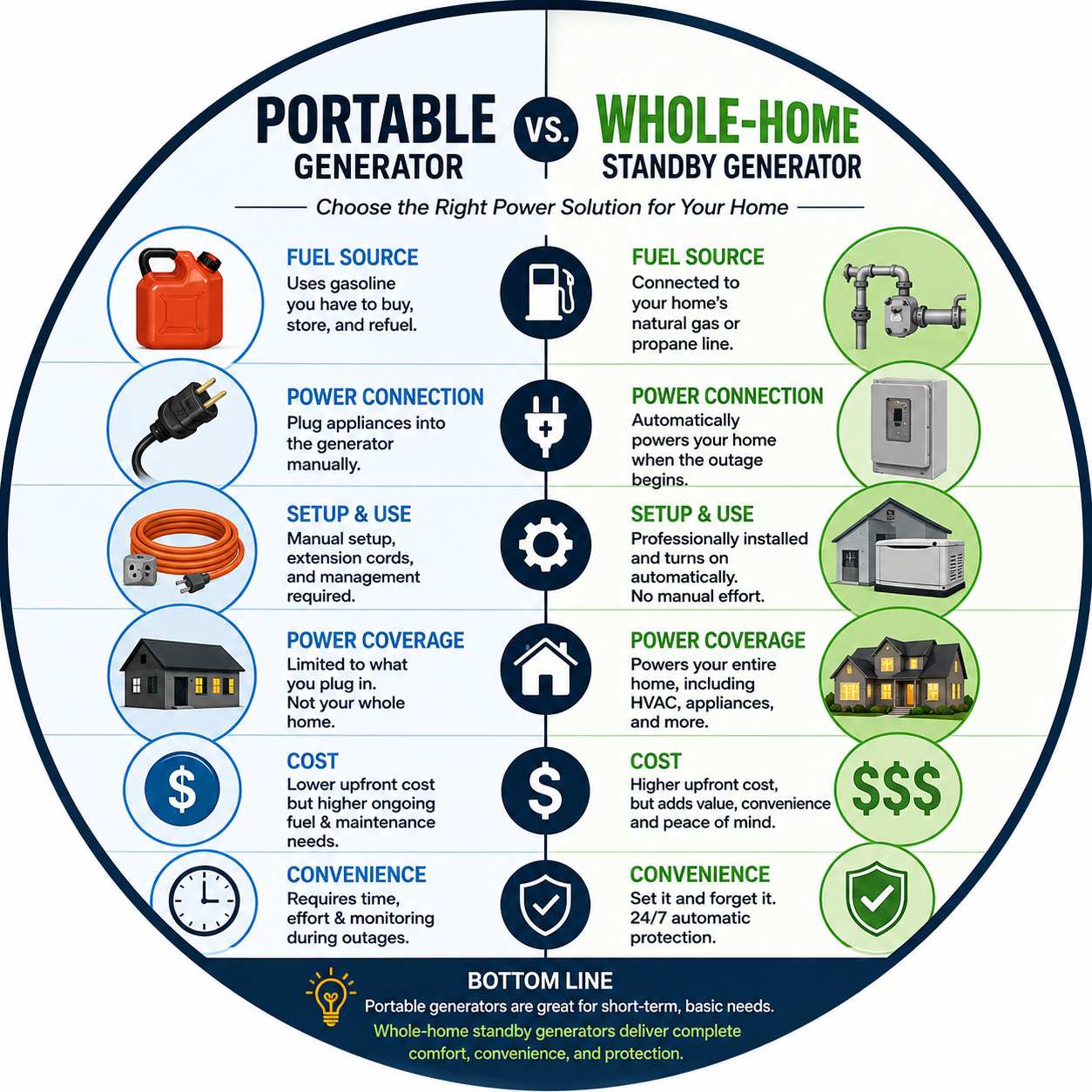
Not every home needs a permanently installed system, but it’s important to understand the trade-offs before you decide. A portable generator is cheaper up front but requires you to be home, manually start it, run extension cords, and refuel it, and running one too close to the house creates a real carbon monoxide risk. A standby generator is permanently wired into your electrical system through an automatic transfer switch, starts on its own within seconds of an outage, and runs on your existing natural gas or propane supply for as long as fuel is available.
| Feature | Portable Generator | Whole-Home Standby Generator |
|---|---|---|
| Power source | Gasoline (manual refill) | Natural gas or propane (continuous) |
| Startup | Manual — you start it and plug in cords | Automatic — powers on within seconds of an outage |
| Typical capacity | 3,000–10,000 watts | 10,000–26,000+ watts |
| Whole-house coverage | No — select circuits only, via extension cords | Yes — can be sized to cover the entire home |
| Installation | None required, plug-and-play | Permanent pad-mounted install by a licensed electrician |
| Safety | Carbon monoxide risk if run too close to the home | Installed at code-required clearance with CO safeguards |
| Typical cost | $500–$2,500 | $6,000–$15,000+ |
How a Standby Generator System Works
A whole-home standby system has three core components: the generator itself (mounted on a concrete or composite pad outside the home), an automatic transfer switch (ATS) installed next to your electrical panel, and the fuel supply line. The ATS constantly monitors incoming utility power. The moment it senses an outage, it signals the generator to start, then switches your home’s electrical load from the utility line to the generator, typically within 10 to 30 seconds. When utility power is restored, the system automatically switches back and shuts the generator down. Most systems also run a short weekly self-test cycle so the unit is always ready when you actually need it.
Stevensville, MT 59870
| Monday | 8 AM–5 PM |
| Tuesday | 8 AM–5 PM |
| Wednesday | 8 AM–5 PM |
| Thursday | 8 AM–5 PM |
| Friday | 8 AM–5 PM |
| Saturday | Closed |
| Sunday | Closed |
The Standby Generator Installation Process
Here’s what a professional installation with Marrow Electric actually looks like, from first call to final walkthrough.
Step 1 — Site Assessment and Electrical Load Calculation
We start by walking the property, reviewing your existing electrical panel, and calculating your home’s total electrical load. This determines whether you need a system sized for essential circuits only or true whole-home coverage, and it tells us whether your existing panel and service size can support the new equipment.
Step 2 — Permitting and Utility Coordination
Standby generator installs require an electrical permit, and depending on the project, mechanical and gas permits as well. As a licensed master electrician and unlimited electrical contractor in Montana, we handle permitting and any required coordination with your utility provider so you don’t have to navigate it yourself.
Step 3 — Pad Placement and Setback Requirements
The generator is mounted on a level concrete or engineered composite pad, positioned to meet manufacturer and code-required clearances from windows, doors, and property lines, both for noise and for safe exhaust ventilation.
Step 4 — Electrical Panel and Transfer Switch Installation
This is the heart of the project: running new circuit wiring, installing the automatic transfer switch, and tying it into your main panel. Older homes with outdated or undersized panels often need a panel upgrade first, we cover that process in detail in our guide to electrical panel upgrades in the Bitterroot Valley.
Step 5 — Gas Line Connection
Most residential standby units run on natural gas or propane. We coordinate the gas line sizing and connection so the generator gets consistent fuel pressure under full load , undersized gas lines are one of the most common causes of underperforming systems we’re called out to fix.
Step 6 — Startup, Testing, and Homeowner Walkthrough
Once everything is connected, we run a full startup test, simulate an outage to confirm the automatic transfer switch performs correctly, and walk you through the self-test schedule, maintenance needs, and warranty registration.
What Size Generator Do You Need?
Sizing is where a lot of installations go wrong, an undersized unit will trip under load, and an oversized one costs more than necessary. Here’s a general starting point; your exact number depends on your home’s actual electrical load calculation.
| Home Size / Load Need | Recommended Generator Size | Typical Coverage |
|---|---|---|
| Small home / essential circuits only | 10–14 kW | Well pump, furnace, fridge, select lighting & outlets |
| Mid-size home (1,800–3,000 sq ft) | 16–20 kW | Most of the home, including HVAC and kitchen |
| Large home or home w/ well + electric heat | 22–26 kW | Whole-home coverage, including AC and large appliances |
| Rural property / hobby farm | 24 kW+ | Home plus shop, barn, or outbuilding circuits |
| Small commercial / office | 30 kW+ | Sized per commercial load calculation |
How Much Does Standby Generator Installation Cost in Missoula?
Most whole-home standby generator installations in the Missoula and Bitterroot Valley area run between $6,000 and $15,000+ installed, depending on generator size, panel condition, gas line work, and site accessibility. For a full breakdown of what drives electrician pricing in our area, including hourly rates and typical project ranges, see our guide on electrician costs in Missoula, MT. The biggest cost variables we see are: whether your panel needs an upgrade, how far the generator sits from the panel and gas meter, permit fees, and whether trenching is required for the fuel line.
New Construction & Remodel Generator Planning
The most cost-effective time to plan for a standby generator is before drywall goes up. If you’re building new, our residential new construction electrical process includes generator-ready panel design from day one. If you’re renovating an existing home, our residential remodel electrical services can incorporate a standby system alongside panel upgrades, EV charger installs, or smart home wiring you’re already planning.
Commercial Standby Power for Missoula Businesses
Outages don’t just cost homeowners comfort, for a restaurant, office, or warehouse, downtime means lost revenue and spoiled inventory. We size and install commercial-grade standby systems as part of our commercial and tenant improvement electrical work throughout Missoula, ensuring critical systems like refrigeration, security, and point-of-sale equipment stay online.
Choosing a Licensed Electrician for Your Installation
A standby generator ties directly into your home’s electrical service, so this isn’t a project for an unlicensed handyman. We walk through exactly what to check for in our guide on how to find a licensed electrician in Missoula, MT. At minimum, confirm your contractor holds a Montana electrical contractor license, carries proper insurance, and pulls permits for every job. If you’re also dealing with flickering lights, tripped breakers, or other issues alongside your generator project, our electrical service and troubleshooting page covers common warning signs worth addressing at the same time.
Maintenance Tips to Keep Your Generator Ready Year-Round
- Let the weekly self-test cycle run uninterrupted, don’t disable it to save fuel
- Schedule an annual professional inspection before winter storm season
- Keep the pad area clear of snow, leaves, and vegetation for airflow and access
- Check battery health annually, a dead start battery is the most common failure point
- Confirm your propane tank stays above 30% through the winter months, if applicable
Frequently Asked Questions
How long does standby generator installation take?
Most residential installs take 1 to 3 days of on-site work, not counting permit approval time, which can add one to several weeks depending on the local permitting office and utility coordination.
Can a standby generator power my whole house, including central air?
Yes, if it’s sized correctly. A 22–26 kW system can typically run an entire home, including central air conditioning, electric water heaters, and kitchen appliances. This is confirmed with a full electrical load calculation before installation.
Do I need a permit to install a standby generator in Missoula?
Yes. Standby generator installations require an electrical permit, and often mechanical or gas permits as well. A licensed contractor handles this as part of the installation.
How much does a whole-home generator cost installed in Missoula, MT?
Most installations range from $6,000 to $15,000 or more, depending on generator size, existing panel condition, and site conditions such as distance from the gas meter.
Natural gas or propane — which is better for a standby generator?
Natural gas offers unlimited run time as long as utility gas service is intact, while propane requires a storage tank but isn’t dependent on a gas utility line, which can be an advantage in more rural parts of the Bitterroot Valley.
Ready to Install a Standby Generator in Missoula or the Bitterroot Valley?
Marrow Electric is a family-owned, fully licensed master electrician and unlimited electrical contractor serving Missoula, Hamilton, and the surrounding Bitterroot Valley. We handle every step of your standby generator project, load calculation, permitting, panel work, and final testing, so your home stays powered no matter what the Montana weather brings. Request a free estimate or explore our Missoula electrical contractor and Hamilton electrical contractor service pages to learn more, or call us at (406) 360-8071.