Every business runs on electricity, but most owners never think about how much of it their building can actually deliver until something goes wrong. A breaker trips in the middle of a lunch rush. The lights dim every time the compressor kicks on. A new tenant asks whether the building can handle their equipment, and nobody knows the answer.
That is exactly the moment to ask a bigger question: when should a business upgrade its electrical service capacity?
In short, a business should upgrade its electrical service when the existing infrastructure can no longer safely or reliably support daily operations, major equipment additions, or building growth. The best time to act is usually before a failure, a failed inspection, or a delayed project forces your hand.
This guide from Marrow Electric explains what electrical service capacity really means, the warning signs that your building is running out of power, the business changes that trigger an upgrade, and what the process looks like for commercial properties in Missoula and the Bitterroot Valley. Whether you run a restaurant, a retail shop, a clinic, a workshop, or an office, you will leave with a clear checklist for deciding if it is time to call a licensed commercial electrician.
Quick Answer: When Should a Business Upgrade Its Electrical Service?
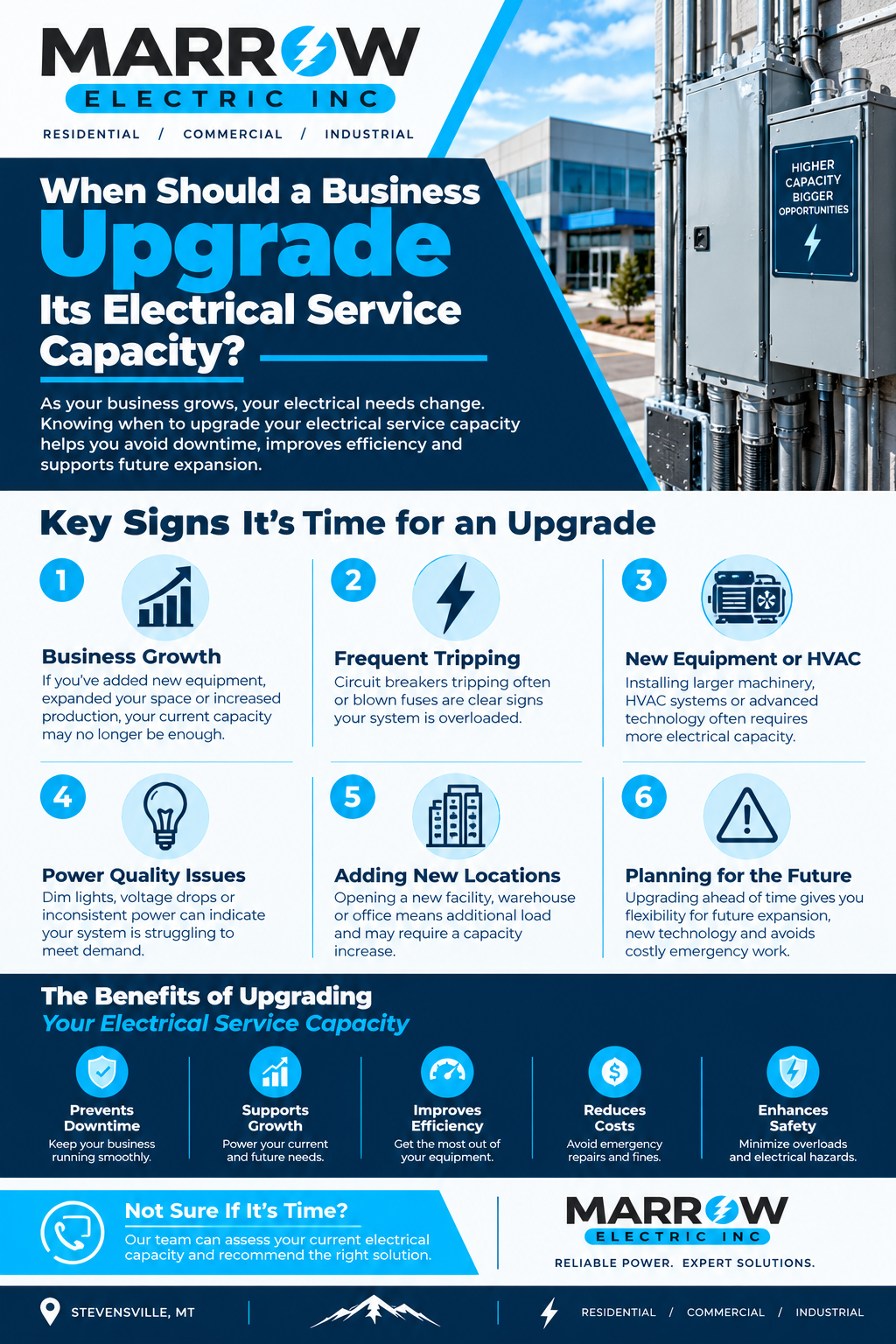
A business should upgrade its electrical service capacity when:
- Breakers trip or fuses blow regularly during normal operation
- Permanent extension cords and stacked power strips are needed to run equipment
- Lights flicker or dim when heavy machinery or HVAC equipment starts
- The panel, wiring, or service equipment is 20 to 40 years old, or uses fuses or outdated wiring
- Panels, outlets, or switch plates feel warm, smell burnt, or look scorched
- The business is expanding, remodeling, or changing its layout
- New high-demand equipment is coming, such as commercial HVAC, industrial machinery, server rooms, or EV chargers
- A load calculation shows the building has little or no spare capacity
If any of these apply, the next step is a formal load calculation performed by a licensed electrician, not a guess or a quick fix.
What Does Electrical Service Capacity Mean?
Before deciding on an upgrade, it helps to understand what you would actually be upgrading. Electrical service capacity is the maximum amount of power your building can safely receive from the utility and distribute to its circuits at one time. It is not just your panel. It is a chain of components, and the weakest link sets the limit.
The Parts of a Commercial Electrical Service
A typical commercial electrical service includes several connected pieces:
- The utility connection: The overhead or underground lines and the transformer that bring power to your property. In western Montana, your local utility controls this part of the system and must be involved in any major service change.
- The service entrance and meter: The point where power enters your building and is measured.
- The main disconnect and main panel: The switchgear that controls and protects everything downstream. Its amperage rating is the headline number most people talk about.
- Feeders and subpanels: The heavy conductors and secondary panels that carry power to different areas or tenant spaces. If your building already has a distribution layout that is stretched thin, our guide on when a building needs a subpanel explains how that decision fits in.
- Branch circuits: The individual circuits that feed outlets, lighting, and equipment.
Upgrading capacity can mean replacing just the main panel, or it can mean upgrading the utility connection, meter, feeders, and panel together. A licensed electrician determines which, based on measured loads and the demands you plan to add.
Amps, Volts, and Phase in Plain English
Three numbers describe what your service can deliver:
- Amperage is the size of the electrical pipe. Common commercial services range from 200 amps to 400 amps and beyond.
- Voltage is the pressure pushing the power through. Many small commercial buildings use single-phase 120/240 volt service, while larger or industrial buildings often use 208, 277, or 480 volt systems.
- Phase describes how power is delivered. Single-phase is common in homes and small shops. Three-phase power is more efficient for large motors, commercial kitchens, shop equipment, and big HVAC systems.
A business may have plenty of amperage but the wrong voltage or phase for new equipment. That is why capacity questions are never answered by the panel label alone.
Warning Signs Your Business Needs an Electrical Service Upgrade
Electrical systems rarely fail without warning. They send signals first. Here are the most common signs that your service capacity no longer matches your needs.
1. Frequent Breaker Trips or Blown Fuses
A breaker is a safety device. It trips to protect wiring from overheating. When it trips once after a freak event, that is normal. When it trips regularly, the circuit or the main panel is being asked to carry more than it was designed for.
In a business, this often shows up as:
- A breaker that trips every time two pieces of equipment run together
- A main breaker that trips on busy days
- Fuses that keep blowing in older buildings
Resetting the breaker again and again is not a fix. Repeated trips are a symptom of overload, and overload creates heat. If this sounds familiar, our article on flickering lights and tripping breakers walks through what causes these problems and how electricians diagnose them.
2. Overuse of Extension Cords and Power Strips
Walk through your workspace. If you see permanent extension cords, power strips plugged into other power strips, or cords running across floors to reach equipment, your building does not have enough outlets or dedicated circuits where you need them.
Extension cords are designed for temporary use. When they become part of the permanent layout, they create trip hazards, overheating risks, and a pattern of overloaded circuits. Sometimes the fix is adding new circuits. Sometimes it means the panel has no room left to add them, which points back to a service or panel upgrade. High-draw equipment such as ovens, compressors, and dryers often needs its own protected line, which we cover in our guide to dedicated circuits and the appliances that need them.
3. Flickering or Dimming Lights
If your lights dim when the HVAC unit starts, when a compressor cycles on, or when machinery powers up, you are seeing voltage drop. That can point to an undersized service, loose connections, or conductors that are overloaded. Occasional flicker can be a bad bulb or fixture. Flicker that follows equipment cycles is a pattern, and patterns deserve a professional look.
Flickering also matters for equipment health. Voltage instability shortens the life of motors, electronics, point-of-sale systems, and refrigeration.
4. Outdated or Aging Electrical Infrastructure
Electrical equipment does not last forever. Panels, breakers, and wiring that are 20 to 40 years old may no longer meet modern safety codes or handle modern loads. Buildings may still use:
- Fuse boxes instead of breaker panels
- Older panel brands with known reliability concerns
- Legacy wiring such as knob-and-tube or aluminum branch wiring
- Panels with no open spaces for new circuits
Many older commercial buildings were wired for a very different workload. Back then, a few lights, a typewriter, and a radio were typical. Today, the same space may hold computers, networking gear, point-of-sale terminals, security systems, space heaters, coffee machines, and more. The wiring did not change, but the load did.
5. Burning Smells, Scorched Outlets, or Warm Panels
This is the most urgent sign on the list. Warm switch plates, a burnt odor, discolored outlets, buzzing from the panel, or a panel cover that is hot to the touch can signal dangerous overheating and a serious fire risk.
If you notice any of these, do not wait for a scheduled upgrade. Turn off the affected equipment if it is safe to do so, stay clear of the panel, and call a licensed electrician right away. If there is visible smoke, fire, or immediate danger, call 911 first. Our guide on what counts as an electrical emergency can help you decide how to respond.
6. Other Quiet Warning Signs
Not every sign is dramatic. These smaller clues also suggest your capacity is tight:
- Your panel has no open breaker spaces
- Electricians have previously used tandem breakers to squeeze in extra circuits
- Your utility bills have jumped without a change in operations
- Equipment resets, shuts down, or behaves strangely under load
- You have been told that a planned equipment purchase may not be supported
Any one of these on its own may be manageable. Several together make a strong case for a formal assessment.
Operational Triggers: Business Changes That Call for More Power
Sometimes there are no warning signs at all. The building runs fine today, but the business is about to change. Planned changes are the best time to evaluate capacity, because upgrades are far cheaper to coordinate before construction than after.
Business Expansion or Remodeling
Adding square footage, building out a new suite, scaling up operations, or reorganizing the layout all add electrical demand. More lights, more outlets, more HVAC, and more equipment all draw from the same service.
Remodels are especially important because they often involve opening walls and ceilings. That is the easiest and most cost-effective moment to upgrade feeders, add subpanels, or replace aging wiring. Many remodels also trigger permit and inspection requirements. If you are planning construction, read our overview of electrical work that requires a permit in Montana so your schedule accounts for it.
Installing High-Demand Equipment
Certain equipment is a capacity game-changer. Before you buy, check the electrical requirements for:
- Commercial HVAC and rooftop units
- Industrial machinery, compressors, and shop tools
- Commercial kitchen equipment such as ovens, fryers, and walk-in coolers
- Server rooms and IT closets
- Smart building systems, security, and access control
- Large signage and lighting retrofits
- Hot tubs and spas, if you run a hospitality or wellness business (see our guide to hot tub electrical installation in Missoula)
- Backup power systems and generators
Equipment spec sheets list the required voltage, amperage, and phase. Give those sheets to your electrician before you sign a purchase order, not after the equipment arrives.
Adding Electric Vehicle Charging
EV charging is one of the fastest-growing reasons for service upgrades. A single Level 2 charger can draw as much power as a large appliance, and several chargers running at once can demand a surprising share of a building’s capacity. Businesses add chargers for employees, customers, and fleets, and the demand often grows over time.
Planning matters here. Even if you install one charger today, it is smart to design the service, conduit, and panel space for future expansion. Learn more about our EV charger installation services and how load management can reduce the size of the upgrade you need.
Changing Tenants or Building Use
If you own or manage commercial property, a change in tenant or use is a classic trigger. A space that once held a quiet office may become a restaurant, salon, fitness studio, or clinic. Each of these has very different electrical demands. A tenant may also bring specialty equipment that the existing service was never designed to feed.
Landlords who plan ahead can avoid delays in leasing. Tenants who ask about capacity early can avoid expensive surprises during build-out.
Increasing Your Main Amperage
Some businesses simply outgrow their service size. Moving from a 100-amp or 200-amp service to a 400-amp or larger service, or from single-phase to three-phase distribution, is a common upgrade path. The correct size depends on measured and calculated loads, not on a rule of thumb. A licensed electrical contractor should always guide this decision, because the utility, the code, and your equipment all play a part.
How to Find Out If You Need More Capacity: The Load Calculation
The most reliable way to answer the question is a load calculation. This is a formal analysis of how much power your building uses now, and how much it will need after planned changes.
What a Load Calculation Includes
A licensed electrician will typically:
- Inventory your connected loads: Lighting, receptacles, HVAC, motors, kitchen equipment, IT systems, and special equipment.
- Apply demand factors: Not every device runs at once. Electrical code allows calculated demand factors that reflect realistic use.
- Measure actual usage: Clamp meters and monitoring tools can show real peak demand, and utility billing history can show seasonal highs.
- Add planned equipment: New machines, expansion, or EV chargers are included so you know the future picture.
- Compare against service capacity: The result shows your spare capacity, or your shortfall.
- Check the weakest link: Panels, feeders, transformers, and the utility connection are each checked, not just the main breaker.
Why Guessing Does Not Work
Some owners assume that a bigger panel is automatically the answer. Others assume a trip means a bad breaker. Both can be wrong. A bigger panel on an undersized utility connection solves nothing. A replaced breaker on an overloaded circuit hides the problem and increases the risk. A proper calculation tells you exactly what is needed, and just as important, what is not.
Questions to Bring to Your Electrician
You will get more from the assessment if you come prepared:
- What equipment are you planning to add in the next one to three years?
- Which circuits trip, flicker, or run warm today?
- How old is the panel, and do you have any past electrical reports or drawings?
- Do you rent or own, and who must approve service changes?
- What is your timeline, and can you schedule work around business hours?
What an Electrical Service Upgrade Involves
Business owners often worry that an upgrade means long shutdowns and chaos. With planning, it usually does not. Here is how a typical commercial service upgrade unfolds.
Step 1: Site Assessment and Load Calculation
Your electrician inspects the panel, wiring, grounding, and service equipment, then completes the load calculation described above. You receive a clear explanation of the findings and your options.
Step 2: Design and Equipment Selection
The electrician designs the new service, selecting the right panel, main disconnect, meter base, feeders, and any subpanels. The design accounts for current needs plus room to grow, so you do not need another upgrade in a few years.
Step 3: Permits and Utility Coordination
Service upgrades are not DIY projects. They require permits and inspections, and they require coordination with your electric utility, which may need to disconnect and reconnect power, approve the new meter arrangement, or upgrade its transformer. Requirements can differ between city, county, and state jurisdictions, so a local electrician who works in the area every day is a major advantage. Utility lead times can be the longest part of the schedule, which is why early planning matters.
Step 4: Scheduling Around Your Business
Most upgrades need a planned power outage for part of a day. Good contractors schedule that outage for evenings, weekends, or slow periods. If your operation cannot go dark, such as a clinic or refrigerated food business, ask about temporary power or generator options. Our guide to generator installation covers backup power planning.
Step 5: Installation, Inspection, and Reconnection
The electrician installs the new equipment, labels circuits clearly, and arranges inspections. Once the work passes, the utility reconnects power. You should leave with an updated panel directory, documentation, and a clear picture of your remaining spare capacity.
Step 6: Testing and Handover
A final test confirms that voltage is stable and that circuits perform under load. A good contractor walks you through the new system and explains how to add loads safely in the future.
Do You Really Need a Service Upgrade? Alternatives to Consider
Not every capacity problem requires a new service. An honest electrician will review lower-cost options first, such as:
- Adding a subpanel: If the main service has spare capacity but the panel is full, a subpanel can add breaker spaces. Learn when this works in our guide on subpanel installation.
- Load management or load shedding: Devices can pause one load, such as an EV charger, while another is running, reducing peak demand.
- Adding dedicated circuits: If problems come from one overloaded circuit, new dedicated lines may fix it.
- Equipment efficiency upgrades: Newer HVAC, lighting, and refrigeration often draw significantly less power than older models.
- Scheduling heavy loads: Staggering startup times of large equipment can reduce peak demand.
These options help in some cases, but they have limits. If the calculation shows that your service is truly undersized, or that growth is coming, a proper upgrade is more economical than a series of patches.
What Affects the Cost and Timeline of an Upgrade?
Commercial upgrade costs vary widely, so any number quoted without a site visit should be treated with caution. The main cost drivers include:
- Service size: The jump from 200 amps to 400 amps or more changes the equipment significantly.
- Voltage and phase: Moving to three-phase power or a different voltage requires different equipment and utility involvement.
- Distance and trenching: Long runs from the utility connection to the building, or underground conduit, increase labor and materials.
- Condition of existing wiring: Aging or damaged conductors may need replacement while the walls are open.
- Utility requirements: Transformer upgrades and meter changes can add cost and lead time.
- Permits and inspections: Fees and required documentation differ by jurisdiction.
- Access and scheduling: After-hours work or complex building access may change labor costs.
For homeowners comparing scale, our article on panel upgrade costs in Missoula explains how pricing works at the residential level, and many of the same factors apply to commercial work on a larger scale.
Timelines depend heavily on the utility. A straightforward panel replacement can sometimes be done in a day or two once materials arrive. A full service upgrade with new feeders, a new meter, and a utility transformer change can take weeks. Starting early is the best way to avoid delaying a grand opening or equipment installation.
The Cost of Waiting Too Long
Delaying an upgrade often feels like saving money. In practice, it usually shifts the cost into less predictable forms:
- Downtime: An overloaded service that fails during business hours stops revenue.
- Equipment damage: Voltage instability and repeated trips shorten the life of expensive machines and electronics.
- Fire risk: Overheated panels and wiring are a leading cause of electrical fires in older buildings.
- Failed inspections: Outdated or unsafe equipment can block a sale, a lease, or a new certificate of occupancy.
- Insurance problems: Insurers may ask about the age and condition of electrical systems, and unresolved hazards can complicate claims.
- Project delays: Discovering a capacity shortfall after equipment arrives can stall an entire project.
An upgrade is an investment in safety, reliability, and growth. Planned work is almost always cheaper and calmer than emergency work.
A Practical Checklist: Is It Time to Upgrade?
Use this quick self-check. Each yes answer raises the case for a professional assessment:
- Do breakers trip or fuses blow more than occasionally?
- Do you rely on extension cords or power strips for permanent equipment?
- Do lights flicker or dim when equipment starts?
- Is your panel or wiring more than 20 years old?
- Does your panel have no open spaces for new breakers?
- Have you noticed warm panels, burning smells, or scorched outlets?
- Are you planning an expansion, remodel, or new tenant?
- Are you adding HVAC, machinery, a server room, or EV chargers?
- Has an electrician or inspector flagged your service equipment?
- Are you unsure whether your building can handle your plans?
If you answered yes to even one of the safety questions (1, 3, or 6), do not wait. If you answered yes to the growth questions (7 or 8), schedule a load calculation before you buy equipment or start construction.
Why Work With a Local Commercial Electrician in Missoula
Electrical service upgrades are regulated work, and the rules differ between jurisdictions. A local electrician understands how Missoula, Ravalli County, and the Bitterroot Valley handle permits, inspections, and utility coordination. Local contractors also understand the realities of the region, including harsh winters that stress electrical equipment, older building stock in historic downtown areas, and rapid growth that is increasing demand on commercial properties.
When you choose a contractor, look for:
- A valid Montana electrical license and current insurance
- Experience with commercial load calculations and service upgrades
- Clear written estimates that explain the scope
- Willingness to coordinate with the utility and inspectors
- Warranties on workmanship
- Reviews and references from local businesses
Not sure what to ask? Our guide on what to know before hiring an electrician lists the questions that separate qualified contractors from risky ones.
Frequently Asked Questions
When should a business upgrade its electrical service?
A business should upgrade when its electrical system can no longer safely or reliably support operations. Common triggers include frequent breaker trips, flickering lights, warm panels, an aging system, business expansion, and new high-demand equipment such as HVAC units, machinery, server rooms, or EV chargers.
How do I know if my business needs a bigger electrical panel?
Warning signs include breakers that trip regularly, no open breaker spaces, reliance on extension cords, and lights that dim when equipment starts. The only reliable confirmation is a load calculation performed by a licensed electrician, which compares your actual and planned loads against your service capacity.
How many amps does a small business need?
It depends on the type of business, the building size, and the equipment. Many small commercial spaces run on 200 amps, while restaurants, workshops, and larger buildings often need 400 amps or more, sometimes with three-phase power. A load calculation gives the real answer for your property.
Is a panel upgrade the same as a service upgrade?
Not always. A panel upgrade replaces the panel and breakers. A service upgrade increases the capacity of the entire entrance, which can include the utility connection, meter, main disconnect, feeders, and panel. Some projects need only a panel replacement or subpanel, while others require the full service upgrade.
Do I need a permit to upgrade my commercial electrical service?
Yes, in most cases. Service upgrades typically require permits and inspections, and they usually involve coordination with the electric utility. Requirements vary by jurisdiction, so a local licensed electrician can confirm what applies to your property.
How long does a commercial electrical service upgrade take?
The installation itself may take a day or several days, depending on scope. The overall timeline can be longer because of design, permitting, equipment lead times, and utility scheduling. Starting the process early prevents delays to openings, remodels, and equipment installs.
Will my business have to shut down during the upgrade?
Usually only for a planned outage of part of a day. A good contractor schedules this outside business hours when possible, and can discuss temporary power options for operations that cannot lose power.
Can I add EV chargers without upgrading my service?
Sometimes. If your building has spare capacity, or if load management can limit peak demand, a service upgrade may not be necessary. A load calculation will show whether your current service can support the chargers you want, now and in the future.
What are the most dangerous signs of an overloaded electrical system?
Burning smells, scorched outlets, warm or buzzing panels, and warm switch plates are the most urgent. They indicate overheating and fire risk. Stop using the affected equipment if it is safe to do so and call a licensed electrician immediately. In case of smoke or fire, call 911.
How often should a commercial electrical system be inspected?
A professional inspection is wise whenever you notice warning signs, plan an expansion, buy a building, or before adding major equipment. Many businesses also schedule periodic inspections as part of preventive maintenance, especially in older buildings.
Final Thoughts: Upgrade Before the Problem Upgrades You
An electrical system that is working today may still be unprepared for tomorrow. Frequent trips, flickering lights, extension cord clutter, aging panels, and warm equipment are all signs that your building is asking for help. Expansion plans, new equipment, and EV charging are all reasons to look at capacity before you buy or build.
The smartest first step is not a new panel. It is a proper load calculation by a licensed commercial electrician. That one assessment tells you what your service can support, what it cannot, and the most cost-effective way to close the gap.
Ready to find out where your business stands? Contact Marrow Electric to schedule a commercial electrical assessment in Missoula and the Bitterroot Valley. Request a quote or assessment here, or learn more about our electrical service and troubleshooting work.
Need an Electrician?
Reliable electrical service in Stevensville and the Bitterroot Valley.
Call Marrow Electric65 Goose Ln, Stevensville, MT 59870