
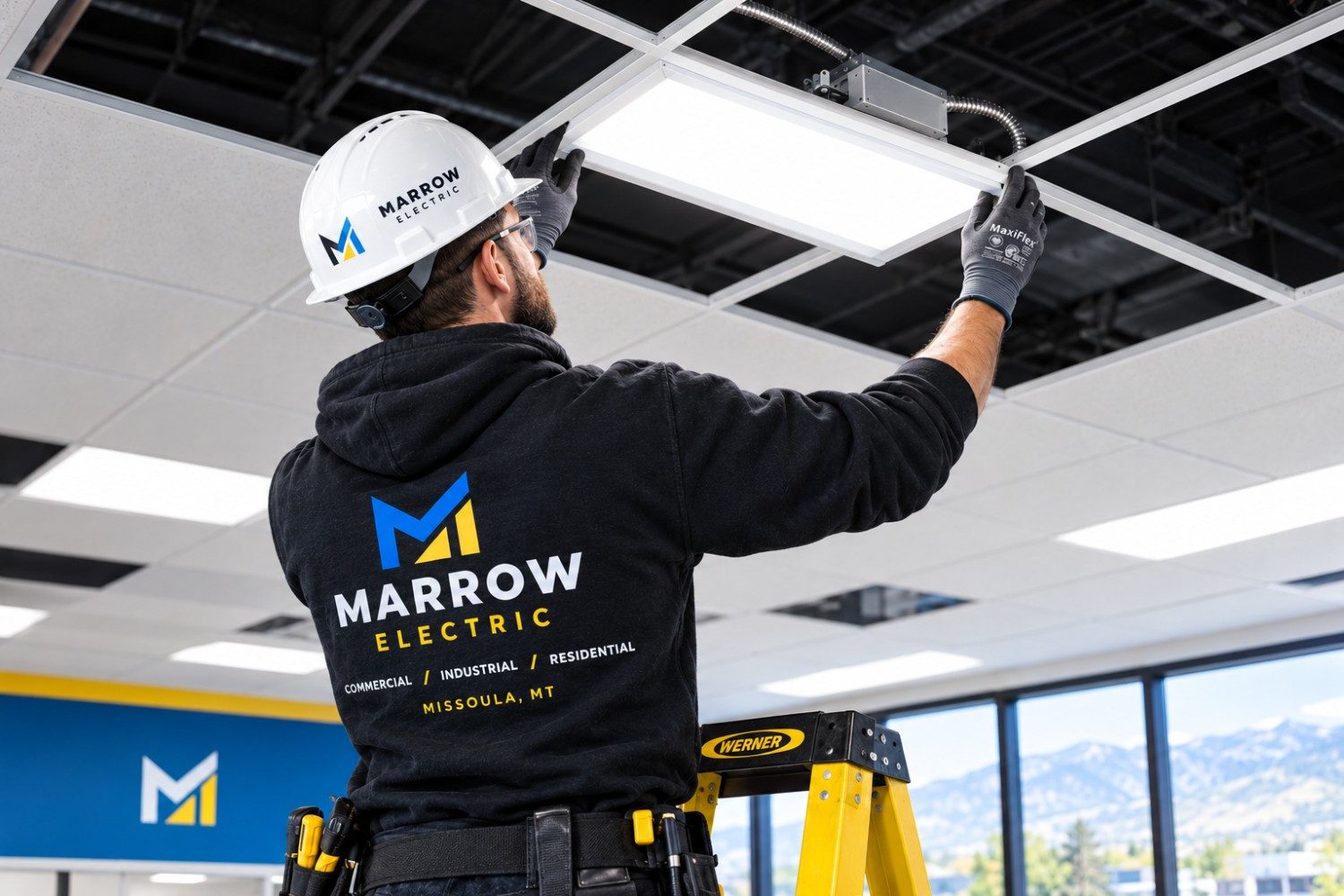
Introduction
If you own or manage commercial property in Missoula, you’ve probably wondered whether upgrading your lighting is worth the upfront cost. The short answer: it depends on your building, your current fixtures, and how long you plan to hold the space. For most Missoula businesses, however, an LED retrofit can pay for itself faster than owners expect.
As a commercial electrician in Missoula, Marrow Electric gets this question constantly from property managers comparing bids, business owners planning a remodel, and landlords preparing a space for a new tenant. This guide breaks down realistic payback timelines, what triggers a lighting upgrade during a tenant improvement buildout, and the code requirements every Missoula commercial space needs to meet.
If you’ve also been comparing residential vs. commercial electrical work, lighting is one of the clearest areas where the two diverge. Commercial projects can involve different code triggers, load calculations, and ROI considerations than a typical home rewiring project.
Whether you’re managing a single storefront on Higgins Ave or a multi-tenant building near the university, this article will help you figure out whether now is the right time to upgrade, what it typically costs, and how to plan the work around your business hours as an electrical contractor in Missoula.
Why Missoula Businesses Are Upgrading Lighting Now
Commercial lighting sits quietly in the background of most businesses until the energy bill arrives or a fixture starts flickering. A few forces are pushing more Missoula property owners to act:
- Rising commercial electricity rates in western Montana, which make inefficient lighting more expensive every year
- Aging fluorescent and metal halide fixtures reaching end-of-life in buildings built before 2010
- Tenant turnover, which is the natural moment to modernize lighting during a tenant improvement electrical scope
- Updated energy code requirements that apply whenever a space pulls permits for renovation
- Simple wear and tear, ballasts failing, uneven light levels, and maintenance calls piling up, which our team also covers under general electrical repair for Missoula properties
None of these forces alone always justifies a full retrofit. But when two or three line up, an aging system, a tenant change, and a permit trigger, that’s usually the point where the math clearly favors upgrading rather than patching.
LED Retrofits: What Actually Change
A “retrofit” doesn’t always mean tearing out the ceiling grid. In most Missoula commercial buildings, it means one of three approaches:
1. Lamp-and-ballast swap
The existing fixture housing stays; the fluorescent tubes and ballast are replaced with LED tubes or a retrofit kit. This is the least invasive and least expensive option, and it’s often where we start when a business wants lower bills without a full remodel.
2. Fixture replacement
The whole fixture is swapped for a new LED unit. This is common when fixtures are visibly aging, when light distribution needs to improve, or when a space is being reconfigured as part of a commercial tenant improvement project.
3. Full redesign with controls
For larger retail, office, or warehouse spaces, a lighting upgrade is paired with occupancy sensors, daylight harvesting, and zoned controls. This tends to happen alongside a broader electrical panel upgrade or new construction electrical scope, since controls wiring and load calculations are easier to plan when walls are already open.
Each approach has a different price point and payback timeline, which is where the numbers below come in.
Energy Cost Payback: What the Numbers Actually Look Like
Every building is different, but there are patterns we see consistently across Missoula commercial projects. Here’s a general framework property owners can use to estimate their own payback period:
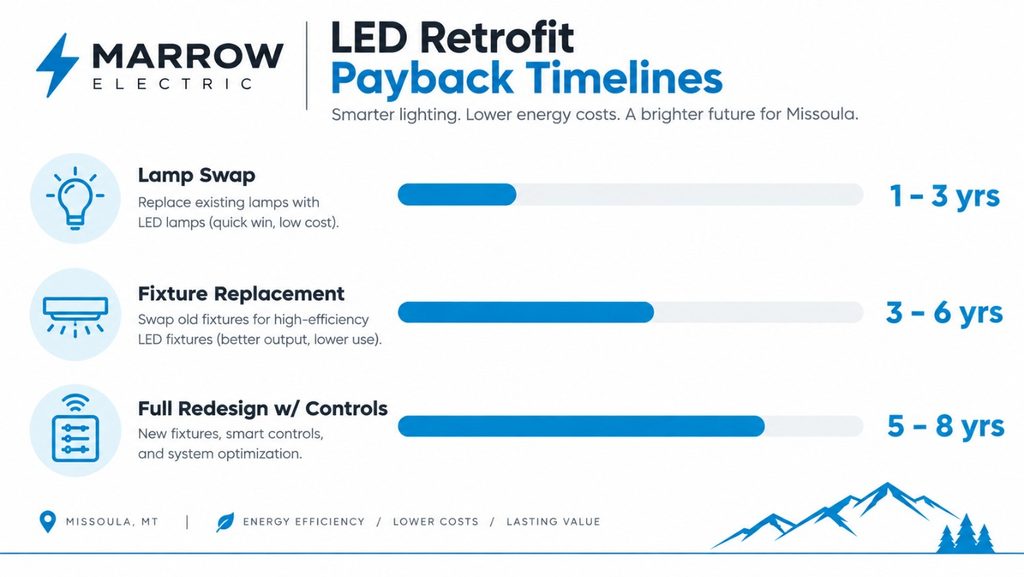
- Simple lamp swaps (T8 fluorescent to LED tube): typically pay back in 1 to 3 years, since material cost is low and energy savings per fixture (roughly 40-50% lower wattage) add up quickly across a building with dozens of fixtures.
- Full fixture replacement: usually pays back in 3 to 6 years, depending on how outdated the existing system was and local utility rates.
- Full redesign with occupancy sensors and controls: often takes 5 to 8 years to fully pay back, but delivers the deepest long-term savings (50-70% reduction in lighting energy use) and the biggest jump in tenant comfort and resale appeal.
A few factors shift these numbers in either direction:
- Hours of operation, a business lit 12+ hours a day sees faster payback than one open 40 hours a week
- Existing fixture age and efficiency, swapping out old metal halide high-bays typically has the fastest payback of any category
- Available utility rebates, which can shorten payback by months when timed correctly
- Whether the upgrade is bundled into a larger renovation, which spreads labor costs across other work already happening on-site
Property managers evaluating multiple buildings often ask us to run this math property-by-property rather than assuming one number applies everywhere, which is exactly the kind of assessment our electrical contractor Missoula team does before quoting a project.
Tenant Improvement Lighting: Timing It Right
Lighting upgrades are most cost-effective when they piggyback on other work that’s already opening up walls, ceilings, or electrical panels. This is why so many of our lighting projects happen as part of a tenant improvement electrical scope rather than as a standalone job.
If you’re a landlord prepping a space for a new tenant, or a business owner taking over a lease, here’s how lighting typically fits into the buildout sequence:
- Space plan finalized — layout determines fixture placement, not the other way around
- Load calculation and panel review — this is when our team checks whether the existing panel can support new lighting and equipment loads, sometimes triggering an electrical panel upgrade alongside the lighting scope
- Rough-in wiring — conduit and wiring run before drywall or ceiling tile goes in
- Fixture installation and trim-out — this is when the visible upgrade happens
- Inspection and final walkthrough — code compliance sign-off, covered in detail below
Trying to add a lighting upgrade after a buildout is finished almost always costs more, since it means reopening finished ceilings and walls. If you know a lighting change is likely, it’s worth flagging it before the tenant improvement scope of work is finalized, not after.
Code Compliance for Commercial Lighting in Missoula
Any commercial lighting project that requires a permit, which includes most retrofits beyond a simple lamp swap, has to meet current energy code requirements. A few things Missoula business owners commonly need to know:
- Lighting power density (LPD) limits — the energy code caps how many watts per square foot a space can use for lighting, based on occupancy type (retail, office, warehouse, etc.). Older buildings often exceed today’s limits, which is one reason a full retrofit is required rather than a partial swap once permits are pulled.
- Automatic shutoff requirements — most commercial spaces are required to have lighting controls that automatically turn off when the space is unoccupied or during unoccupied hours, which usually means occupancy sensors or scheduled controls.
- Egress and exit lighting — emergency and exit lighting has its own set of code requirements separate from general illumination, and these get checked closely during inspection.
- Permit and inspection process — as a licensed electrical contractor in Missoula, we pull permits, coordinate inspections, and make sure the finished lighting scope meets code the first time, which avoids the delays and rework we sometimes see with unpermitted work.
Skipping permits on a lighting upgrade might save time upfront, but it creates real risk at resale, at insurance renewal, or if the space is inspected for any other reason down the line. It’s a mistake we see property owners try to avoid the hard way, similar to the risks covered in our guide on how to find a licensed electrician in Missoula.
What This Looks Like for Different Business Types
Retail storefronts: Lighting upgrades here are often as much about customer experience and merchandising as energy savings, better color rendering and even light distribution can matter more than the payback timeline alone.
Offices: Occupancy sensors and daylight harvesting tend to deliver the biggest wins, since office space usage is uneven throughout the day and week.
Warehouses and shops: High-bay LED retrofits usually have the fastest, most dramatic payback of any commercial category, since they’re replacing the least efficient legacy fixtures (metal halide) with the biggest wattage gap.
Restaurants and hospitality: Lighting upgrades here often get bundled with other electrical work, dedicated equipment circuits, standby generator planning for walk-in coolers, or a broader remodel, since kitchens and dining rooms rarely get touched in isolation.
If you’re unsure which category your business falls into or how the math changes for your specific space, that’s exactly the kind of walkthrough our team provides during a site visit.
Frequently Asked Questions
How much does a commercial LED retrofit cost in Missoula?
Costs vary widely based on square footage, fixture count, and scope, a simple lamp-and-ballast swap costs far less per fixture than a full redesign with controls. Getting a walkthrough and written estimate is the only reliable way to know your number.
Do I need a permit to upgrade commercial lighting?
In most cases, yes, especially for full fixture replacement or any work that changes circuits, adds controls, or is part of a larger renovation. Simple lamp swaps in existing fixtures sometimes fall outside permit requirements, but it’s worth confirming before starting.
Can lighting upgrades happen while my business stays open?
Often yes, especially for phased retrofits. We coordinate around business hours whenever possible and can discuss scheduling options during your estimate.
Is a commercial lighting upgrade worth it if I’m not sure how long I’ll keep the space?
Even shorter holds can benefit from a lamp-and-ballast swap, since the payback window is short and the cost is low. Full redesigns make more sense for longer-term ownership.
Get a Commercial Lighting Estimate
If your building’s lighting is outdated, your energy bills feel too high, or you’re planning a tenant improvement project, it’s worth getting a real number before deciding what to do. Marrow Electric works with Missoula and Bitterroot Valley property owners and managers as a licensed commercial electrician and electrical contractor in Missoula, from single-fixture swaps to full building retrofits tied into tenant improvement buildouts.
What Our Customers Say About Commercial Lighting Upgrades
Paul Walters
TJ electrified my custom sauna and outbuilding. The project was completed professionally and in a timely manner – I’m enjoying the sauna immensely. Thanks TJ for the great work – come over and sweat sometime…
Jonathan Stoops
TJ and Thomas installed a new light for my wife and I during our bathroom remodel. They were thorough and walked us through our options. TJ also took the time to advise on some other electrical needs in our home. We greatly appreciated the care taken during the install and are very pleased with the final product.
Kevin Piazza
We love to support small / family businesses. This is a great one. Marrow Electric is top notch quality and communication. Incredible knowledge. High integrity. Would recommend.
LeVogue
The best electrician for business panel upgrades. We needed more power and TJ came out with his son and helped make it happen. System works great and looks great as well, thanks guys!
Daniel Burns
TJ is a man of high moral character and puts quality and commitment into everything he does. Easy to work with and very personable. Highly recommend.
Steven Dulkevich
Wow, I was totally impressed. They came out extremely quickly, did an amazing job and cleaned up perfectly afterward. This is hands down the best Electrical company. They did great work, quickly and at a good price. This was hands down the easiest construction project we have had thanks to this extremely professional company.